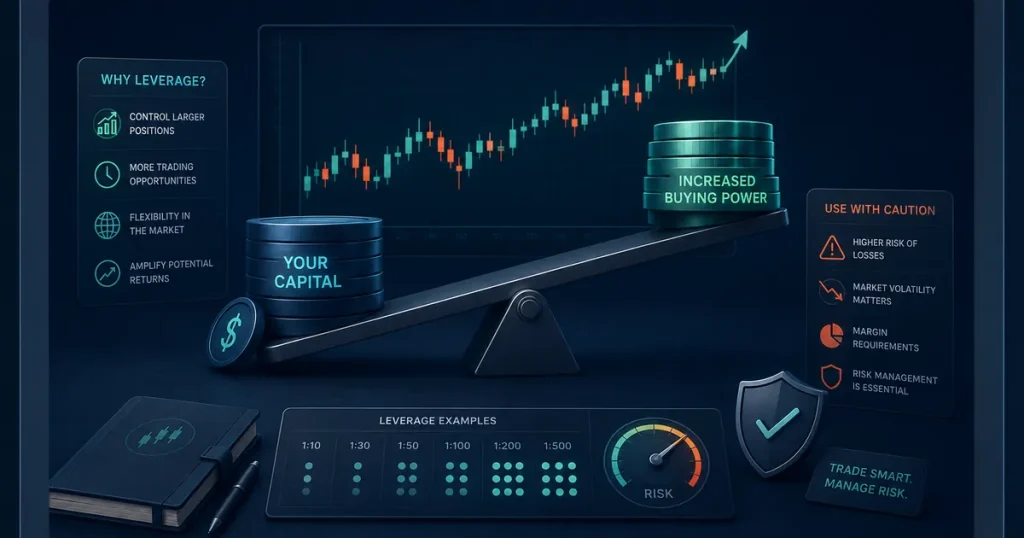
Quick Answer: What Is the Best Leverage for Forex?
The best leverage is not the highest ratio a broker offers. A better rule is:
Best leverage = the lowest leverage that supports your planned position size while keeping margin, free margin, and account risk under control.
If you searched “forex what leverage should I use”, “what leverage should I use in forex”, or “what is the best leverage for forex”, the honest answer is: choose leverage after you know your account size, lot size, stop-loss distance, pip value, required margin, and maximum risk per trade.
Available leverage may vary by account type, instrument, platform, and jurisdiction. Regulatory rules also vary by country, so examples and external resources may not reflect the rules in every jurisdiction.
This page assumes you already understand the basic idea of leverage. The goal here is choosing leverage more safely. For the basic definition and mechanics, see what is leverage in forex trading.
Best Leverage Is Not Maximum Leverage
The best leverage for forex is not the same as the maximum leverage available on the account. Maximum leverage shows what the account may allow. It does not show what the trader should use.
A trader with 1:500 available leverage can still trade conservatively by opening small positions. A trader with 1:50 available leverage can still take excessive risk by opening oversized positions or stacking several trades at once.
The safer question is not only “what is the best leverage in forex?” It is:
What exposure can my account handle if the trade goes wrong?
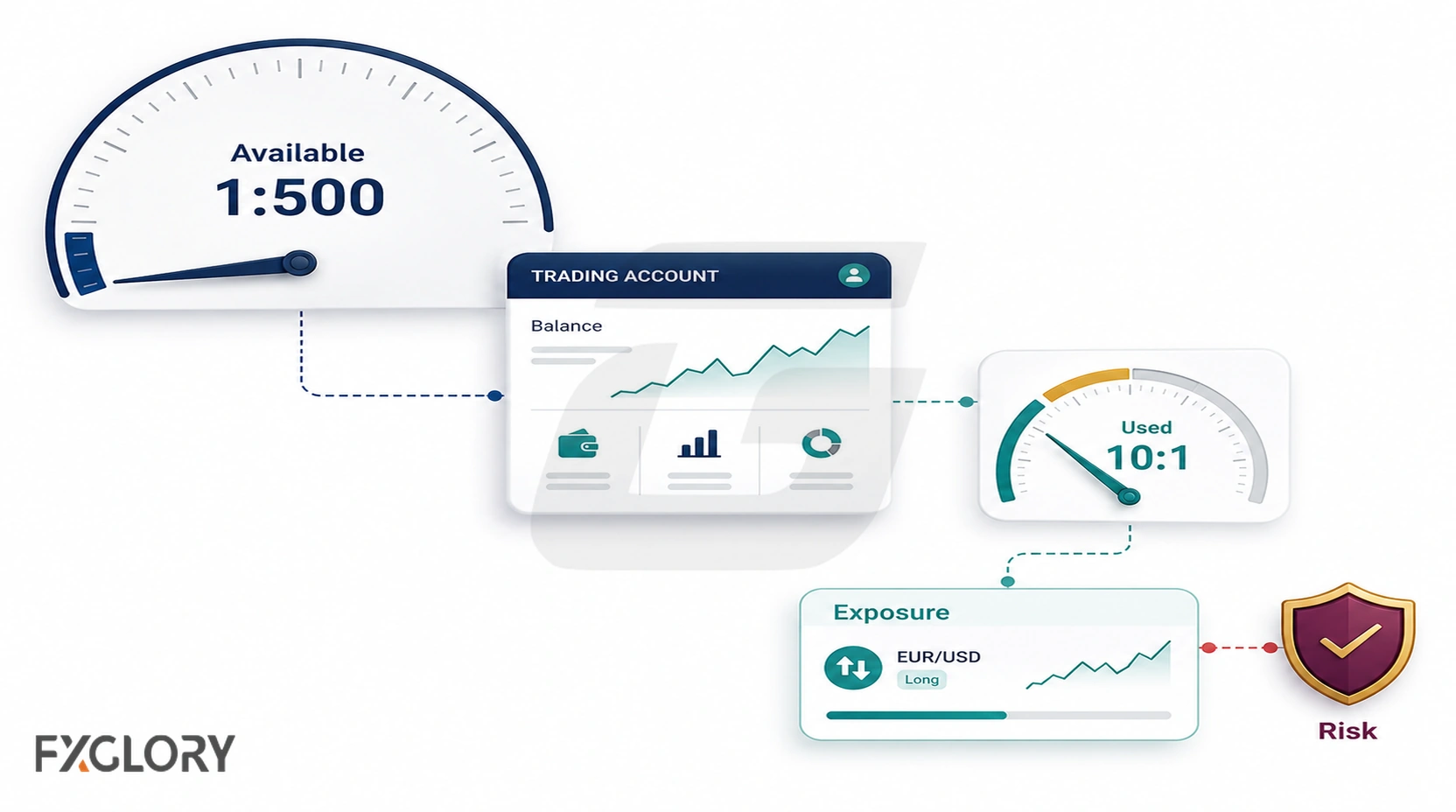
Available leverage is the maximum leverage the broker or account allows. Used leverage is the exposure the trader actually opens. Risk per trade is the money that could be lost if the trade goes wrong.
High available leverage does not force high risk. The risk comes from how much exposure the trader actually opens and whether that exposure fits the account.
What Leverage Should You Use in Forex?
The leverage you should use in forex depends on your account size, experience, position size, stop-loss distance, trading style, jurisdiction, and risk tolerance. A good leverage ratio is not the biggest available ratio. A good leverage ratio is one that lets the planned trade fit the account without forcing oversized exposure or low free margin.
The table below is an educational quick guide, not a personal recommendation. These ranges may not match the leverage limits, protections, or suitability rules in your jurisdiction.
| Trader Situation | Educational Range Often Used for Learning | Main Warning |
|---|---|---|
| New beginner | 1:5 to 1:10 | Learn sizing, pip value, margin, and stops before increasing exposure. |
| Beginner with demo practice | 1:10 to 1:20 | Do not use leverage to recover losses or force income. |
| Intermediate trader | 1:20 to 1:50 | Control total exposure and avoid stacking correlated trades. |
| Experienced trader | 1:50+ | Higher leverage requires strict position sizing and margin control. |
Before choosing leverage, know these numbers:
- Account equity: How much capital is available?
- Maximum risk per trade: How much can be lost if the stop is hit?
- Stop-loss distance: How many pips away is the stop?
- Pip value: How much is each pip worth for the position size?
- Lot size: What position size fits the risk plan?
- Required margin: How much equity is locked to open the trade?
- Free margin: How much room remains after opening the trade?
- Total exposure: Are there other open trades or correlated positions?
Formula: Estimated trade risk = stop-loss pips × pip value for the full position
If a position has a 20-pip stop and the pip value is $1 per pip, the estimated trade risk is about $20 before slippage, spread changes, or extra costs. This risk calculation matters more than the leverage number by itself.
Effective Leverage and Margin Formula
Effective leverage and required margin help traders understand whether they are using leverage conservatively or aggressively.
Effective leverage formula
Formula: Effective leverage = total open position value ÷ account equity
Example: if account equity is $1,000 and total open positions equal $10,000, the effective leverage is:
$10,000 ÷ $1,000 = 10:1 effective leverage
When traders ask “what leverage should I use?”, they often really need to ask: “what effective leverage can my account safely handle?”
| Account Equity | Total Open Position Value | Effective Leverage |
|---|---|---|
| $1,000 | $5,000 | 5:1 |
| $1,000 | $10,000 | 10:1 |
| $1,000 | $25,000 | 25:1 |
| $1,000 | $50,000 | 50:1 |
Required margin formula
Formula: Required margin = position size ÷ leverage
Formula: Margin percentage = 1 ÷ leverage ratio × 100
For example, with 1:100 leverage, use 100 as the leverage ratio: 1 ÷ 100 × 100 = 1% margin.
| Leverage | Margin Percentage | Required Margin on $10,000 Position |
|---|---|---|
| 1:10 | 10% | $1,000 |
| 1:50 | 2% | $200 |
| 1:100 | 1% | $100 |
| 1:500 | 0.2% | $20 |
The trap is simple: lower required margin does not mean lower trade risk. It only means less margin is needed to open the same position.
Same position, different leverage: margin changes, risk does not
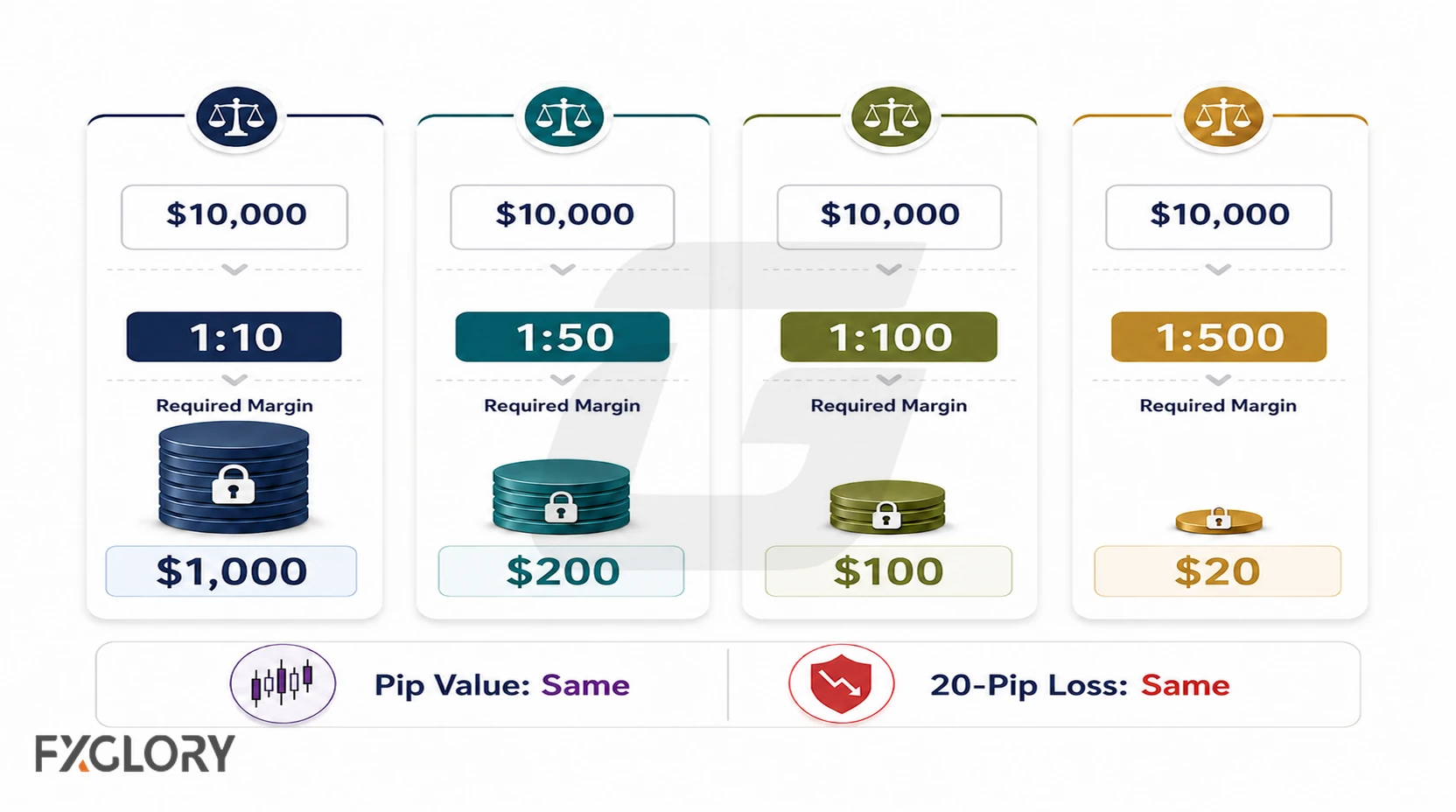
The table below uses a simplified EUR/USD-style example with USD as the quote/account currency. It assumes a $10,000 position with an approximate pip value of $1 per pip. The required margin changes, but the 20-pip loss estimate stays about the same because the position size is unchanged.
| Position Size | Leverage | Required Margin | Approx. Pip Value | 20-Pip Loss Estimate |
|---|---|---|---|---|
| $10,000 | 1:10 | $1,000 | About $1/pip | About $20 |
| $10,000 | 1:50 | $200 | About $1/pip | About $20 |
| $10,000 | 1:100 | $100 | About $1/pip | About $20 |
| $10,000 | 1:500 | $20 | About $1/pip | About $20 |
This is the part many beginners miss: leverage changes the margin required to open the position. It does not make the same position safer. The trade's money impact still depends on position size, pip value, stop-loss distance, spread, slippage, and execution.
Margin-call terms beginners should know
Used margin: Funds set aside to keep open leveraged positions. This depends on position size and leverage.
Free margin: Equity available after used margin is accounted for. Platform calculations can vary, but the simplified idea is: free margin = equity - used margin.
Margin level: A percentage comparing equity with used margin. Platform calculations can vary, but the simplified idea is: margin level = equity ÷ used margin × 100.
Margin call / stop-out: A margin call may warn that equity is too low compared with used margin. A stop-out may close positions automatically, depending on account and platform rules.
A free-margin buffer matters because normal price movement can create floating losses. If too much margin is used, the account has less room to absorb adverse movement before margin pressure increases.
Best Leverage for Beginners in Forex
For many beginners, the best leverage is usually lower leverage. A beginner is still learning how pips, lots, margin, spread, stop loss, and emotions work together. High leverage can make early mistakes more expensive.
A conservative beginner may test lower leverage such as 1:5, 1:10, or 1:20 in demo or small-size conditions. The goal is not to maximize buying power. The goal is to learn how position size and risk behave.
Demo trading can help beginners understand margin and order sizing, but demo does not fully reproduce live execution, emotions, slippage, spread changes, or the pressure of real money.
Before using higher leverage, a beginner should be able to answer:
- How much of my account is at risk if the stop loss is hit?
- What is the pip value of my position?
- How much margin is required?
- How much free margin remains after opening the trade?
- How much total exposure do I already have open?
- Can I survive several losing trades without revenge trading?
- Am I using leverage for a trade plan or to chase profit?
For pip value and risk calculations, see how to calculate pips in forex.
Best Leverage by Trading Style
Trading style does not justify high leverage by itself. Risk per trade, position size, stop-loss distance, spread, slippage, and total exposure come first. The examples below are illustrative only and do not mean the leverage is suitable for every trader in that style.
- Conservative swing trader: May prefer lower available leverage because wider stops and slower trades need room. The risk is holding oversized trades through larger price swings.
- Day trader with rules: May need margin flexibility, but strict sizing is still required. The risk is overtrading and stacking losses.
- Experienced scalper: Some experienced scalpers may use higher available leverage while keeping effective leverage and per-trade risk controlled. Spread, slippage, speed, execution, and oversized exposure are the main dangers.
- Beginner or learning phase: Should usually focus on lower exposure, clear stops, and position-size discipline before thinking about higher leverage.
The style label does not make leverage safe. A trader calling themselves a scalper, day trader, or swing trader still needs risk limits and position-size rules.
High Leverage Risk: 1:100, 1:500, Profit and Pip Value
High leverage becomes dangerous when it lets a trader open positions that are too large for the account. The problem is not only the leverage setting. The problem is using that leverage to create exposure the account cannot handle.
Is 1:100 leverage good for forex?
1:100 leverage can be usable for experienced traders who control position size, stop loss, and total exposure. It can be dangerous for beginners if they treat it as buying power. A $10,000 position has the same pip value whether it is opened with 1:10, 1:50, or 1:100 leverage. The margin requirement changes, but the price movement impact of the position does not.
Is 1:500 leverage too high?
1:500 leverage gives very high available exposure and very low margin requirements. That can be risky if a trader uses it to open oversized positions. Lower required margin does not mean lower risk. It only means the account needs less margin to open the position.
Does leverage affect profit?
Leverage can increase possible profit only because it allows larger positions. The same larger position can also increase losses. Leverage does not make a trade more accurate, and it does not protect the account when price moves against the position.
Does leverage affect pip value?
No. Leverage does not change pip value. Lot size changes pip value. Leverage changes required margin and available exposure, but pip value comes from position size, pair, exchange rate, and account currency.
High leverage can increase the risk of large losses from small price moves, low free margin, margin calls or stop-outs, emotional trading, and overconfidence after wins.
The Small Account Leverage Trap
Small accounts make high leverage tempting because the trader may want larger profits from limited capital. This is one of the biggest reasons beginners ask for the best leverage in forex.
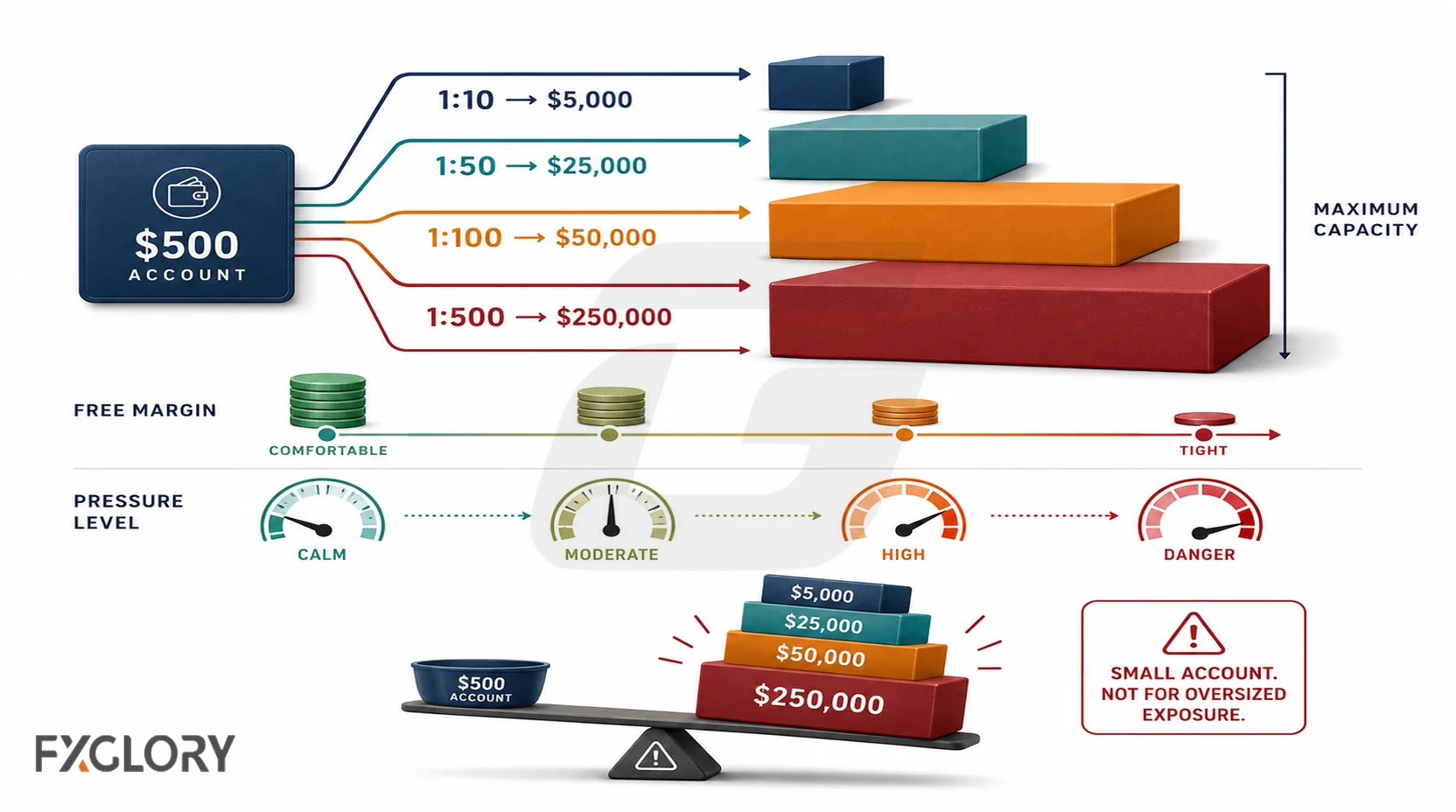
The table below shows maximum theoretical exposure, not recommended position size.
| Account Balance | Available Leverage | Maximum Theoretical Exposure | Beginner Reality |
|---|---|---|---|
| $500 | 1:10 | $5,000 | Lower exposure and easier to control. |
| $500 | 1:50 | $25,000 | More flexibility, but easier to oversize. |
| $500 | 1:100 | $50,000 | High exposure if misused. |
| $500 | 1:500 | $250,000 | Dangerous if treated as buying power. |
Just because an account can open more exposure does not mean it should. A small account can be damaged quickly if leverage is used to force large returns.
Multiple positions can also raise effective leverage faster than beginners expect. For example, three open $10,000 positions on a $1,000 account create $30,000 of total exposure, or 30:1 effective leverage before considering correlation or floating loss.
How to Choose the Right Leverage in Forex
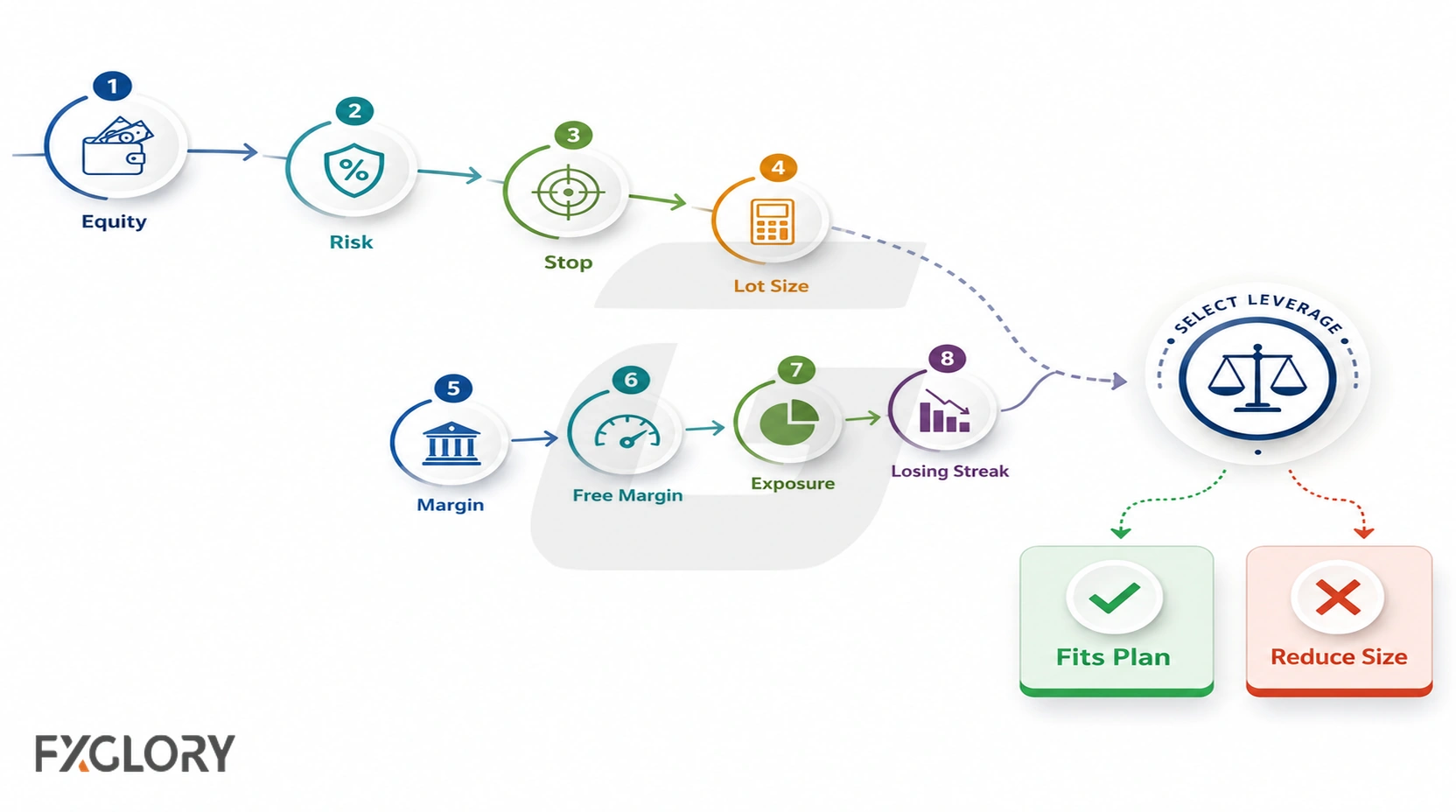
Choosing leverage should start with risk, not with the biggest ratio available. Use this decision process before deciding what leverage to use in forex.
| Step | Question | Why It Matters |
|---|---|---|
| 1. Account size | How much equity do I have? | Small accounts can be damaged faster by oversized exposure. |
| 2. Risk per trade | How much can I lose if the stop is hit? | Risk should be defined before position size. |
| 3. Stop-loss distance | How many pips away is the stop? | Wider stops need smaller position size if risk is fixed. |
| 4. Lot size | What position size fits the risk? | Lot size controls pip value and money impact. |
| 5. Margin required | How much margin is locked? | Too much used margin can create pressure. |
| 6. Free margin | How much room remains? | Low free margin increases margin-call risk. |
| 7. Total exposure | Do I already have open or correlated trades? | Multiple positions can raise effective leverage quickly. |
| 8. Losing streak | Can I survive several losses? | A leverage plan should survive normal losing periods. |
If leverage makes the trade possible but leaves the account with low free margin or unacceptable risk, the trade size is probably too large.
For position-size context, see what is lot size in forex.
You can also practice reading price movement on the EUR/USD live price page or the USD/JPY live price page before building a leveraged trade plan. Use those pages to understand price movement and pip risk, not as a reason to increase leverage.
Common Mistakes When Choosing Forex Leverage
The wrong leverage choice usually comes from thinking about profit before risk. Beginners should avoid these mistakes:
- Choosing the highest leverage because it is available: Available leverage is not a target.
- Confusing margin with risk: Lower required margin does not mean the trade is safer.
- Ignoring effective leverage: Actual exposure matters more than the broker's maximum leverage.
- Using leverage to recover losses: Increasing exposure after losses can damage the account faster.
- Forgetting correlated trades: Several similar trades can create more exposure than expected.
- Ignoring stop-loss distance: A large position with a wide stop can create excessive risk.
- Thinking leverage changes pip value: Lot size changes pip value; leverage changes required margin.
- Using high leverage on a small account: This can create pressure to take account-damaging risk.
- Not checking margin rules: Margin, margin call, and stop-out rules vary by account and platform.
- Treating leverage as a shortcut: Leverage is a risk tool, not a guaranteed profit tool.
Quick Recap: Best Leverage for Forex
The best leverage for forex is not the highest leverage available. It is the lowest leverage that supports the planned position size while keeping risk, margin, and free margin under control.
Beginners may be safer testing lower leverage examples such as 1:5 to 1:20 while learning pips, lots, margin, stop losses, and risk. Experienced traders may use higher leverage, but only with strict position sizing and risk controls.
Available leverage is what the broker allows. Used or effective leverage is the exposure the trader actually opens. Lower margin requirement does not make the same position less risky. That effective exposure is what matters most for account risk.
Frequently Asked Questions
What is the best leverage for forex?
There is no single best leverage for forex. A safer answer is to use the lowest leverage that supports your planned position size while keeping margin, free margin, and account risk under control.
Which leverage is best in forex?
The best leverage in forex is not the highest ratio. It is the leverage that lets the trader follow a risk-controlled plan without oversized exposure or low free margin.
What leverage should I use in forex?
If you are asking what leverage should my leverage be in forex, start with risk first. Know your account size, stop-loss distance, pip value, lot size, required margin, free margin, and total open exposure before choosing leverage.
What is a good leverage ratio for forex?
A good leverage ratio is one that lets the trader open the planned position without creating oversized exposure, low free margin, or unacceptable risk. For many beginners, lower leverage is usually safer for learning.
What is the best leverage for beginners in forex?
For beginners, lower leverage such as 1:5, 1:10, or 1:20 is often used as an educational starting range because it reduces the temptation to open positions that are too large for the account.
What leverage should I use with a small forex account?
Small accounts often tempt traders to use high leverage, but lower leverage and smaller position sizes are usually safer while learning. High leverage should not be used to make a small account behave like a large account.
Is 1:100 leverage good for forex?
1:100 leverage can be usable for experienced traders who control position size and risk, but it can be dangerous for beginners if they treat it as buying power. For the same position size, changing leverage changes required margin, not pip value or price movement result.
Is 1:500 leverage good for forex?
1:500 leverage gives very high available exposure and can create serious risk if misused. It may allow small margin requirements, but lower required margin does not mean lower trade risk.
Does leverage affect profit?
Leverage can increase possible profit only because it allows larger positions. The same larger position can also increase losses. For the same position size, leverage changes margin requirement, not pip value or price movement result.
Does leverage affect pip value?
No. Leverage does not change pip value. Lot size changes pip value. Leverage affects required margin and how much exposure the account can open.
What is effective leverage?
Effective leverage is the actual exposure a trader uses compared with account equity. The formula is total open position value divided by account equity.
How do I calculate required margin from leverage?
Required margin can be estimated by dividing position size by leverage. For example, a $10,000 position at 1:100 leverage requires about $100 of margin before platform-specific rules or other requirements.
Related Contents
Practice Before Trading Live
Use a free demo account to test your strategy, risk rules, and execution process before placing a real-money trade.
Open a Free Demo Account