
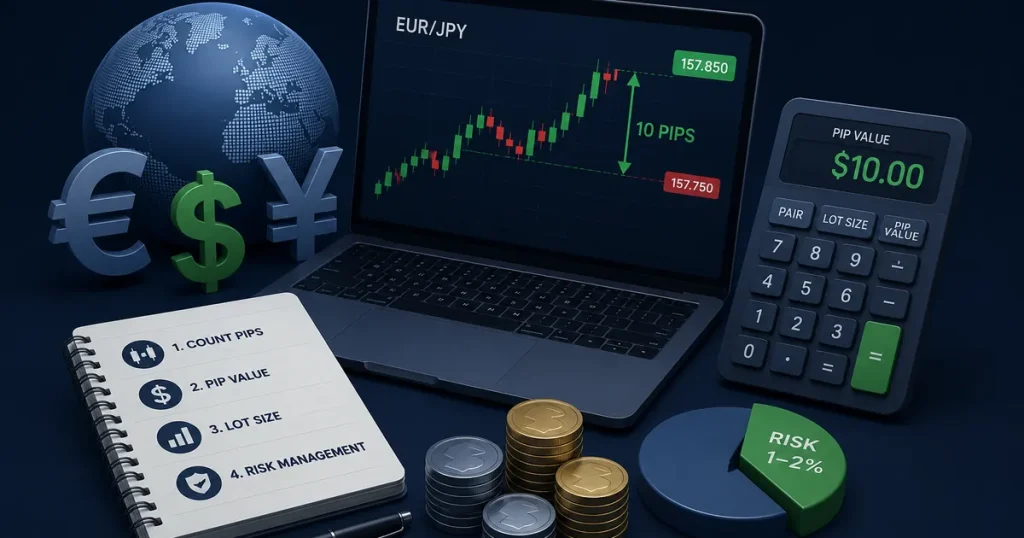
Quick Answer: How to Calculate Pips in Forex
Formula: Pips moved = price difference ÷ pip size
Use the absolute price difference when you only want distance. When evaluating profit or loss, also account for trade direction and the actual entry and exit prices.
Example: if EUR/USD moves from 1.1000 to 1.1050, the difference is 0.0050. With a pip size of 0.0001, that move equals 50 pips.
For real trades, the chart price alone may not match execution. Use the relevant bid/ask prices or actual fills when measuring spread, break-even movement, profit, or loss.
This page focuses on pip calculation, pip value, currency conversion, and risk. For the basic definition, see what is a pip in forex trading.
Count, Value, Risk: The Manual Pip Calculation Framework
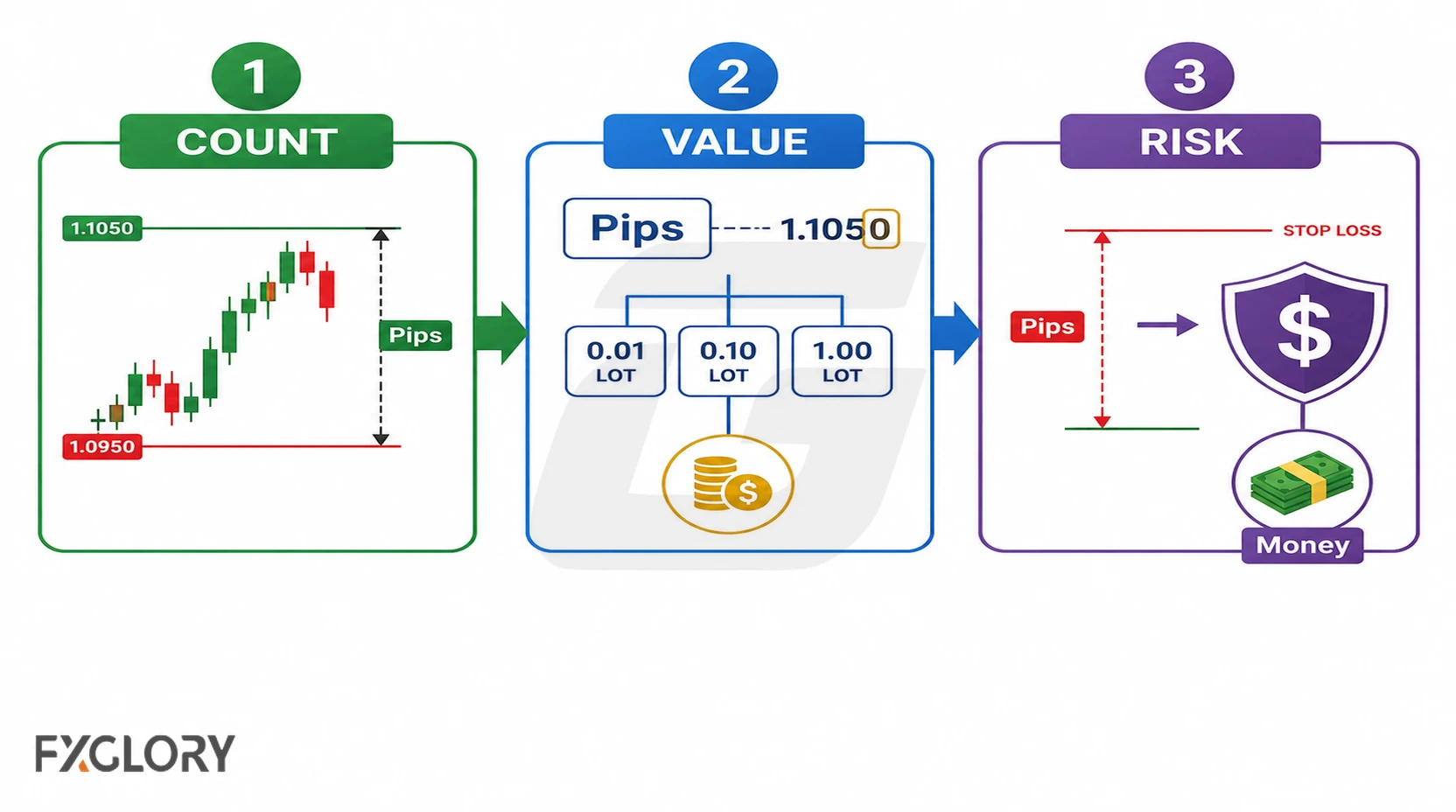
The easiest way to avoid confusion is to separate the process into three tasks: Count → Value → Risk.
| Step | Question | Method | Output |
|---|---|---|---|
| Count | How many pips did price move? | Convert the price difference into pip units using the pair’s pip size | Pip distance |
| Value | How much is one pip worth? | Calculate pip value in the quote currency, then convert if needed | Pip value |
| Risk | What is the money impact? | Combine pip distance with the pip value of the position | Estimated profit, loss, spread cost, or stop-loss risk |
| Spread | How wide is the spread? | Measure the bid/ask difference in pip units | Spread in pips |
This distinction is important because pip distance and pip value are not the same thing. Pip distance shows how far price moved. Pip value shows how much each pip may be worth for a specific trade size and account currency.
Pip Size and How to Calculate 1 Pip in Forex
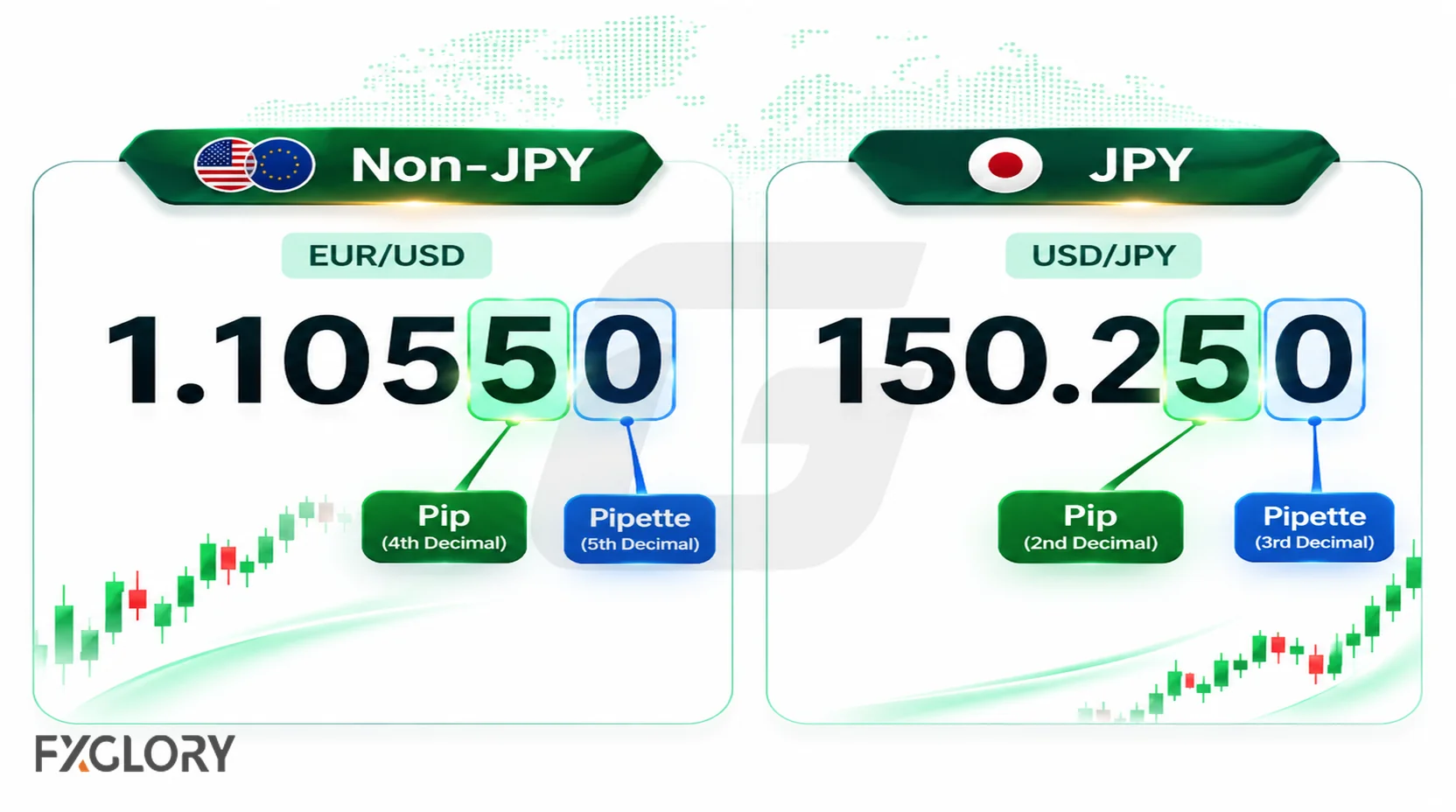
This section is only for identifying pip size before calculation. For most non-JPY pairs, one pip is usually 0.0001. For JPY pairs, one pip is usually 0.01. Platform decimal formatting can vary, so confirm the quote format on the trading platform.
| Pair Type | Common Pip Size | Fractional Pip / Pipette |
|---|---|---|
| Most non-JPY pairs | 0.0001 | 0.00001 |
| JPY pairs | 0.01 | 0.001 |
How to calculate 1 pip in forex
Calculating 1 pip means identifying the smallest standard pip movement for the pair type, not calculating the money value of that pip.
- EUR/USD: 1.1000 to 1.1001 = 1 pip.
- GBP/USD: 1.2500 to 1.2501 = 1 pip.
- USD/JPY: 150.25 to 150.26 = 1 pip.
- EUR/JPY: 162.40 to 162.41 = 1 pip.
Points vs pips on trading platforms
The word point is not used consistently across every platform. In MetaTrader-style quote precision, a point is typically the smallest displayed price increment. On a 5-digit EUR/USD quote, for example, one point is 0.00001, so 10 points equal 1 standard pip. On a 3-digit JPY quote, one point is typically 0.001, again making 10 points equal 1 standard pip.
Because some educational material uses “point” and “pip” more loosely, check the instrument specification and quote digits before converting points into pips.
How to Count Pips in Forex
Once you know the pair’s pip size, apply the calculation from the quick answer to the two price levels you want to compare.
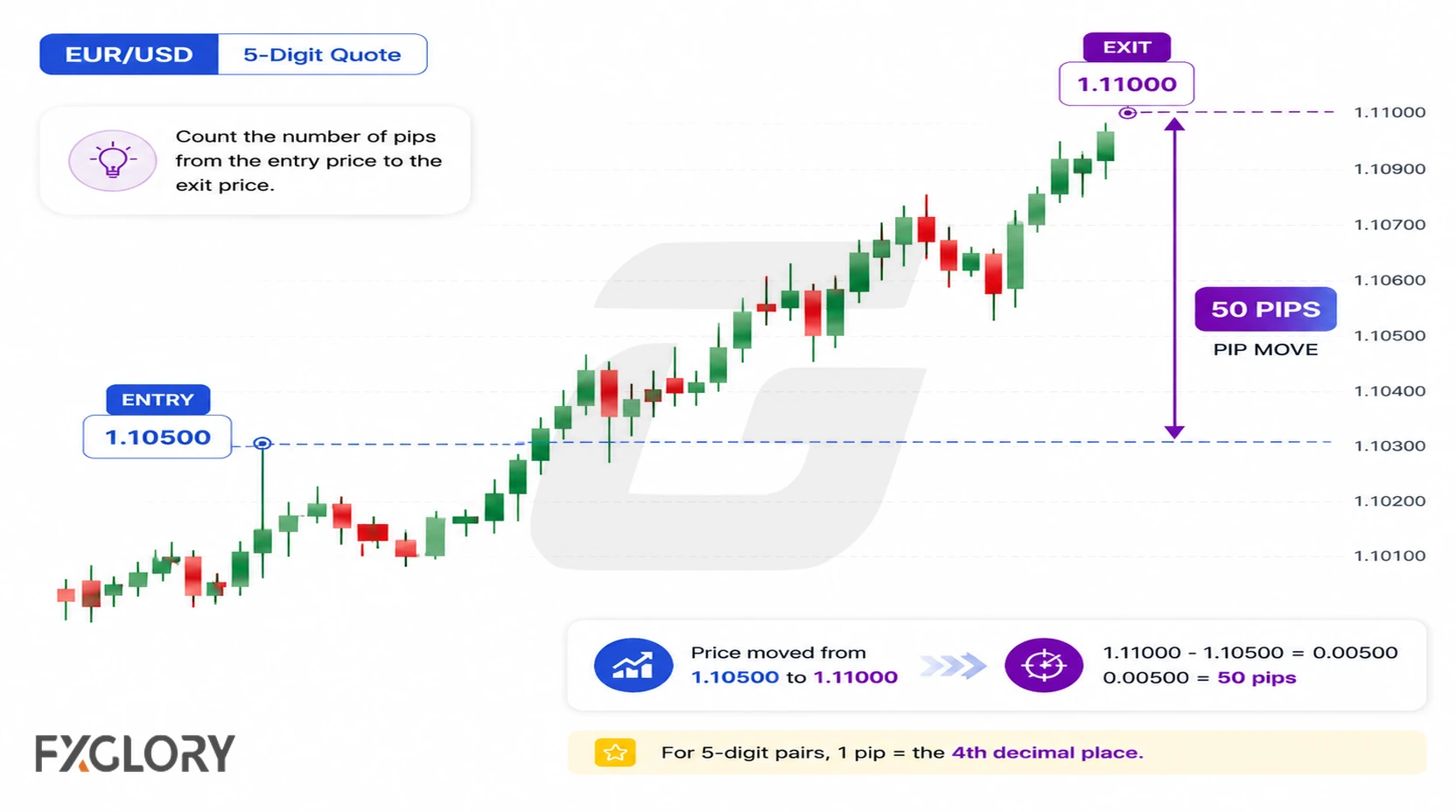
Use the absolute difference when you only want distance. Keep the direction of the move when evaluating whether the movement helped or hurt a buy or sell trade.
Example: Counting pips on EUR/USD
Suppose EUR/USD moves from 1.1000 to 1.1050.
- Starting price: 1.1000
- Ending price: 1.1050
- Price difference: 1.1050 - 1.1000 = 0.0050
- Pip size: 0.0001
- Pips moved: 0.0050 ÷ 0.0001 = 50 pips
If EUR/USD moved from 1.1050 down to 1.1000, the distance would still be 50 pips. A 50-pip move is not automatically profit. It becomes profit or loss depending on whether the trade direction matched the price move.
Spread in pips
Formula: Spread in pips = (ask price - bid price) ÷ pip size
Example: if EUR/USD bid is 1.1000 and ask is 1.1002, the difference is 0.0002. Since the pip size is 0.0001, the spread is 0.0002 ÷ 0.0001 = 2 pips.
Break-even pips with spread and commission
If a trade has both spread and commission, the price must move far enough to cover both costs before the net result reaches break-even.
Estimate: Break-even pips = spread in pips + (total round-turn commission ÷ pip value for the full position)
Example: suppose the spread is 1.2 pips, the total opening-and-closing commission is $7, and the position’s pip value is $10 per pip. Commission equals 0.7 pip, so the estimated break-even movement is 1.9 pips before considering slippage, swaps, or other charges.
Use the EUR/USD live price page as a practice screen. Pick two prices, calculate the difference, divide by 0.0001, and check whether the result makes sense.
JPY Pairs and Pipette Mistakes
JPY pairs use a different pip size. For most JPY pairs, one pip is usually 0.01, not 0.0001.
JPY pair example
Suppose USD/JPY moves from 150.25 to 150.75.
- Starting price: 150.25
- Ending price: 150.75
- Price difference: 150.75 - 150.25 = 0.50
- JPY pip size: 0.01
- Pips moved: 0.50 ÷ 0.01 = 50 pips
A USD/JPY move from 150.250 to 150.260 is usually 1 pip, not 10 pips, because the third decimal is normally a pipette.
Use the USD/JPY live price page as a JPY-pair practice screen. Pick two USD/JPY prices, calculate the difference, divide by 0.01, and check whether you counted full pips instead of pipettes.
Pipette mistake: do not count the extra decimal as a full pip
A pipette is one-tenth of a pip. On many 5-digit non-JPY quotes, the fifth decimal is usually a pipette. On many 3-digit JPY quotes, the third decimal is usually a pipette.
Example: if EUR/USD moves from 1.10000 to 1.10010, the move is 1 pip. If it moves from 1.10000 to 1.10001, the move is usually one pipette, or one-tenth of a pip.
How to Calculate Pip Value Manually
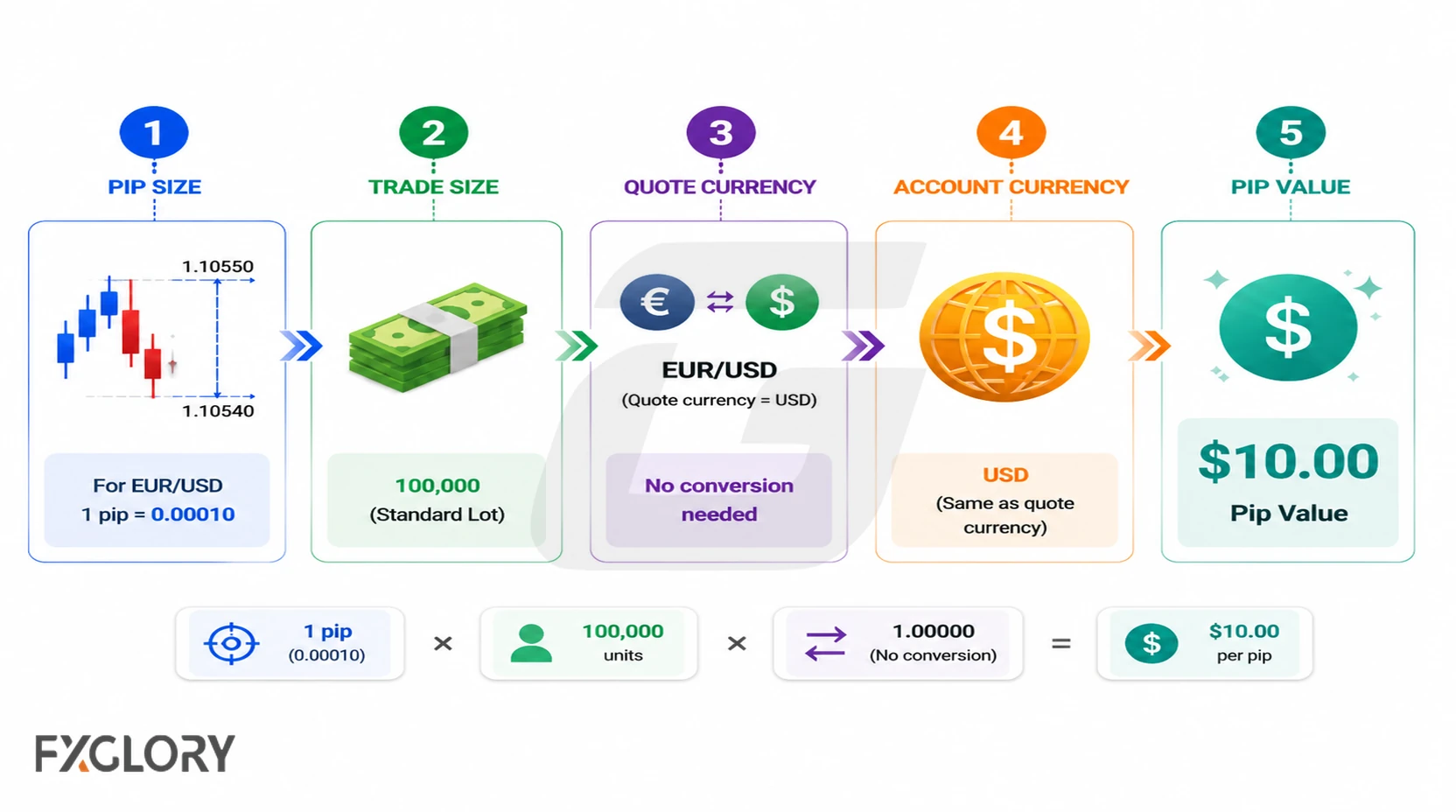
Counting pips tells you how far price moved. Pip value tells you how much each pip may be worth in money. This section is the manual pip value workflow.
Manual pip value checklist
- Find the pip size: Usually 0.0001 for most non-JPY pairs and 0.01 for JPY pairs.
- Find the trade size: Use the position size in units.
- Calculate quote-currency pip value: pip size × trade size.
- Check the quote currency: Pip value is first calculated in the quote currency.
- Convert if needed: If the quote currency is different from the account currency, convert the pip value.
- Multiply by pips: Use pips moved or stop-loss pips to estimate money impact.
Pip value formulas
Formula: If account currency equals quote currency, pip value = pip size × trade size.
Formula: If account currency differs from quote currency, calculate pip value in the quote currency, then convert it into the account currency.
Formula: For USD/JPY in a USD account, pip value = (0.01 × trade size) ÷ USD/JPY rate.
Does leverage change pip value?
No. Leverage does not change pip value. Lot size changes pip value. Leverage affects required margin and how much exposure a trader can open, but the money value of each pip comes from trade size, pair, exchange rate, and account currency.
Pip value by lot size
For EUR/USD in a USD account, common educational examples are:
| Trade Size | Units | Approx. Pip Value |
|---|---|---|
| Standard lot | 100,000 units | About $10 per pip |
| Mini lot | 10,000 units | About $1 per pip |
| Micro lot | 1,000 units | About $0.10 per pip |
These common $10 / $1 / $0.10 examples apply neatly when USD is the quote currency and the account is USD, such as EUR/USD in a USD account. Other pairs may need conversion, and pip value can change as exchange rates change.
For a deeper explanation of position size, see what is lot size in forex.
Account-currency conversion rule
If converting quote currency into account currency, the conversion direction depends on how the exchange rate is quoted. Multiply when the conversion rate is quoted as quote currency/account currency. Divide when the conversion rate is quoted as account currency/quote currency.
EUR/USD with a USD account: EUR/USD has USD as the quote currency. If trade size is 100,000 units, pip value is 0.0001 × 100,000 = $10 per pip. No extra conversion is needed.
EUR/GBP with a USD account: EUR/GBP has GBP as the quote currency. If trade size is 100,000 units, pip value is 0.0001 × 100,000 = 10 GBP per pip. If GBP/USD is 1.2500, then 10 GBP × 1.2500 = $12.50 per pip.
USD/JPY with a USD account: USD/JPY has JPY as the quote currency. If trade size is 100,000 units, pip value is 0.01 × 100,000 = 1,000 JPY per pip. If USD/JPY is 150.00, then 1,000 JPY ÷ 150.00 = about $6.67 per pip. For JPY pairs, USD pip value changes as the exchange rate changes.
EUR/USD with a EUR account: EUR/USD has USD as the quote currency, so a 100,000-unit position gives about $10 per pip first. If EUR/USD is 1.1000, converting $10 into EUR would be about $10 ÷ 1.1000 = €9.09 per pip. Because EUR/USD shows how many USD equal 1 EUR, converting USD back into EUR requires dividing by EUR/USD.
Worked Examples: Pip Move, Pip Value and Risk
The examples below combine pip distance, pip value, and possible money impact without repeating the same calculation in separate sections.
Example 1: EUR/USD pip move and money impact
- Entry: 1.1000
- Exit: 1.1050
- Price difference: 0.0050
- Pip size: 0.0001
- Pips moved: 0.0050 ÷ 0.0001 = 50 pips
- Trade size: 10,000 units
- Pip value: about $1 per pip for EUR/USD in a USD account
- Money impact: 50 pips × $1 = about $50 before spread, slippage, swaps, or other costs
A 50-pip move could be profit or loss depending on trade direction. If the trader bought and price rose, the move helped. If the trader sold and price rose, the move hurt.
Example 2: USD/JPY pip move, pip value and conversion
- Entry: 150.25
- Exit: 150.75
- Price difference: 0.50
- Pip size: 0.01
- Pips moved: 0.50 ÷ 0.01 = 50 pips
- Trade size: 100,000 units
- Pip value in JPY: 0.01 × 100,000 = 1,000 JPY per pip
- If USD/JPY is 150.00: 1,000 ÷ 150.00 = about $6.67 per pip
- Money impact: 50 pips × $6.67 = about $333.50 before spread, slippage, swaps, or other costs
Example 3: EUR/GBP pip value in a USD account
- Pair: EUR/GBP
- Account currency: USD
- Trade size: 100,000 units
- Pip size: 0.0001
- Pip value in GBP: 0.0001 × 100,000 = 10 GBP per pip
- If GBP/USD is 1.2500: 10 GBP × 1.2500 = $12.50 per pip
Example 4: Calculating spread cost in pips and money
If EUR/USD bid is 1.1000 and ask is 1.1002, the spread is:
- Spread in pips: (1.1002 - 1.1000) ÷ 0.0001 = 2 pips
- If pip value is $1 per pip: 2 pips × $1 = about $2 before other costs
For more on bid, ask, and spread, see bid and ask price in forex.
How Pip Calculation Helps With Stop Loss and Risk
Pip calculation becomes more useful when it is connected to risk. A stop loss measured in pips can be converted into estimated money risk using pip value.
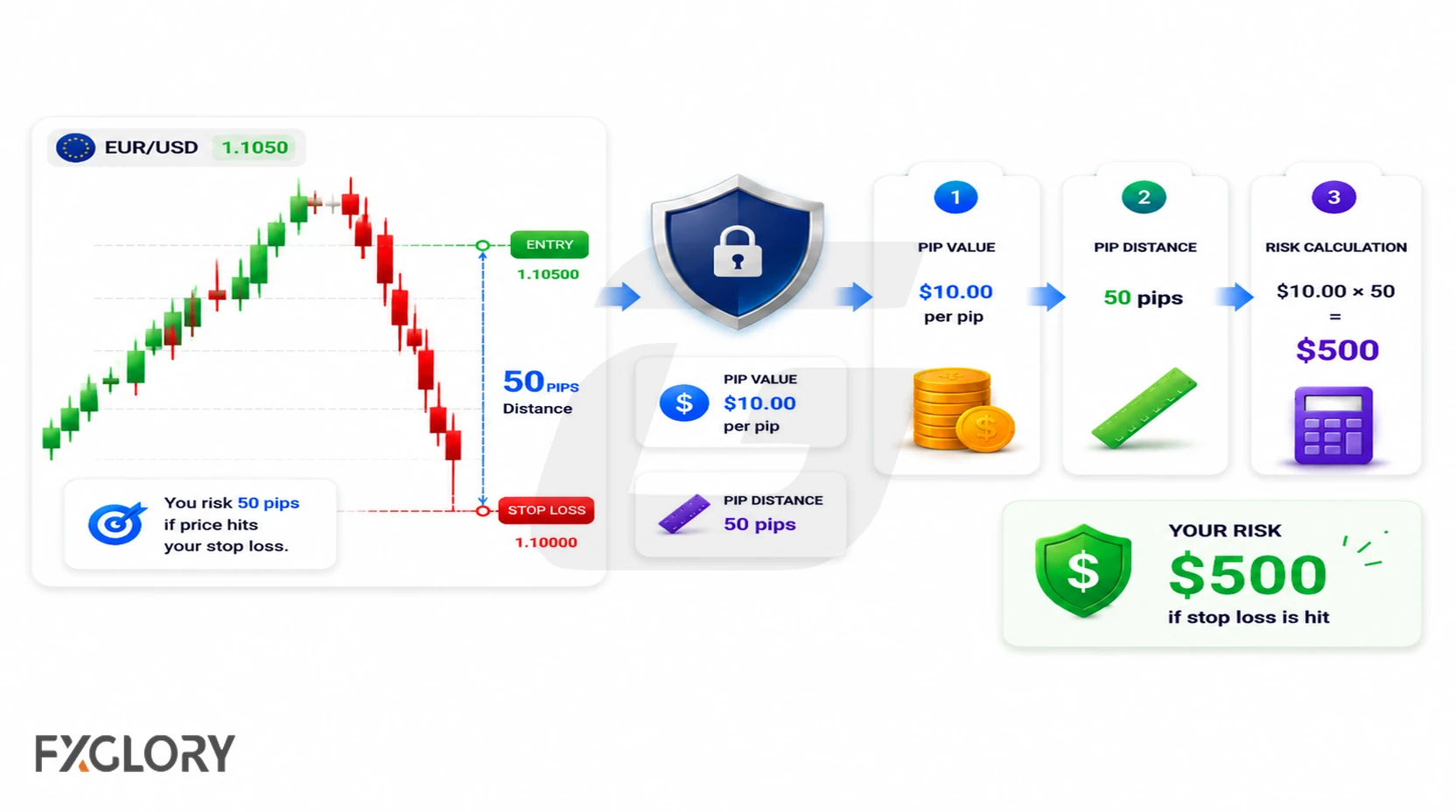
If pip value is already calculated for the full position size:
Formula: Estimated money risk = stop-loss pips × pip value for the full position
If pip value is quoted per 1 lot and the trade uses multiple lots:
Formula: Estimated money risk = stop-loss pips × pip value per lot × number of lots
| Stop-Loss Distance | Pip Value for Full Position | Estimated Risk Before Slippage/Extra Costs |
|---|---|---|
| 20 pips | $0.10 per pip | About $2 |
| 20 pips | $1 per pip | About $20 |
| 20 pips | $10 per pip | About $200 |
If the account balance is $1,000 and the estimated risk is $20, that is about 2% of the account before slippage or extra costs. This is why pip value matters before choosing a lot size or stop-loss distance.
For a full trade workflow, see how to trade forex.
Manual Pip Calculation vs Pip Calculator
A pip calculator can save time, especially when account-currency conversion is involved. Manual calculation is still useful because it helps traders understand whether the calculator output makes sense.
Use manual calculation to understand the mechanics. Use a calculator when you need to repeat calculations quickly or handle account-currency conversion across multiple pairs. Do not use either method without checking the pair type, lot size, account currency, and current exchange rate.
A pip calculator usually asks for inputs such as account currency, currency pair, trade size or lots, and current price. Some calculators may also ask for leverage or account type when they estimate margin, but leverage is relevant to margin, not pip value.
Common Pip Calculation Mistakes
Pip calculation mistakes can make a trade look safer, cheaper, or more profitable than it really is. Beginners should watch for these problems:
- Using 0.0001 for JPY pairs: JPY pairs usually use 0.01 as one pip.
- Counting pipettes as full pips: The extra decimal is usually one-tenth of a pip.
- Confusing pip distance with pip value: Pips show movement; pip value shows money impact.
- Ignoring account currency conversion: Pip value may need conversion if the quote currency differs from the account currency.
- Using the wrong trade size: Pip value changes with lot size.
- Assuming leverage changes pip value: Leverage affects margin, not pip value.
- Ignoring spread: Spread can be measured in pips and converted into money cost.
- Ignoring slippage: Actual results can differ from calculated estimates.
- Using live prices without checking bid/ask: The displayed chart price may not match the trade execution price.
- Forgetting that examples are educational: Real pip value can change with exchange rates, account currency, and platform conditions.
Quick Recap: Pip Calculation in Forex
Start by identifying the correct pip size for the pair, then convert the price movement into pips. After that, calculate the money value of each pip for the position and convert currencies when necessary.
For real-trade decisions, connect the pip distance to the actual position size, bid/ask spread, commission, stop-loss distance, and account currency rather than treating pip count alone as the final result.