
Quick Answer: Bid and Ask Price in Forex
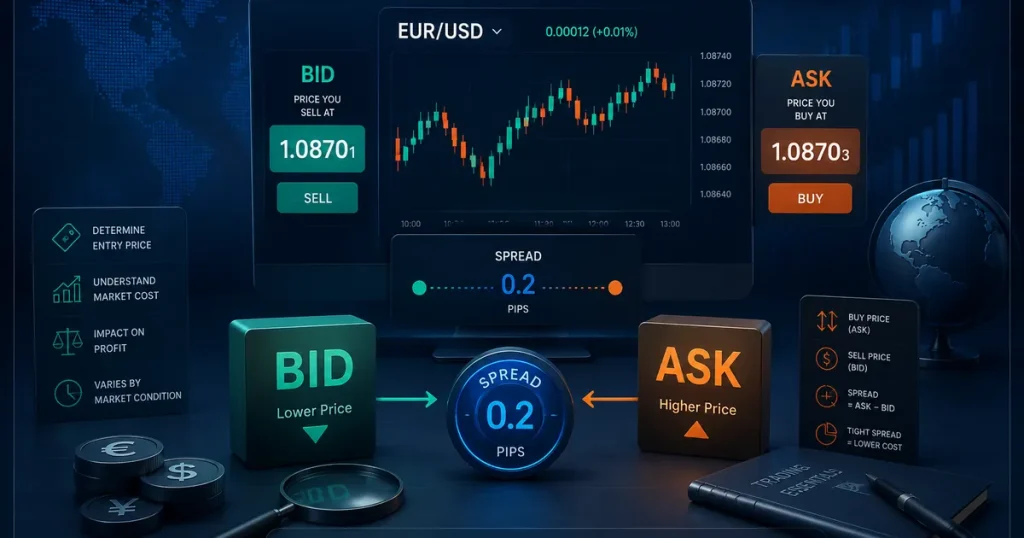
In a standard two-way quote such as EUR/USD 1.10000 / 1.10010, the first price is commonly the bid and the second is the ask. Many retail platforms label the same sides Sell and Buy.
For a market trade, the practical rule is: a buy generally opens at ask and a sell generally opens at bid. Closing the position uses the opposite side of the quote.
How to Read Bid and Ask in 5 Steps
Use this 5-step process to move from the quote to the order ticket: Read → Decide → Calculate → Check → Place.
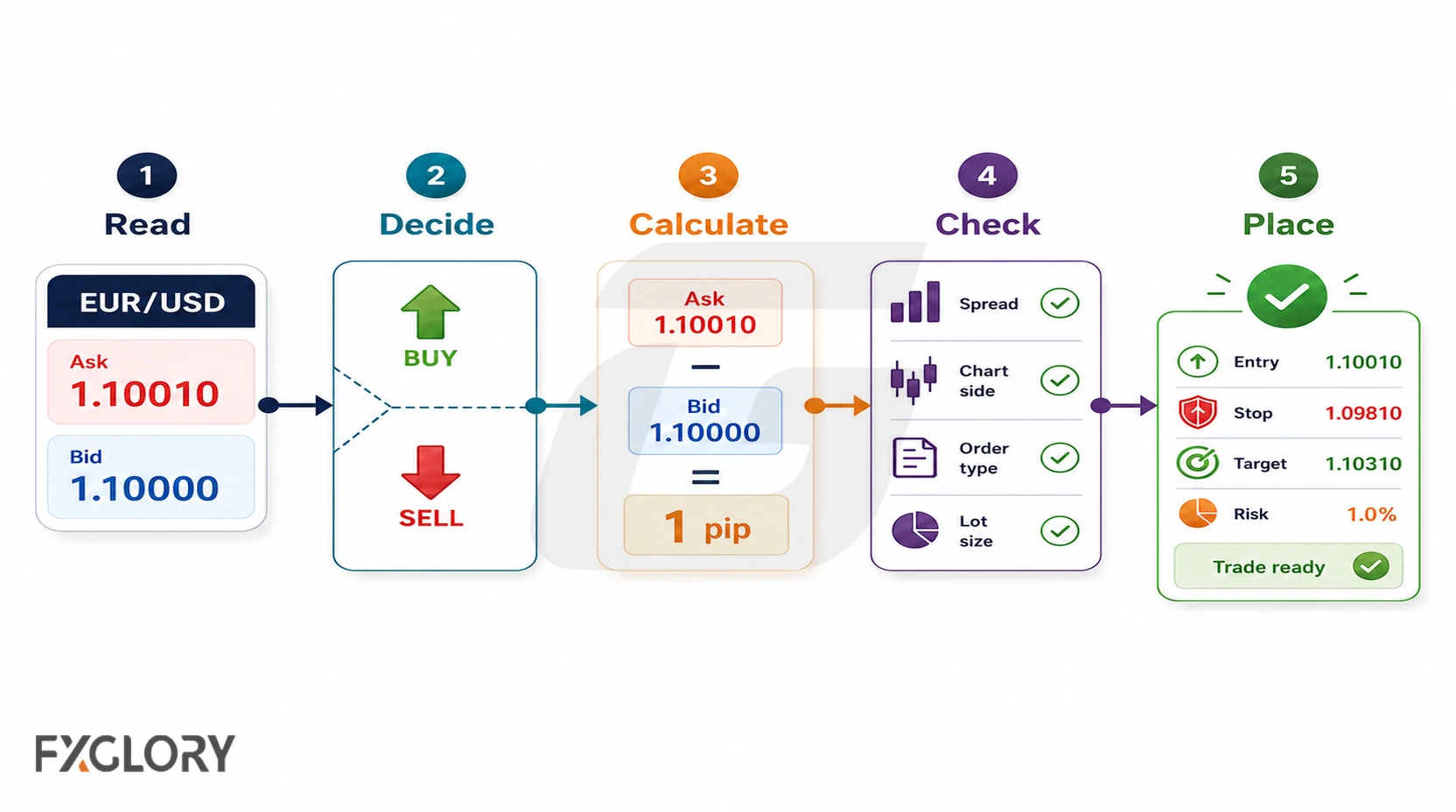
| Step | What to Check | Beginner Meaning |
|---|---|---|
| Read | Identify bid/sell and ask/buy. | Know both sides of the quote before acting. |
| Decide | Match the trade direction to the correct quote side. | A buy generally uses ask; a sell generally uses bid. |
| Calculate | Subtract bid from ask. | The result is the bid-ask spread. |
| Check | Check spread, chart price side, order type, and position-size impact. | The visible chart price may not be the price side used for execution or triggering. |
| Place | Confirm order type, stop loss, take profit, and risk. | Submit the order only after the quote and trade details match the plan. |
Bid and Ask Checklist Before Placing a Forex Trade
Before placing a trade, check the full two-way quote instead of relying on one displayed chart price.
| Check | Question |
|---|---|
| Bid | What is the current sell-side price? |
| Ask | What is the current buy-side price? |
| Spread | How wide is the gap between ask and bid? |
| Chart side | Which price series does the chart display? |
| Order type | Which price side is relevant to the entry or exit trigger? |
| Position size | What account-currency impact can the spread have at this size? |
What Are Bid and Ask Prices in Forex?
Forex quotes are normally two-way prices. The bid is the price available to a trader who wants to sell the base currency, while the ask is the price available to a trader who wants to buy it. The ask is also called the offer.
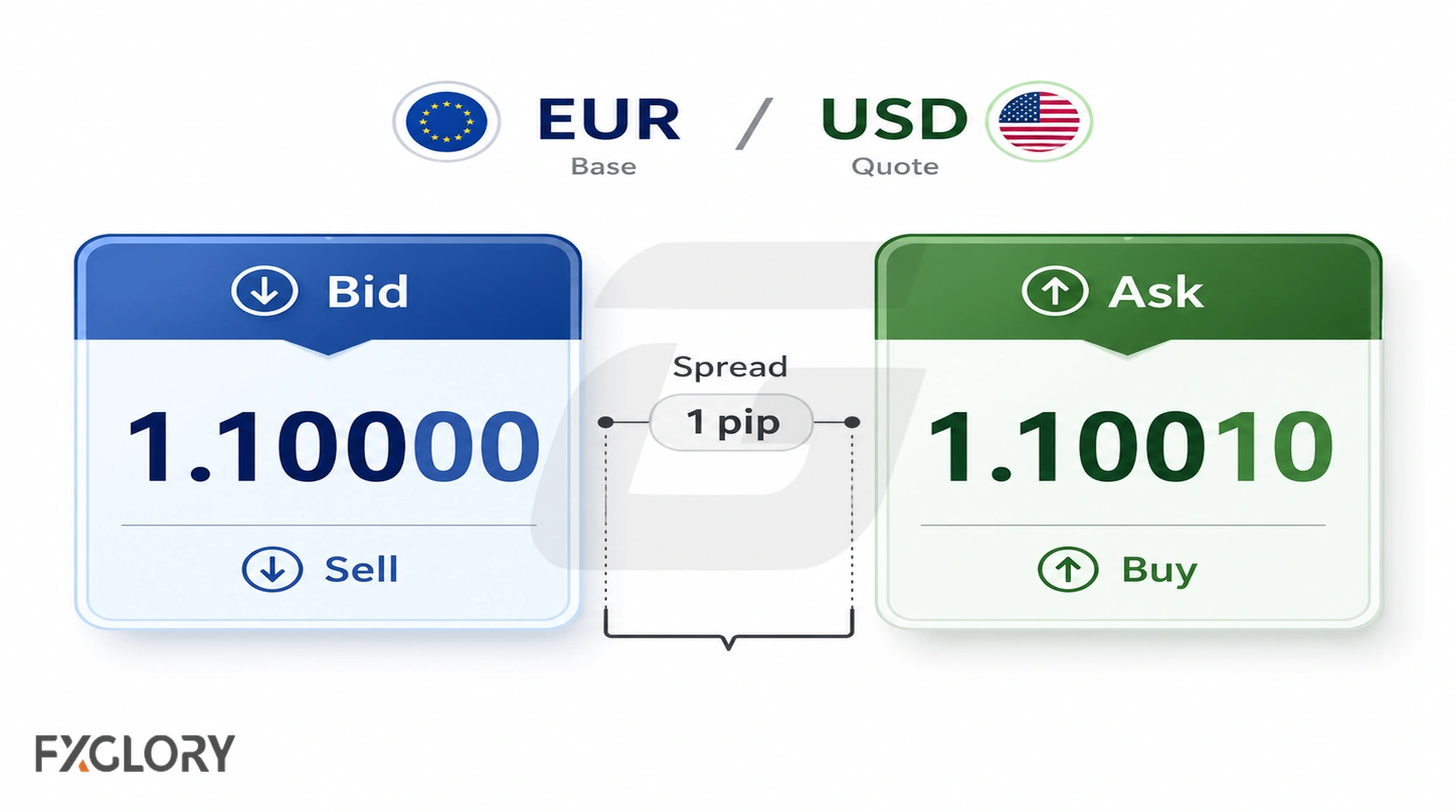
- Bid price or bid rate: The price at which a trader can usually sell the base currency.
- Ask price, ask rate, or offer: The price at which a trader can usually buy the base currency.
- Spread: The ask price minus the bid price.
From the quote provider's perspective, the terminology is reversed in wording: it bids to buy and offers to sell. From the retail trader's perspective, that means selling at the bid and buying at the ask.
If EUR/USD is shown as 1.10000 / 1.10010, the first price is commonly the bid and the second is the ask. A market sell would generally use the bid; a market buy would generally use the ask.
Reading forex quotes explains how these two prices fit with the base currency, quote currency, and exchange rate.
Bid vs Ask Price in Forex: Which Price Do You Use?
The price side depends on whether the trade is buying or selling the base currency. Opening and closing a position normally use opposite sides of the quote.
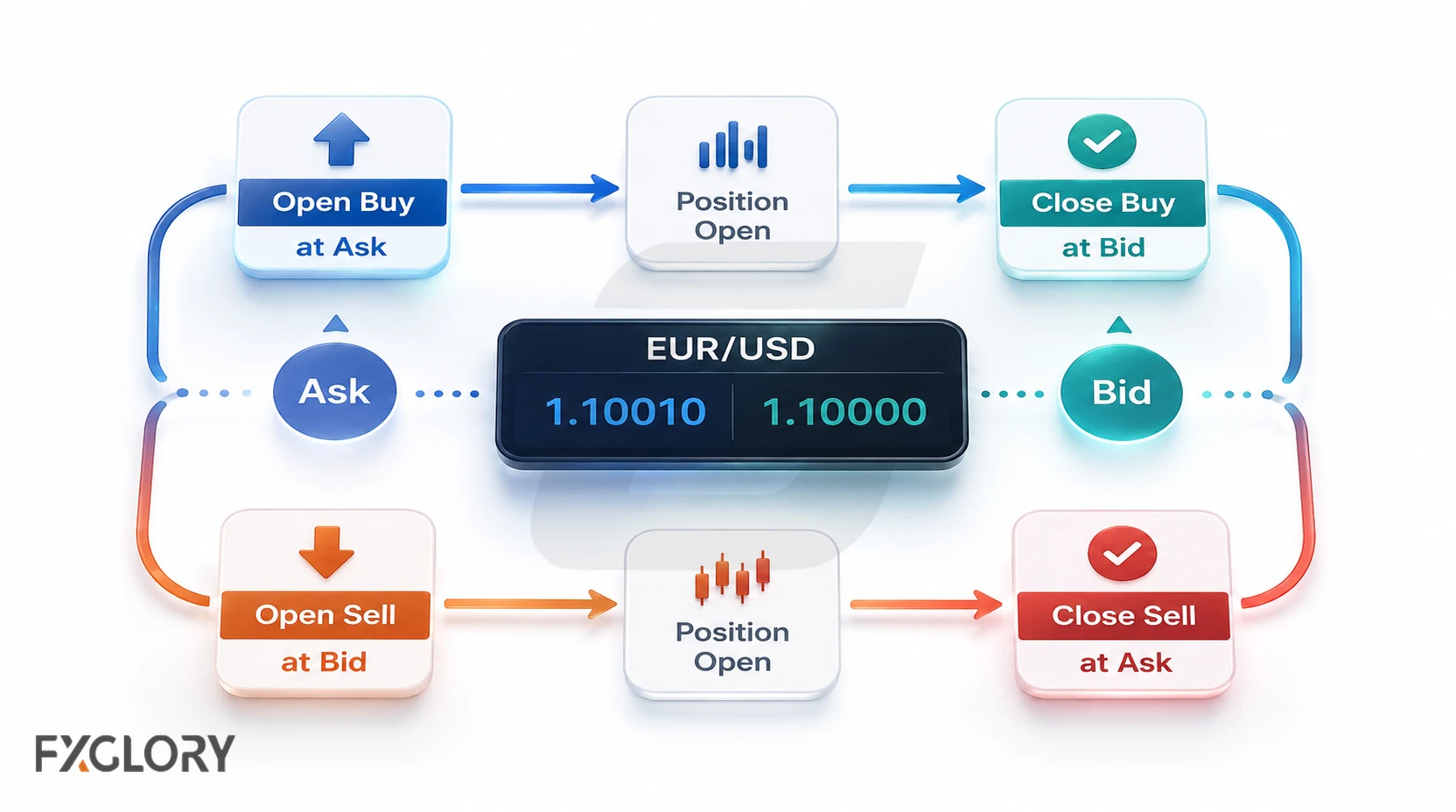
| Action | Price Usually Used | Common Platform Label | What Happens |
|---|---|---|---|
| Open a buy trade | Ask | Buy | Buy the base currency. |
| Open a sell trade | Bid | Sell | Sell the base currency. |
| Close a buy trade | Bid | Sell | Sell the base currency back. |
| Close a sell trade | Ask | Buy | Buy the base currency back. |
Bid/Ask vs Buy/Sell labels
Retail platforms often present the quote as Sell and Buy rather than Bid and Ask. In that layout, Sell normally corresponds to the bid and Buy normally corresponds to the ask.
For the wider entry-and-exit process, see how to trade forex.
What Is the Spread in Forex and How Is It Calculated?
The spread is the distance between the ask and bid prices. Calculate it with Ask - Bid = Spread.
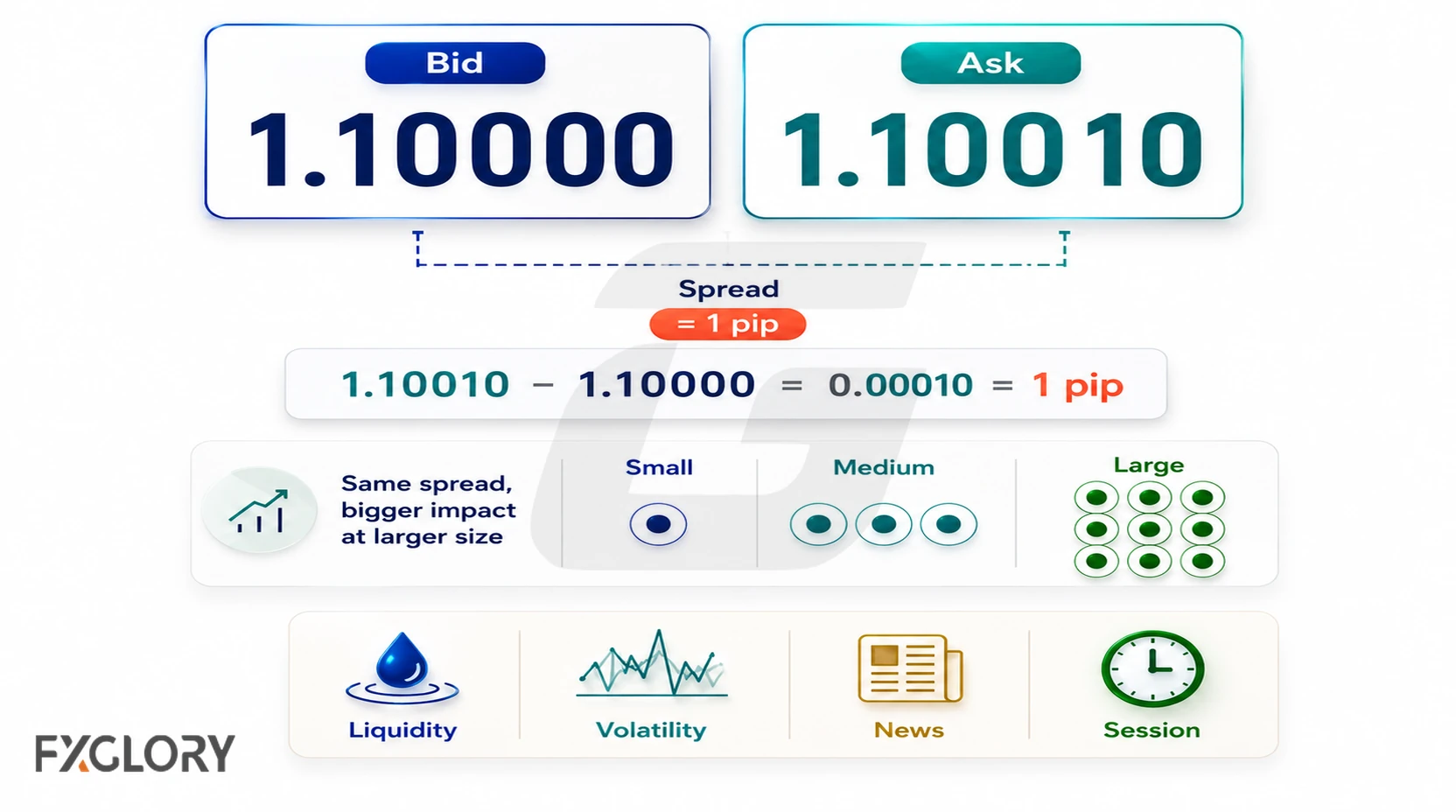
Because a position opens on one side of the quote and would normally close on the other, the spread can create an immediate gap between the entry price and the current close-out price even when the underlying quote has barely moved.
| Pair | Bid | Ask | Calculation | Spread |
|---|---|---|---|---|
| EUR/USD | 1.10000 | 1.10010 | 1.10010 - 1.10000 | 1 pip |
| GBP/USD | 1.30500 | 1.30530 | 1.30530 - 1.30500 | 3 pips |
| USD/JPY | 145.000 | 145.020 | 145.020 - 145.000 | 2 pips |
These are educational quote examples. Platforms may display fractional pips or points, so the number of decimal places alone should not be used to assume the pip convention.
Spread in pips vs money: A spread measured in pips describes price distance. Its account-currency impact depends on position size, pip value, account currency, and any other applicable fees. A larger position generally gives the same pip distance a larger money impact.
What is a pip in forex trading explains pip measurement, while what is lot size in forex explains how position size changes exposure.
What makes forex spreads wider or tighter?
Forex spreads can change with market and broker conditions rather than remaining fixed at one number.
- Liquidity: Lower available liquidity can be associated with wider spreads.
- Volatility: Rapid price changes can be accompanied by wider spreads.
- News events: Some economic releases, central-bank decisions, or unexpected events can coincide with spread widening.
- Trading time: Spreads can change around market openings, closings, and quieter periods.
- Currency pair: Different pairs can have different typical spread ranges.
- Account and pricing model: Spread and commission structures can differ by broker, account type, and pricing model.
The forex trading plan template shows how costs and execution conditions can be included in pre-trade rules.
Example: Reading EUR/USD Bid and Ask Prices
Suppose EUR/USD is quoted as:
In this educational example:
- Bid: 1.10000, the price generally available for a market sell.
- Ask: 1.10010, the price generally available for a market buy.
- Spread: 0.00010, or 1 pip under the standard EUR/USD pip convention.
- Buy then close: The position would normally open on ask and close on bid.
- Sell then close: The position would normally open on bid and close on ask.
The example separates three questions that beginners often mix together: which side of the quote applies, how wide the spread is, and which price the platform displays on the chart.
Bid/Ask vs Chart Price: Why the Chart Can Confuse Beginners
A chart does not necessarily display both sides of the quote. The price series depends on the platform, instrument, and data feed. For example, MetaTrader 5 documents its OTC charts as being based on Bid prices.
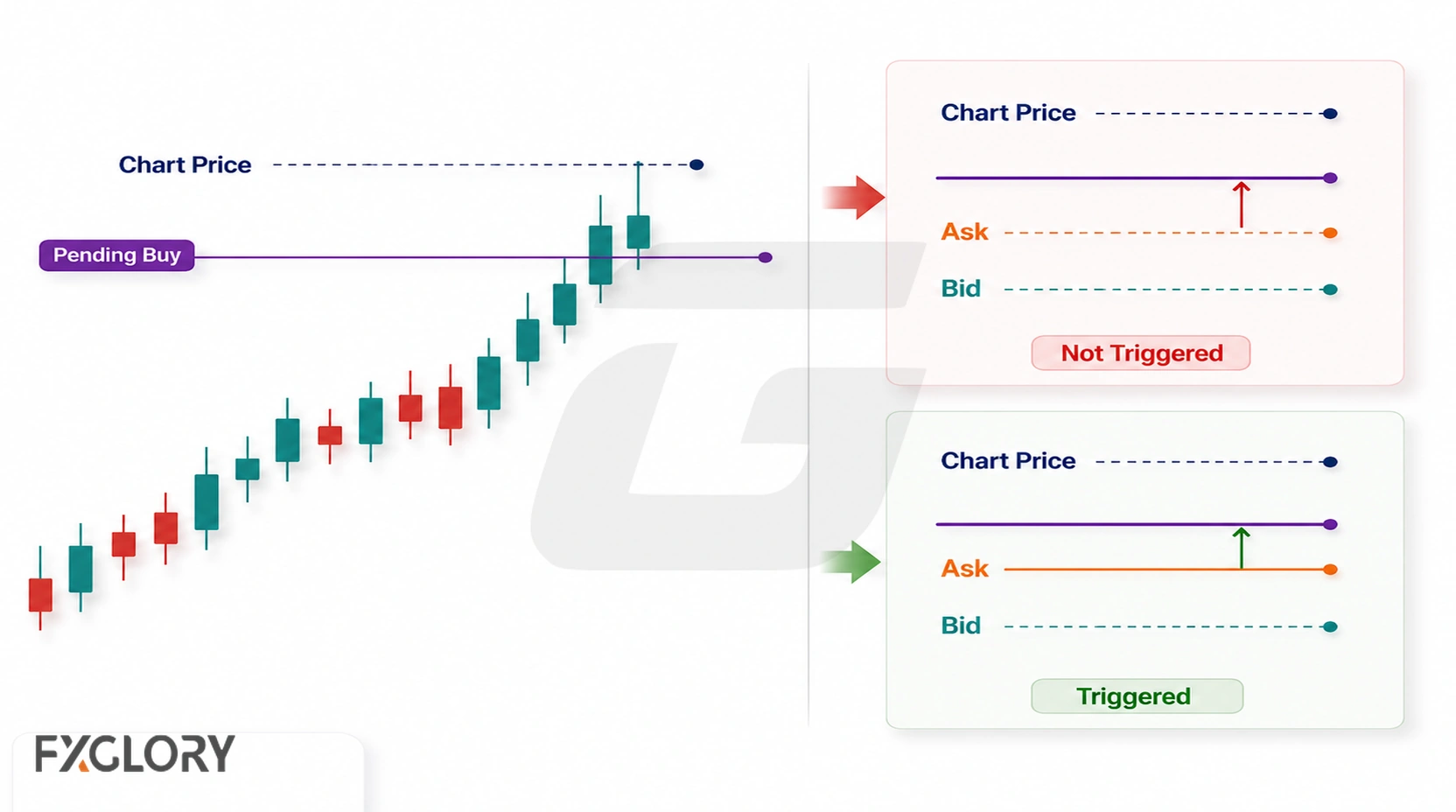
That distinction matters because an order, stop loss, or take profit can be evaluated against a particular quote side. A chart touch therefore does not automatically prove that the price used for that order reached the same level.
For example, when a Bid-based chart is visible and a buy-side trigger depends on Ask, the Bid can touch a level while the Ask remains elsewhere because of the spread.
Some platforms or instruments also expose other price fields, but OTC forex does not have one centralized exchange print that every provider must display identically. Check the platform's own price and order documentation when exact trigger behavior matters.
How Bid and Ask Affect Orders, Stop Loss and Take Profit
Bid and ask can affect both entry and exit conditions. The exact rule depends on the platform, instrument, and order type, so platform documentation should control when a live order's trigger behavior is in question.
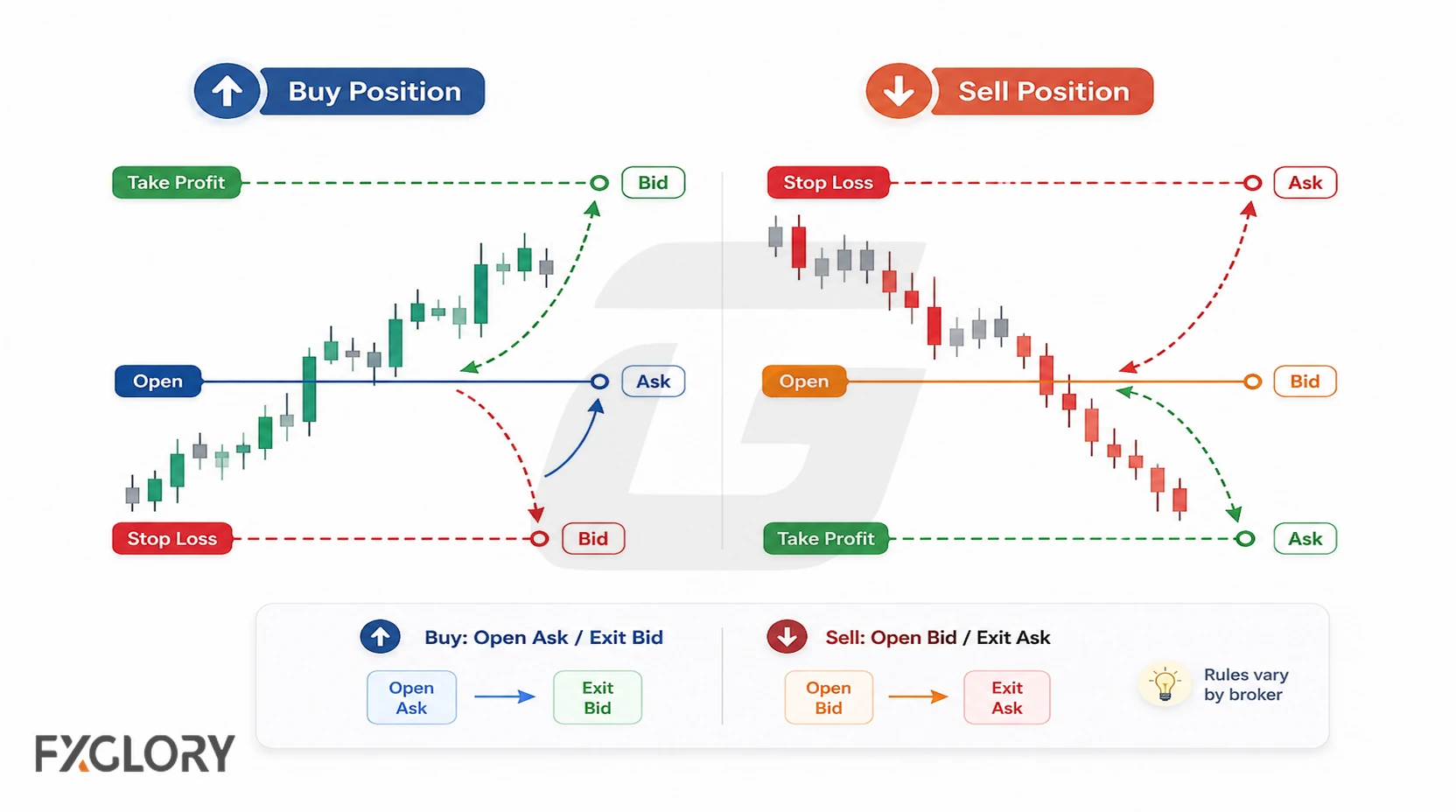
Pending orders are instructions intended to become active when specified price conditions are met. A stop loss defines an exit condition intended to limit loss, while a take profit defines a planned profit-taking exit.
Core order behavior
- Open buy: Ask usually applies because the transaction buys the base currency.
- Open sell: Bid usually applies because the transaction sells the base currency.
- Close buy: Bid usually applies because the position is closed by selling.
- Close sell: Ask usually applies because the position is closed by buying back.
Common OTC trigger convention
- Buy-side pending order: Ask may need to reach the trigger level.
- Sell-side pending order: Bid may need to reach the trigger level.
- Stop loss or take profit on a long position: Bid may be the relevant side because closing the position requires a sell.
- Stop loss or take profit on a short position: Ask may be the relevant side because closing the position requires a buy.
Common Beginner Mistakes With Bid and Ask in Forex
Most bid/ask mistakes come from treating one displayed number as if it represented every part of the quote and execution process.
- Looking only at the chart: The chart may display one price series while the trade ticket shows both Bid and Ask.
- Ignoring the spread: Bid and Ask are different prices, and the gap affects the entry-to-exit price relationship.
- Using the wrong quote side: Buy actions generally use Ask, while sell actions generally use Bid.
- Ignoring position size: The same spread in pips can have a different account-currency impact at different sizes.
- Assuming every order triggers from the visible chart line: Trigger rules can use a different quote side.
- Assuming the spread is fixed: Spreads can change with liquidity, volatility, time, instrument, and pricing conditions.
- Confusing pips with money: Pip distance and account-currency cost are related through pip value and position size.
Quick Recap: Bid and Ask Price in Forex
A two-way forex quote contains a Bid and an Ask. The trader generally sells at Bid and buys at Ask; the difference between those prices is the spread.
From there, three checks matter: calculate the spread, identify which price series the chart displays, and confirm which quote side the order uses for entry or exit.