Quick Answer: What Is Lot Size in Forex?
In forex trading, lot size is the setting that defines how large the currency position will be. It is not just a platform number. It controls position size, which affects pip value, margin use, notional exposure, and possible account risk.
What Is a Lot Size in Forex?
A lot size in forex is the trade size, or the number of currency units being traded. A forex lot is a standardized group of units used to describe the size of a currency trade.
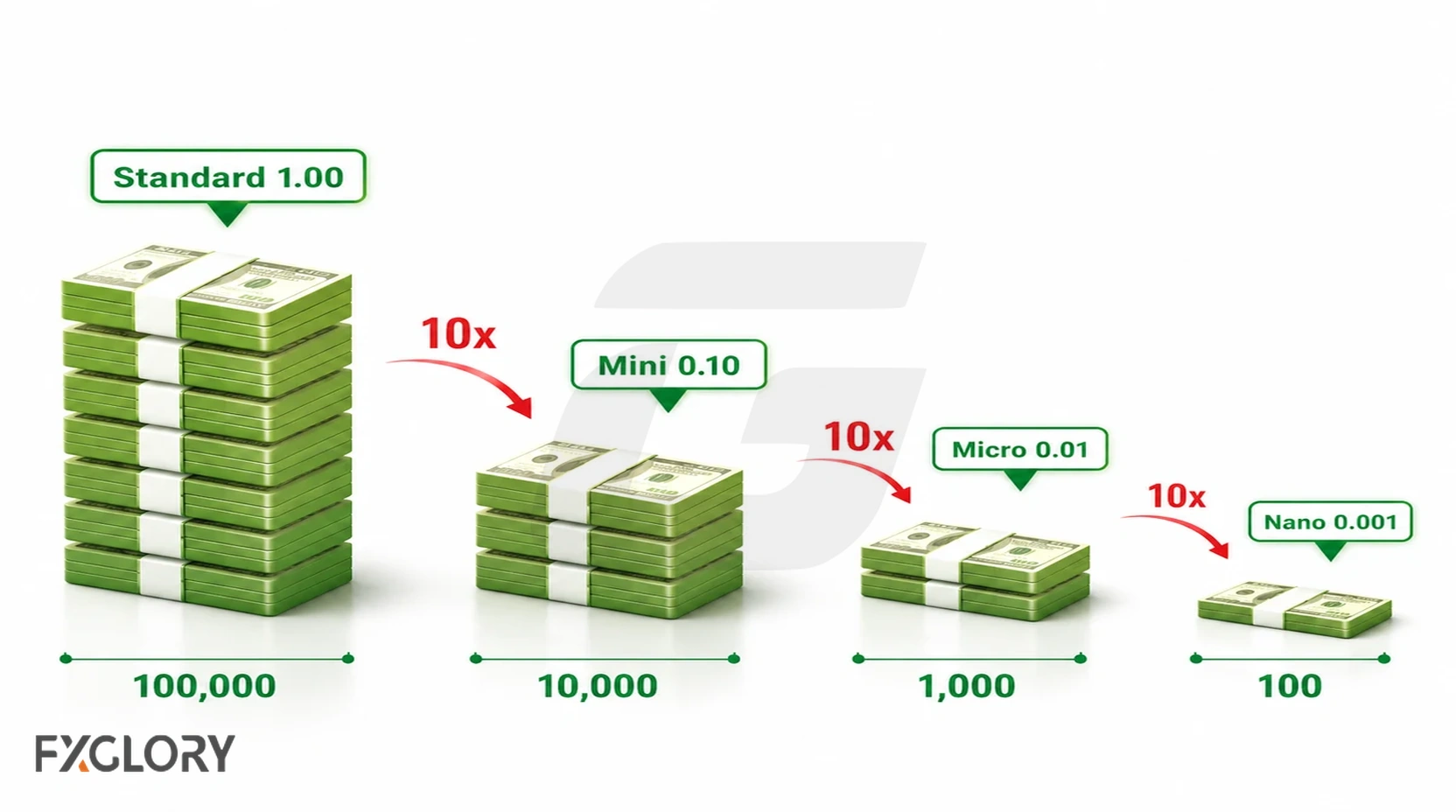
Instead of saying a trader bought 100,000 units, 10,000 units, or 1,000 units of a currency, forex platforms often group those amounts into standard lots, mini lots, micro lots, and sometimes nano lots.
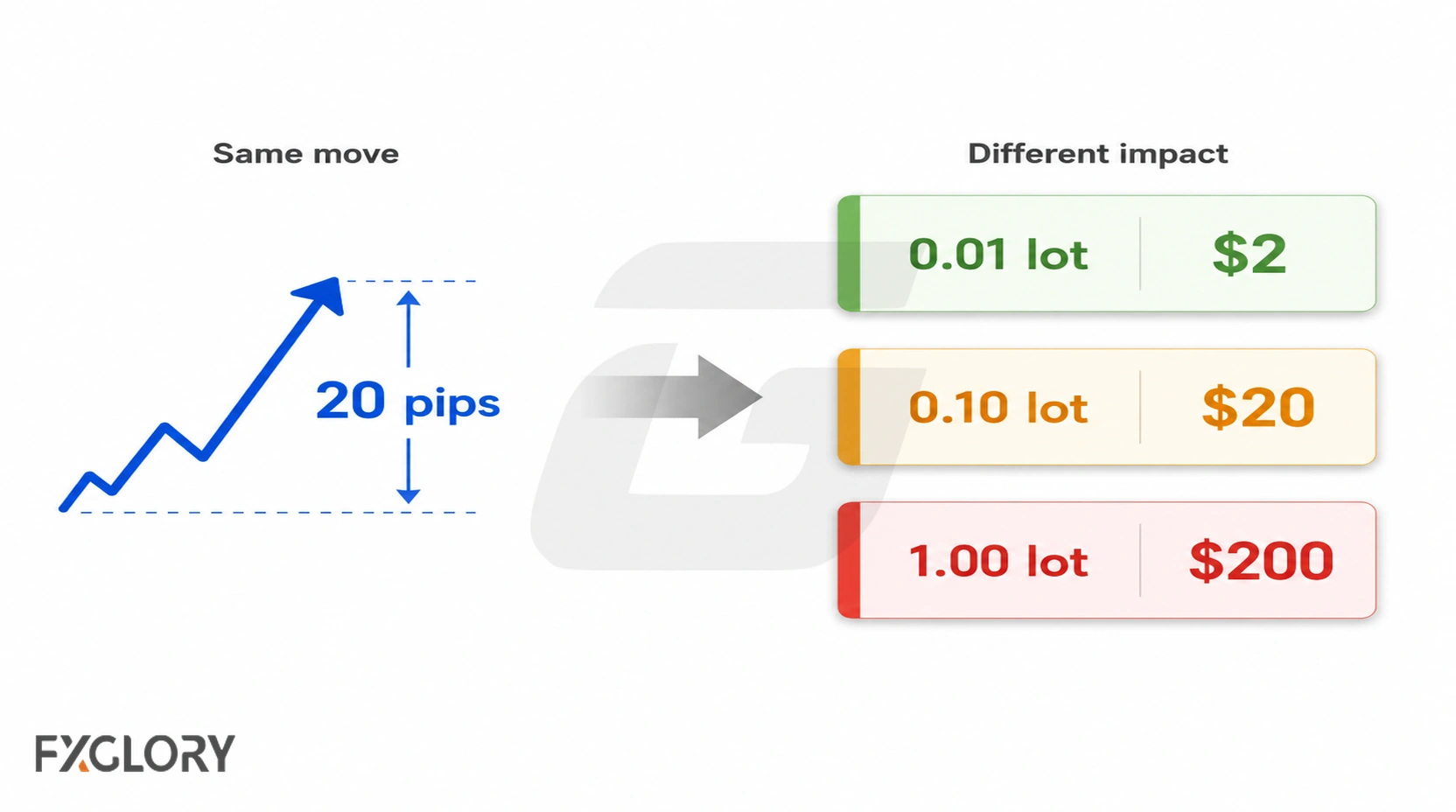
Lot size matters because it connects price movement to account impact. A 20-pip move is not the same for every trade. The money result depends heavily on how large the position is.
What Is a Standard Lot in Forex?
A standard lot in forex usually equals 100,000 units of the base currency. The base currency is the first currency in the pair.
For example, in EUR/USD, the euro is the base currency. So 1 standard lot of EUR/USD usually means 100,000 euros. In GBP/USD, 1 standard lot usually means 100,000 British pounds. In USD/JPY, 1 standard lot usually means 100,000 U.S. dollars.
On many USD-quoted pairs, simplified education examples often treat 1 standard lot as about $10 per pip. That estimate is useful for learning, but it is not universal. Actual pip value can vary by pair, exchange rate, account currency, and platform settings.
Forex Lot Sizes: Standard, Mini, Micro and Nano Lots
The common forex lot sizes are standard, mini, micro, and nano. These lot sizes help traders scale position size up or down.
| Lot Type | Lot Size | Common Units | Approx Pip Value on Many USD-Quoted Pairs |
|---|---|---|---|
| Standard lot | 1.00 | 100,000 units | About $10 per pip |
| Mini lot | 0.10 | 10,000 units | About $1 per pip |
| Micro lot | 0.01 | 1,000 units | About $0.10 per pip |
| Nano lot | 0.001 where available | 100 units where available | About $0.01 per pip where available |
- Standard lot: Usually 100,000 units of the base currency. This is often written as 1.00 lot.
- Mini lot: Usually 10,000 units of the base currency. This is often written as 0.10 lot.
- Micro lot: Usually 1,000 units of the base currency. This is often written as 0.01 lot.
- Nano lot: Usually 100 units of the base currency where available. This is often written as 0.001 lot on platforms that support it.
For many beginners, micro lots are easier to use in learning examples because each pip movement is smaller than with mini or standard lots. That does not make the trade risk-free, but it can make risk easier to control.
Units, Contract Size, Volume and Position Size
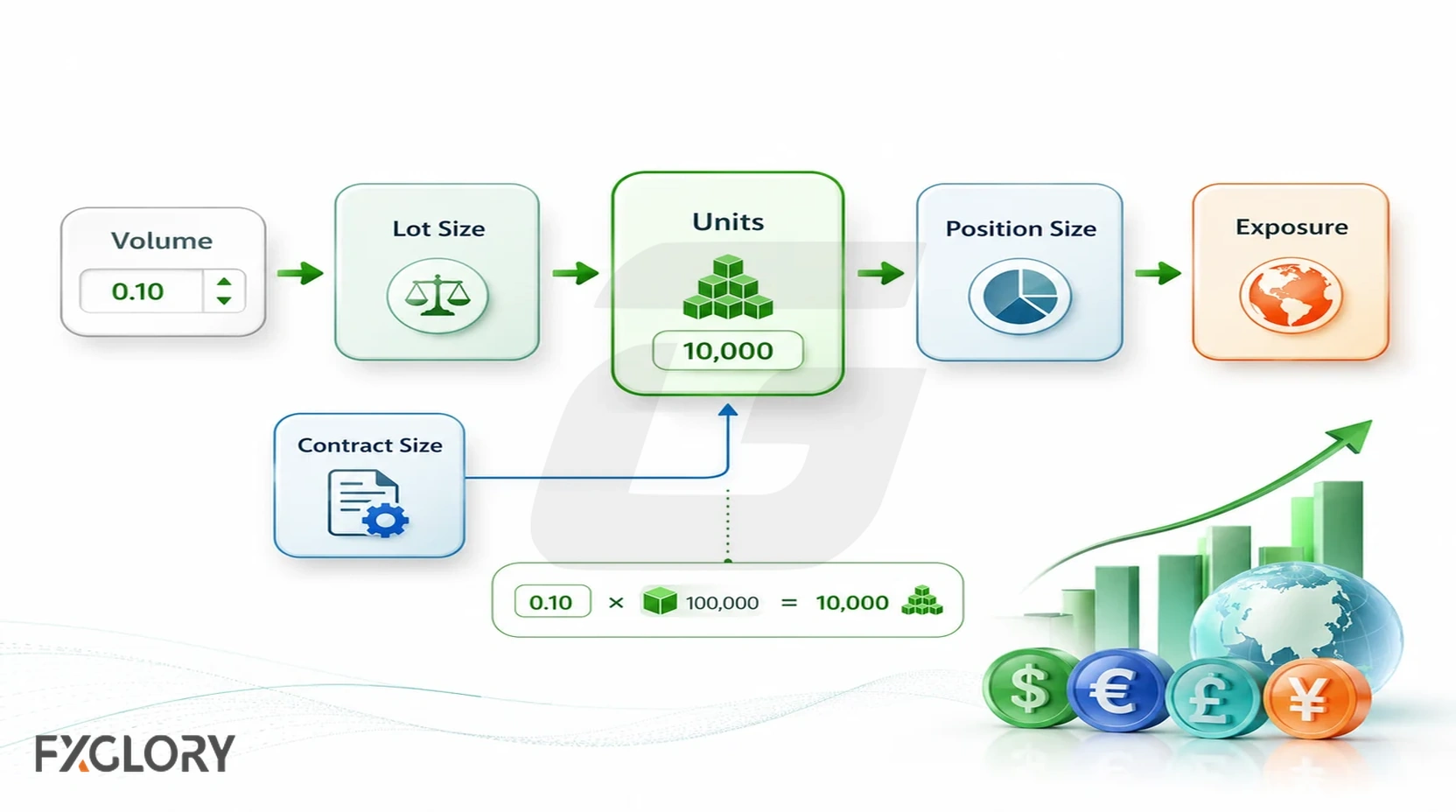
Units in forex are the actual quantity of the base currency being traded. Lots are standardized groupings of those units. Lot size is the amount selected on the trading platform, and position size is the total exposure created by that selection.
- Unit: One unit of the base currency.
- Lot: A standardized group of units.
- Contract size: The unit amount represented by one lot on the platform.
- Lot size: The number of lots or fractional lots selected for the trade.
- Volume: Some platforms use this label for the lot-size input, such as volume 0.10 for 0.10 lots.
- Position size: The total size of the open trade.
- Exposure: The market amount the account is exposed to through that position.
In EUR/USD, the euro is the base currency. If a trader opens 1.00 lot of EUR/USD, the position is usually based on 100,000 euros. If the trader opens 0.01 lots of EUR/USD, the position is usually based on 1,000 euros.
This distinction matters because a lot size is not just a number in an order ticket. It represents real exposure to a currency pair. For a broader explanation of base and quote currency, see how to read forex quotes.
How Much Is 1 Lot in Forex?
One lot in forex usually means one standard lot, or 100,000 units of the base currency. But the phrase how much is 1 lot in forex can mean three different things.
- Unit meaning: 1 lot usually equals 100,000 units of the base currency.
- Pip-value meaning: On many USD-quoted pairs, 1 standard lot is often about $10 per pip in simplified examples.
- Money exposure meaning: The approximate market value of the position depends on the pair price.
For example, if EUR/USD is trading near 1.1000, then 1 standard lot of EUR/USD represents 100,000 euros. The approximate notional value in U.S. dollars would be 100,000 × 1.1000 = about $110,000.
This does not mean the trader pays $110,000 upfront when using leverage. It means the position has exposure based on that approximate market value. The margin required depends on leverage, account type, platform rules, and market conditions.
1.00, 0.10 and 0.01 Lots by Currency Pair
Many platforms allow traders to enter lot sizes as decimals. These decimals are fractions of a standard lot. The base currency determines what the units represent.
| Pair | 1.00 Lot | 0.10 Lot | 0.01 Lot |
|---|---|---|---|
| EUR/USD | 100,000 EUR | 10,000 EUR | 1,000 EUR |
| GBP/USD | 100,000 GBP | 10,000 GBP | 1,000 GBP |
| USD/JPY | 100,000 USD | 10,000 USD | 1,000 USD |
| AUD/USD | 100,000 AUD | 10,000 AUD | 1,000 AUD |
This table helps clarify searches such as 1 lot in forex, 0.1 lot size forex, 0.01 lot size forex, and how much is one lot in forex. The exact minimum trade size can vary by broker, account type, and platform settings.
Lot Size and Notional Value
Notional value is the approximate market value of the position. It helps explain how much exposure the trade represents, even when the margin required is much smaller.
Units show the base-currency quantity. Notional value translates that quantity into approximate market exposure. Margin is only the amount required to open or maintain the leveraged position. Risk depends on how price moves, how large the position is, and how the trade is managed.
For pairs where USD is not the quote currency, or where the account currency is different from the quote currency, notional value and pip value may need an additional conversion step.
| Concept | Beginner Meaning | Example |
|---|---|---|
| Units | Base-currency quantity | 100,000 EUR in 1 lot of EUR/USD |
| Notional value | Approximate market value of the position | EUR/USD at 1.1000 means about $110,000 exposure |
| Margin | Funds required to open or maintain the position | Depends on leverage, account type, pair, and platform rules |
| Risk | Possible loss from price movement and execution | Depends on pip distance, pip value, lot size, spread, and slippage |
How Lot Size Connects to Pips and Pip Value
Lot size and pips are connected because lot size affects the money value of each pip movement. A pip measures price movement. Lot size helps determine how much that movement may affect the account.
For example, on many USD-quoted pairs, simplified education examples often use these approximate pip values:
- 1.00 standard lot: About $10 per pip.
- 0.10 mini lot: About $1 per pip.
- 0.01 micro lot: About $0.10 per pip.
If price moves 20 pips, the account impact can be very different depending on the lot size. A 20-pip move at about $0.10 per pip is around $2 before costs. A 20-pip move at about $10 per pip is around $200 before costs.
Spread can also affect the final result because it changes the cost of entering and exiting a trade. For quote mechanics, see bid and ask price in forex.
These are simplified examples for many USD-quoted pairs. Pip value can change when the quote currency, account currency, exchange rate, or platform convention differs. To review the price-movement side first, read what is a pip in forex trading.
Lot Size, Leverage and Margin
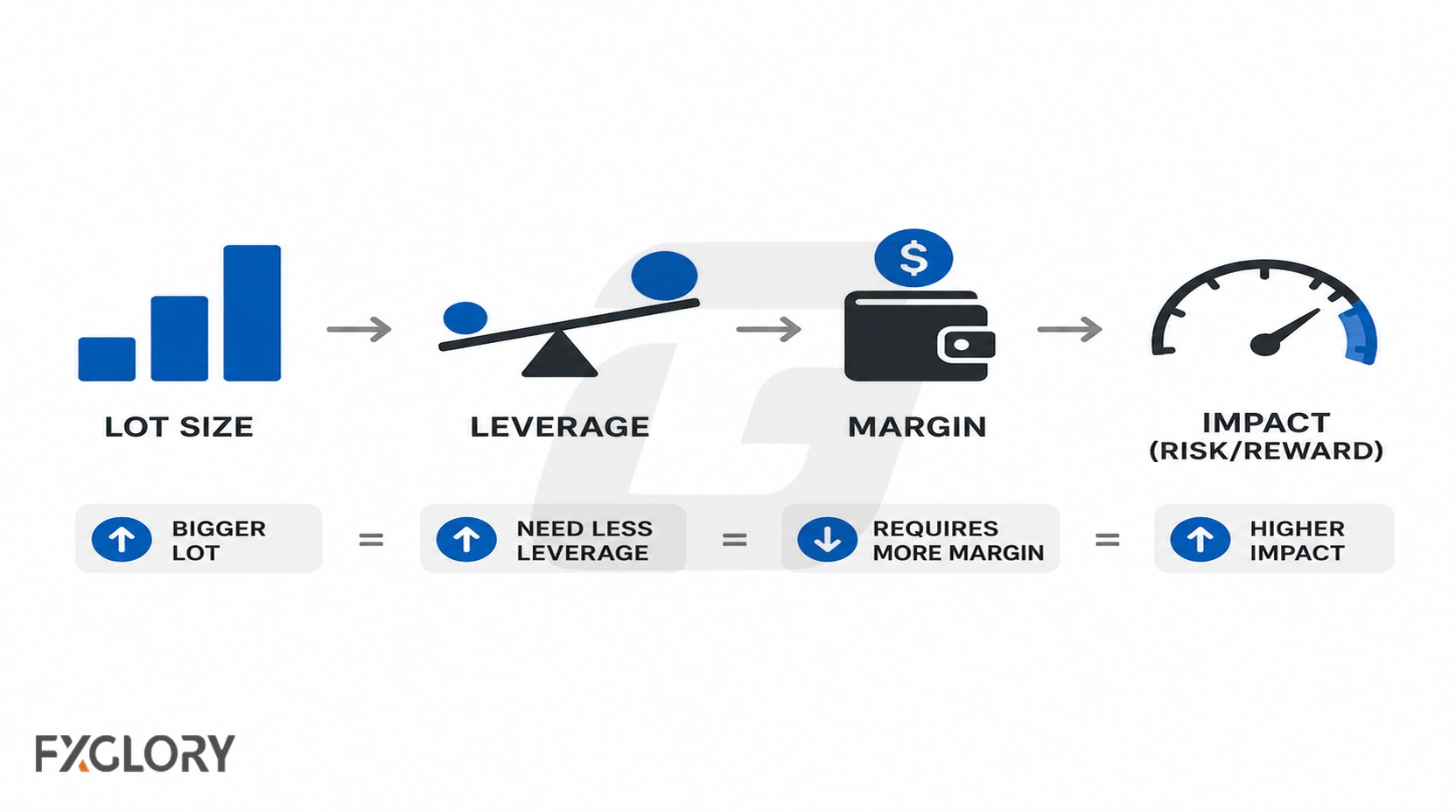
Lot size, leverage, and margin are connected, but they are not the same thing. Confusing them is one of the most common beginner mistakes.
- Lot size: The size of the trade, measured in currency units.
- Leverage: A tool that allows a trader to control a larger position with less required margin.
- Margin: The amount of funds required to open or maintain a leveraged position.
- Risk: The possible loss from the trade if price moves against the position.
Leverage does not make a trade safer. It can reduce the margin required to open a position, but the position size still determines how much each pip movement affects the account.
Higher leverage can also make it easier to open a lot size that is too large for the account. That is one of the main beginner dangers: the platform may allow a position that the risk plan cannot support.
For more detail, see what is leverage in forex trading.
Forex Risk Management and Lot Size Formula
Forex risk management and lot size should be planned together. A beginner should not choose lot size based on how much profit they want. Lot size should begin with how much loss the trader can accept if the trade is wrong.
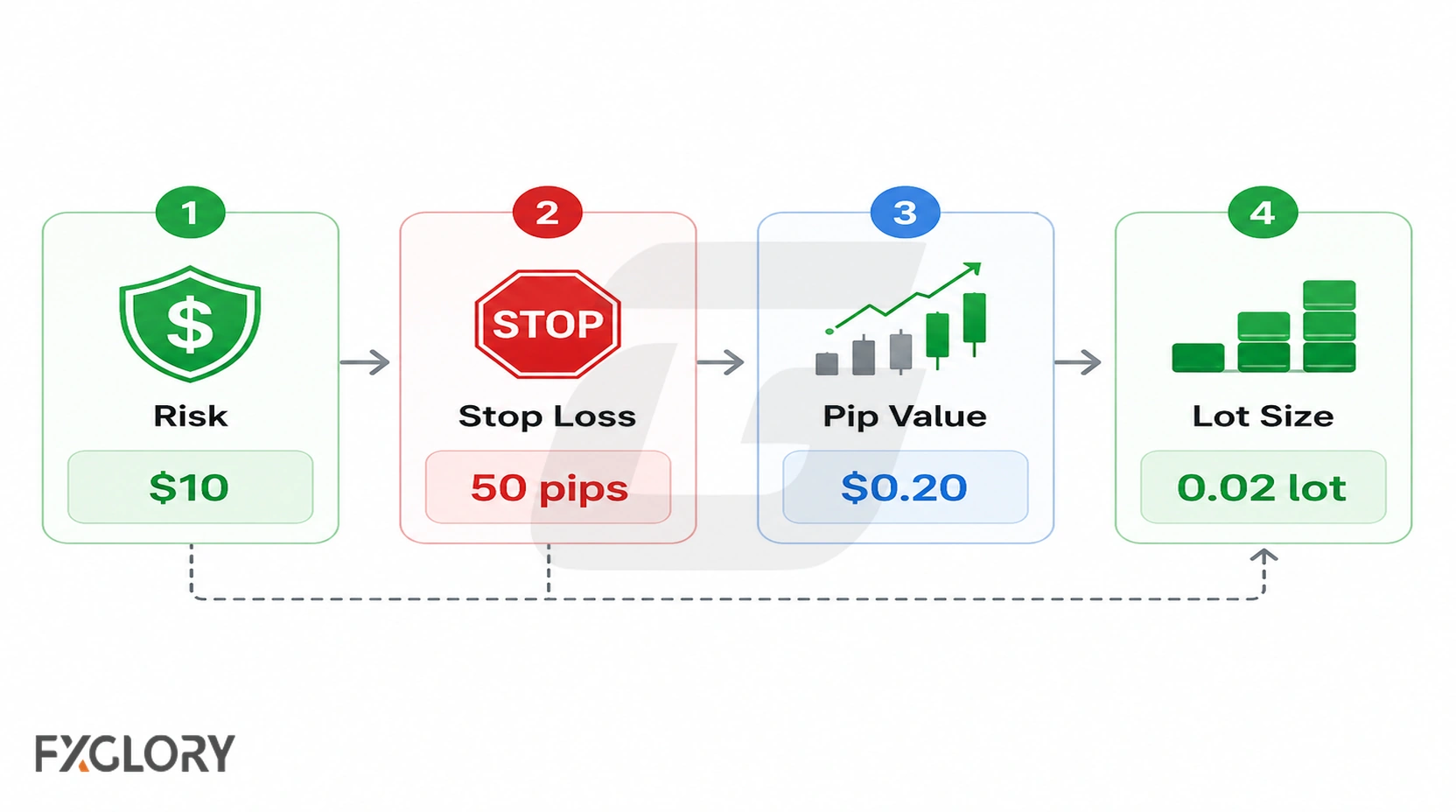
A simple lot-size calculation starts with risk. The trader first defines money risk, then stop-loss distance, then target pip value, and finally the lot size that fits that pip value.
If the pip value for 1.00 lot is not known, confirm it on the platform or with a position-size calculator before using the formula.
For example, if the money risk is $10 and the stop loss is 50 pips, the target pip value is $10 ÷ 50 = $0.20 per pip. If 1.00 lot is about $10 per pip on that pair, then $0.20 ÷ $10 = 0.02 lots.
This is a simplified planning example. Exact lot size can vary depending on the currency pair, account currency, exchange rate, and platform settings. A position-size calculator or demo platform can help confirm the lot size before placing a live trade.
Worked Example: Margin, Risk and Lot Size
Imagine a beginner has a $1,000 account and decides to risk 1% on a trade. That means the planned money risk is $10.
- Account size: $1,000
- Risk percentage: 1%
- Money risk: $10
- Stop-loss distance: 50 pips
The target pip value is $10 divided by 50 pips, or $0.20 per pip. On many USD-quoted pairs, a micro lot is often about $0.10 per pip. In that simplified example, 0.02 lots would be about $0.20 per pip. That means 0.02 lots is roughly two micro lots because 0.01 lot is one micro lot.
| Lot Size | Approx Pip Value | 50-Pip Move Approx Impact | Fits $10 Risk? |
|---|---|---|---|
| 0.01 lot | About $0.10 per pip | About $5 | Below the $10 limit |
| 0.02 lot | About $0.20 per pip | About $10 | Near the $10 limit |
| 0.10 lot | About $1 per pip | About $50 | Above the $10 limit |
| 1.00 lot | About $10 per pip | About $500 | Far above the $10 limit |
This larger-position example is for understanding margin, notional exposure, and pip impact. It is not a recommendation for beginners to trade 1 standard lot.
Now compare margin and risk using a larger position. If EUR/USD is near 1.1000, 1 standard lot represents about $110,000 of notional exposure. In a simplified margin example at 1:100 leverage, margin might be about $1,100. In a simplified margin example at 1:500 leverage, margin might be about $220. But a 50-pip move at about $10 per pip is still about $500 before costs.
These are simplified educational examples. Actual margin can vary by broker, account type, currency pair, leverage tier, platform rules, and market conditions.
Common Beginner Mistakes With Forex Lot Size
Many lot-size mistakes come from focusing on possible profit before understanding position size and risk. Beginners should watch for these problems:
- Choosing lot size from desired profit: Lot size should begin with risk, not with how much the trader wants to make.
- Choosing lot size from available margin: A platform may allow a position that is still too large for the risk plan.
- Confusing lot size with leverage: Lot size is the position size. Leverage affects margin access, not whether the trade is safe.
- Confusing margin with risk: Margin required is not the same as maximum possible loss.
- Ignoring pip value: A larger lot size makes each pip movement worth more money.
- Using 1 lot too early: A standard lot may be too large for many beginner accounts.
- Ignoring stop-loss distance: The same lot size can be risky or less risky depending on how far the stop loss is.
- Forgetting account currency: Pip value may need conversion if the account currency differs from the quote currency.
- Ignoring spread and slippage: Trading costs and execution can affect the final result. For quote mechanics, see bid and ask price in forex.
The goal is not to find the biggest lot size the account can open. The goal is to find a lot size that fits the trade plan and keeps risk controlled. A forex trading plan template can help organize those rules.
Quick Recap: Forex Lot Sizes Explained
A forex lot is a standardized trade size. One standard lot usually equals 100,000 units of the base currency. A mini lot is usually 10,000 units, and a micro lot is usually 1,000 units. Some platforms may also offer nano lots.
Lot size matters because it connects pip movement to money impact. A larger lot size makes each pip movement worth more money, which can increase both potential gain and potential loss.
Margin required is not the same as risk. Notional exposure is not the same as margin. Beginners should choose lot size by starting with account risk, stop-loss distance, pip value, and position size. For the full beginner pathway, return to forex basics for beginners.
Frequently Asked Questions
What is a lot size in forex?
Lot size in forex means the trade size, or the number of currency units being traded. A standard lot usually equals 100,000 units of the base currency.
What are lots in forex?
Lots in forex are standardized trade sizes used to group currency units. A standard lot is usually 100,000 units, a mini lot is usually 10,000 units, and a micro lot is usually 1,000 units.
What is a forex lot?
A forex lot is a standardized group of currency units used to set trade size. One standard forex lot usually equals 100,000 units of the base currency.
How much is 1 lot in forex?
One standard lot in forex usually equals 100,000 units of the base currency. For EUR/USD, 1 lot means 100,000 euros. The notional value depends on the exchange rate.
What is a standard lot in forex?
A standard lot in forex usually equals 100,000 units of the base currency. On many USD-quoted pairs, simplified examples often treat 1 standard lot as about $10 per pip, but actual pip value can vary.
What is 0.1 lot size in forex?
A 0.1 lot size is usually one mini lot, equal to 10,000 units of the base currency.
What is 0.01 lot size in forex?
A 0.01 lot size is usually one micro lot, equal to 1,000 units of the base currency.
Does lot size affect pip value?
Yes. A larger lot size makes each pip movement worth more money. On many USD-quoted pairs, simplified examples often use about $10 per pip for a standard lot, $1 per pip for a mini lot, and $0.10 per pip for a micro lot.
Is margin the same as risk?
No. Margin is the amount required to open or maintain a leveraged position. Risk is the amount the trader could lose if price moves against the trade.
How do I calculate lot size in forex?
Divide money risk by stop-loss pips to find target pip value. Then divide target pip value by the pip value of 1.00 lot for that pair and account currency. Exact results can vary by pair, exchange rate, account currency, and platform.
Related Contents
Practice Before Trading Live
Use a free demo account to test your strategy, risk rules, and execution process before placing a real-money trade.
Open a Free Demo Account