
Volatility in Forex: What It Is and Why It Matters
Volatility measures how much a currency pair's price moves over a given period. High volatility means large, fast price movements. Low volatility means small, slow movements. Understanding volatility is essential for setting appropriate stop losses, sizing positions correctly, and choosing which pairs and sessions to trade.
Key Takeaways
- Volatility measures how much a currency pair’s price moves over a given period.
- ATR (Average True Range) is the standard tool for quantifying forex volatility.
- Higher volatility means larger potential gains and larger potential losses.
- Major news events like NFP and central bank decisions spike volatility sharply.
What Causes Forex Volatility?
Price movement in forex is driven by new information arriving in the market. The more impactful the information, the larger the movement. Common causes of high volatility:
- Central bank decisions and forward guidance: Interest rate decisions, policy statements, and central bank speeches are the highest-impact events in forex. A surprise rate decision or unexpected language can move a pair 100+ pips instantly. See: Hawkish vs Dovish Explained
- Economic data releases: Non-Farm Payrolls (NFP), CPI, GDP, retail sales, employment data. High-impact releases create a brief volatility spike as the market reprices based on new information.
- Geopolitical events: Political instability, elections, sanctions, and military events can cause rapid repricing, especially in emerging market pairs and safe-haven currencies (USD, CHF, JPY).
- Market hours: Volatility is highest during London and New York sessions; lowest during the Asian session and on weekends.
Average Daily Volatility: Major Pairs
Approximate ATR(14) values under normal market conditions:
| Pair | Approx daily ATR (pips) | Volatility level |
|---|---|---|
| EUR/USD | 50–80 pips | Moderate — most liquid major |
| GBP/USD | 80–120 pips | High — GBP sensitive to UK data |
| USD/JPY | 60–90 pips | Moderate — spikes on BOJ news |
| USD/CHF | 50–75 pips | Moderate — CHF is safe haven |
| AUD/USD | 50–80 pips | Moderate — commodity-linked |
| NZD/USD | 50–70 pips | Moderate |
| GBP/JPY | 120–180 pips | Very high — cross of two volatile currencies |
| USD/TRY | 500–2,000+ pips | Extreme — emerging market exotic |
These ranges vary significantly during high-impact news events, where a pair may move its entire weekly ATR in minutes.
How to Measure Volatility: ATR
The Average True Range (ATR), developed by J. Welles Wilder, is the most widely used forex volatility indicator. It measures the average range of price movement over a set number of periods.
True Range = max(High − Low, |High − Prev Close|, |Low − Prev Close|)
ATR(14) = 14-period moving average of True Range
The True Range uses the previous close to account for gaps — where the opening price differs from the prior close. ATR(14) is standard.
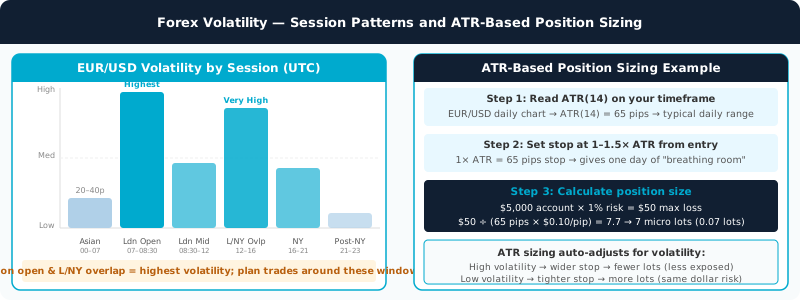
EUR/USD daily chart shows ATR(14) = 65 pips. This means over the past 14 days, the average daily price range was 65 pips. A stop loss of 65 pips gives the trade approximately one day’s worth of “breathing room” before being stopped out by normal volatility rather than directional movement against you.
Volatility-Based Position Sizing
Using ATR to set stops and size positions creates consistent risk management across different market conditions — you automatically trade smaller in high-volatility environments.
Lot size = (Account balance × risk%) ÷ (ATR stop pips × pip value per micro lot)
Example: EUR/USD, $5,000 account, 1% risk
- Maximum risk: $5,000 × 1% = $50
- ATR(14) = 65 pips → stop at 1× ATR = 65 pips
- EUR/USD micro lot (0.01 lots) pip value = $0.10/pip
- Lot size = $50 ÷ (65 × $0.10) = $50 ÷ $6.50 = 7.7 → 7 micro lots (0.07 lots)
This scales your position smaller when volatility is high (wider stops needed) and larger when volatility is low (tighter stops allow more lots for the same dollar risk). In high-volatility markets, you automatically trade smaller — an inherently protective property.
See also: What Is a Lot Size?
Volatility by Session
| Session | Typical EUR/USD volatility | Notes |
|---|---|---|
| Asian (00:00–07:00 UTC) | Low — 20–40 pips typical range | JPY pairs more active; EUR/USD often consolidates |
| London open (07:00–08:30 UTC) | High — often the highest spike of the day | Large institutional orders trigger significant moves |
| London mid-session (08:30–12:00 UTC) | Moderate | Trend often established in first session hour |
| London/NY overlap (12:00–16:00 UTC) | High — most active combined session | US economic data typically released 13:30–15:00 UTC |
| NY session (16:00–21:00 UTC) | Moderate, decreasing | Activity drops after London close |
| Post-NY (21:00–23:00 UTC) | Very low | Lowest liquidity and volatility of the day |
High Volatility vs Low Volatility: What to Adjust
In high volatility:
- Use ATR-based stops, not fixed pip stops — fixed stops get hit by normal volatility
- Reduce position size to maintain the same dollar risk at the wider stop
- Avoid breakout trades without confirmation — false breaks are more frequent
- Be cautious around news events — fills and execution quality may deteriorate
In low volatility:
- Tighter stops are more appropriate — less “breathing room” needed
- Can increase position size while maintaining the same dollar risk
- Range-bound strategies may outperform trend-following
- Breakouts from tight consolidations can produce explosive directional moves when volatility expands
Frequently Asked Questions
Related Forex Basics Guides
Build confidence with a free FXGlory demo account. Test forex strategies, learn platform tools, and practice risk management without using real funds.
Open a Free Demo Account