What Is Liquidity in Forex?
Liquidity describes how easily a currency pair can be bought or sold at a stable price. A liquid market has many buyers and sellers active at any moment, so trades fill quickly at prices close to what you expected. An illiquid market has fewer participants, causing spreads to widen and prices to move sharply even on modest trade sizes.
The forex market is the most liquid financial market in the world, processing over $7 trillion per day (BIS, 2022). But liquidity varies enormously between different currency pairs, different times of day, and different market conditions.
Key Takeaways
- Liquidity means how quickly you can buy or sell without moving the price.
- The EUR/USD and USD/JPY are the most liquid pairs with the tightest spreads.
- Liquidity peaks during the London–New York overlap (13:00–17:00 UTC).
- Low-liquidity periods lead to wider spreads, slippage, and erratic price moves.
Why Liquidity Matters to Retail Traders
Liquidity affects your trading in three direct ways:
- Spread width: High liquidity = tight spreads. EUR/USD during the London session: 0.5–1 pip. USD/TRY (exotic): 20–50 pips. The spread is your transaction cost — you pay it every time you enter a trade.
- Slippage: In liquid markets, orders fill at or near the requested price. In illiquid conditions (thin Asian session, major news, exotic pairs), your order may fill at a worse price than requested — adding to your entry cost invisibly.
- Price stability: High liquidity means large orders are absorbed without dramatically moving the price. In illiquid conditions, even a medium-sized retail trade can push price against itself.
Which Currency Pairs Are Most Liquid?
| Category | Examples | Typical spread | Daily volume |
|---|---|---|---|
| Major pairs | EUR/USD, GBP/USD, USD/JPY, USD/CHF, USD/CAD, AUD/USD, NZD/USD | 0.5–2 pips | Highest — USD on one side of all |
| Minor pairs (crosses) | EUR/GBP, EUR/JPY, GBP/JPY, AUD/JPY | 1–4 pips | Medium |
| Exotic pairs | USD/TRY, EUR/ZAR, USD/MXN, USD/SGD | 10–50+ pips | Lower |
EUR/USD is the most liquid currency pair in the world, accounting for approximately 23% of all daily forex turnover. Its tight spreads and deep market make it the default starting pair for most retail traders. GBP/USD and USD/JPY are the second and third most liquid pairs.
When Forex Liquidity Is Highest (and Lowest)
Forex liquidity follows the global trading session calendar. The market is open 24 hours a day, Monday to Friday, but liquidity is not evenly distributed.
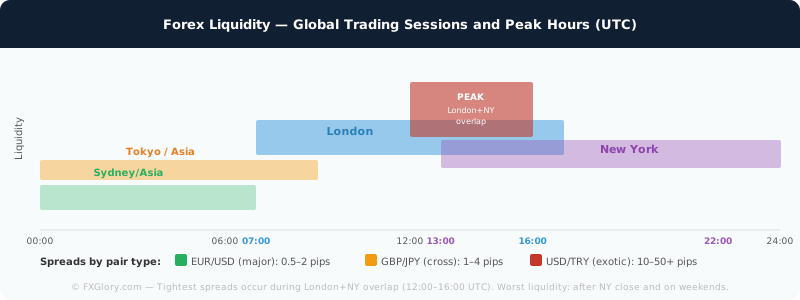
| Session | Active hours (UTC) | Key pairs | Liquidity level |
|---|---|---|---|
| Sydney | 22:00–07:00 UTC | AUD/USD, NZD/USD | Lowest for EUR pairs |
| Tokyo / Asia | 00:00–09:00 UTC | USD/JPY, AUD/JPY | Moderate for JPY pairs |
| London | 07:00–16:00 UTC | EUR/USD, GBP/USD, EUR/GBP | High liquidity begins |
| London + NY overlap | 12:00–16:00 UTC | EUR/USD, GBP/USD, USD/JPY | Peak global liquidity |
| New York | 13:00–22:00 UTC | USD pairs | High; decreases after 17:00 |
Liquidity drops sharply in these windows:
- 17:00–20:00 UTC (after NY close, before Asian session builds)
- Weekends (market technically closed)
- Major public holidays in financial centres (UK bank holidays affect EUR/GBP; US federal holidays affect USD pairs)
- Year-end period (reduced bank staffing, thin interbank market)
Liquidity and News Events
Major economic announcements (NFP, CPI, central bank rate decisions) create a brief but extreme liquidity vacuum. Immediately before and during releases:
- Liquidity providers temporarily pull their quotes
- Spreads widen sharply — sometimes 5×–20× the normal width
- Slippage on stop-loss orders is common
- Price can gap — jumping instantly past your stop level without a fill at your specified price
Liquidity vs Volatility
These are often confused but describe different things:
| Concept | What it measures | Example |
|---|---|---|
| Liquidity | How many participants are active and how easily trades execute at stable prices | EUR/USD has deep liquidity at any time during weekday hours |
| Volatility | How much price is moving — the size of price swings | GBP/USD can be highly volatile during Bank of England announcements |
EUR/USD during the London session: typically both highly liquid AND moderately volatile — many participants, meaningful price movement. EUR/USD at 2 AM Sunday: both illiquid AND low volatility — few participants, minimal price movement. GBP/USD during a major Bank of England announcement: can be highly liquid AND extremely volatile simultaneously.
Practical Tips for Trading with Liquidity in Mind
- Trade major pairs during London or NY sessions for tightest spreads and most reliable fills
- Avoid opening new positions in the 5 minutes before major news releases — check the economic calendar daily
- Check spreads before trading exotic pairs — a 30-pip spread on USD/TRY means price must move 30 pips just to break even
- Be cautious around rollover time (22:00 UTC) — spreads temporarily widen
- Weekend gap risk: positions held over weekends can open Monday at a price significantly different from Friday’s close — liquidity is zero while markets are closed
Frequently Asked Questions
Related Forex Basics Guides
Build confidence with a free FXGlory demo account. Test forex strategies, learn platform tools, and practice risk management without using real funds.
Open a Free Demo Account