Long and Short in Forex
In forex, every trade is either long or short. There is no third option. Understanding what these terms mean — and how profit and loss work in each direction — is foundational to everything else in trading.
Key Takeaways
- Going long means buying the base currency expecting the price to rise.
- Going short means selling the base currency expecting the price to fall.
- Forex lets you profit in both rising and falling markets.
- Swap charges apply when long or short positions are held overnight.
What Going Long Means
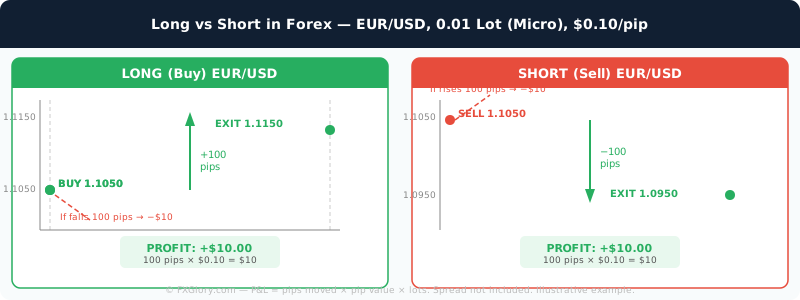
Going long means buying the base currency of a pair and selling the quote currency. You profit when the base currency rises in value relative to the quote currency — when the pair price goes up.
- You buy euros and sell US dollars
- You want EUR to strengthen against USD (price to rise)
- Price rises to 1.1150 → +100 pips → 100 × $0.10 = +$10 profit
- Price falls to 1.0950 → −100 pips → 100 × $0.10 = −$10 loss
What Going Short Means
Going short means selling the base currency and buying the quote currency. You profit when the base currency falls in value — when the pair price goes down.
- You sell euros and buy US dollars
- You want EUR to weaken against USD (price to fall)
- Price falls to 1.0950 → −100 pips → 100 × $0.10 = +$10 profit
- Price rises to 1.1150 → +100 pips → 100 × $0.10 = −$10 loss
P&L Calculation — Long vs Short
P&L = Pips moved × Pip value × Number of lots
100 pips × $0.10/pip × 1 micro lot = $10.00
Same formula, same dollar amount — direction does not change the math, only which way the money flows.
| Direction | Entry | Exit | Movement | Pip Value (0.01 lot) | Result |
|---|---|---|---|---|---|
| Long (buy) | 1.1050 | 1.1150 | +100 pips | $0.10/pip | +$10 profit |
| Long (buy) | 1.1050 | 1.0950 | −100 pips | $0.10/pip | −$10 loss |
| Short (sell) | 1.1050 | 1.0950 | −100 pips | $0.10/pip | +$10 profit |
| Short (sell) | 1.1050 | 1.1150 | +100 pips | $0.10/pip | −$10 loss |
EUR/USD, 0.01 lot (micro), USD account. Spread not included.
Shorting Forex vs Stocks
In the stock market, going short requires borrowing shares from your broker, selling them, then buying them back later to return — a complex process with borrowing fees, availability limitations, and additional margin requirements.
In spot forex, shorting is identical to going long in terms of mechanics. You simply click Sell instead of Buy. No borrowing occurs. You can short any forex pair at any time with no additional requirements or approval. This is one of the structural advantages of forex: directional symmetry. You can profit whether the market rises or falls, in any session.
How to Open Long or Short on MT4/MT5
- Press F9 (or right-click chart → Trade → New Order)
- Select the currency pair
- Set your lot size (volume)
- Set stop-loss and take-profit prices
- Click Buy to go long, or Sell to go short
In the MT4/MT5 Terminal panel (open positions tab), the Type column shows your direction: buy = long, sell = short. The floating P&L column updates in real time.
Net Position — Long and Short Simultaneously
On MT4 hedging-mode accounts, you can hold both a long and a short on the same pair simultaneously. This is called hedging. On MT5 netting-mode accounts, an opposite position will reduce or close the existing one instead.
Having equal long and short positions on the same pair and lot size produces zero net market exposure but doubles your swap costs. This is rarely a useful strategy.
Net long example: 0.03 lots long EUR/USD + 0.01 lots short EUR/USD = net long 0.02 lots. Your effective exposure is 0.02 lots in the long direction.
Long, Short, Bullish and Bearish
Bullish and bearish describe your market expectation:
- Bullish on EUR/USD → you expect price to rise → you go long
- Bearish on EUR/USD → you expect price to fall → you go short
- Bullish on USD (the currency itself) → USD strengthens → could mean going short EUR/USD, short GBP/USD, or long USD/JPY
Frequently Asked Questions
Related Forex Basics Guides
Build confidence with a free FXGlory demo account. Test forex strategies, learn platform tools, and practice risk management without using real funds.
Open a Free Demo Account