
Forex Investing vs Forex Trading: What Is the Difference?
The terms "forex investing" and "forex trading" are often used interchangeably, but they describe fundamentally different approaches to currency markets. Understanding the distinction helps you choose the right approach for your goals, time horizon, and risk tolerance.
Key Takeaways
- Long-term investing typically uses buy-and-hold in stocks, bonds, or index funds.
- Forex trading is short-term speculation on price movements, not ownership.
- Investing builds wealth through compounding; forex trading relies on active decisions.
- Risk profiles differ greatly: investing involves market risk; trading adds execution risk.
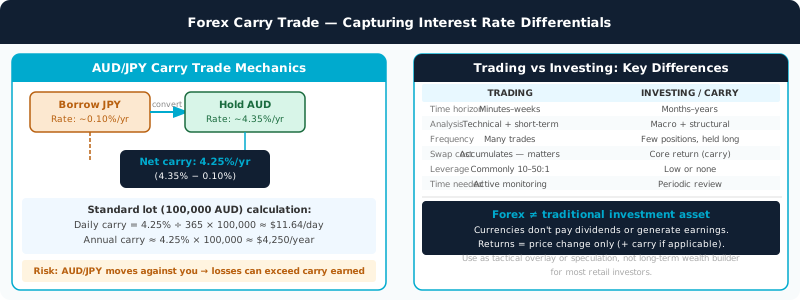
Trading vs Investing: Core Differences
Does Forex Investing Really Exist?
Strictly speaking, forex as a standalone asset class does not “invest” the way stocks do. When you buy shares in a company, you own a piece of a productive asset that generates earnings. A currency pair does not produce earnings — it only changes in price relative to another currency.
However, currency exposure is a real component of portfolio investing in several forms:
- Carry trading: Borrowing a low-interest currency and investing in a high-interest currency to capture the rate differential. This is the closest thing to genuine “forex investing” — it has a yield-based return logic rather than pure speculation.
- Foreign currency savings/deposits: Holding deposits in a higher-yielding currency. A eurozone investor holding USD deposits captures higher USD interest rates — but takes on USD/EUR exchange rate risk.
- Indirect exposure through international stocks/bonds: Most institutional currency “investing” is a byproduct of international equity or bond investing. A US investor buying European stocks holds EUR exposure — either hedged (currency-neutral) or unhedged (capturing the exchange rate return alongside the equity return).
Carry Trading: The Yield-Based Approach
Carry trading attempts to profit from interest rate differentials between currency pairs. The mechanics: go long a high-yield currency, receive the positive swap (interest differential) each night you hold the position, and manage the exchange rate risk.
Annual carry = rate differential (%) × position notional value
Daily carry = annual carry ÷ 365
Example (illustrative rates): AUD/JPY carry trade
- AUD 3-month rate: 4.35% | JPY 3-month rate: 0.10%
- Annual rate differential: 4.35% − 0.10% = 4.25%
- Standard lot (100,000 AUD): annual carry ≈ 4.25% × 100,000 = $4,250/year
- Daily carry ≈ $4,250 ÷ 365 ≈ $11.64/day
Over a year, one standard lot earns roughly $4,250 in carry — before any exchange rate movement. If AUD/JPY appreciates, the position makes additional capital gains. If AUD/JPY falls significantly, the carry income is overwhelmed by exchange rate losses.
Carry trades work well in low-volatility environments with stable rate differentials. They tend to unwind sharply in risk-off events (such as the 2008 financial crisis) when carry traders exit simultaneously — causing rapid, sharp moves against the carry direction.
See: Forex Swap Explained
Forex as Part of a Diversified Portfolio
Most retail investors who want currency exposure without active trading can access it through:
- Currency ETFs: ETFs tracking a specific currency or currency index provide exposure through exchange-listed instruments without requiring a forex account.
- International bonds: Bonds issued in foreign currencies provide interest income plus currency return. A US investor holding a German Bund receives euros — capturing EUR/USD movement alongside the bond yield.
- Unhedged international equity: International equity funds without currency hedging include the exchange rate return in their total return. Over long periods, currency effects tend to reduce but can be significant in shorter windows.
Key Considerations for Long-Term Forex Positions
If holding a forex position over weeks to months:
- Swap accumulation: A negative swap erodes returns over time. Before holding any position long-term, check whether the swap is positive or negative. Going long a pair with a negative swap means paying a small cost each night — this becomes significant over months.
- Long-term currency trends: Major pairs trend over months or years driven by central bank policy, trade balances, and growth differentials. EUR/USD can trend from 1.05 to 1.25 over a cycle — a 2,000-pip move. Long-term directional positions can capture these moves but require wide stops and patience.
- Low leverage required: Short-term volatility in a long-term position can trigger margin calls if leverage is high. Long-term positions require either very low leverage or sufficient capital to absorb temporary drawdowns.
Is Forex Suitable as an Investment?
For most retail investors seeking long-term wealth building, direct forex trading is not the most efficient vehicle:
- No dividends, earnings, or fundamental value growth — price returns only
- Swap costs make carrying positions expensive unless in the correct direction
- High leverage amplifies short-term volatility against long-term positions
- Transaction costs (spreads) are meaningful relative to expected long-term price moves
Forex is most appropriate for active speculation, hedging existing currency exposure, or as a tactical overlay to a broader investment portfolio — not as a primary long-term investment asset class for most retail participants.
Frequently Asked Questions
Related Forex Basics Guides
Build confidence with a free FXGlory demo account. Test forex strategies, learn platform tools, and practice risk management without using real funds.
Open a Free Demo Account