
Hawkish vs Dovish: What It Means for Forex Traders
Hawkish and dovish describe a central bank's stance on monetary policy — whether it leans toward tighter or looser policy. Understanding the difference is fundamental for forex trading: central bank policy direction is the single most powerful driver of long-term currency trends.
Key Takeaways
- A hawkish central bank signals rate hikes or tighter monetary policy.
- A dovish stance signals rate cuts or looser policy to stimulate growth.
- Hawkish language typically strengthens a currency; dovish language weakens it.
- Traders watch central bank statements closely for any shift in tone.
Hawkish Meaning
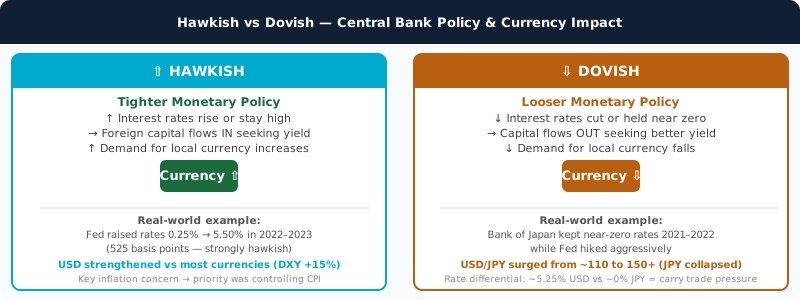
A hawkish central bank or official favours tighter monetary policy: higher interest rates and/or reducing the money supply. The primary goal is to slow economic growth and control inflation.
Higher interest rates attract capital from foreign investors seeking better returns on deposits and bonds. To buy those assets, foreign investors must first buy the local currency — increasing demand for it. More demand = higher exchange rate.
2022–2023 Fed example: The Federal Reserve raised US interest rates from 0.25% to 5.50% (525 basis points). The US dollar (DXY index) strengthened significantly against most currencies because higher USD yields attracted global capital into US assets.
Dovish Meaning
A dovish central bank or official favours looser monetary policy: lower interest rates and/or expanding the money supply. The primary goal is to stimulate economic growth and prevent deflation.
Lower interest rates make holding that currency less attractive relative to alternatives with higher yields. Capital flows out seeking better returns elsewhere, reducing demand for the currency.
Bank of Japan example (2021–2022): While other central banks raised rates, the Bank of Japan maintained near-zero policy. USD/JPY climbed from ~110 to over 150 as the interest rate differential between the US (~5.25%) and Japan (~0%) widened dramatically, driving carry trade flows from JPY into USD.
Hawkish vs Dovish: Side-by-Side
How to Identify Hawkish or Dovish Signals
Central bank communication is deliberate and layered. Officials signal their stance through multiple channels:
- Interest rate decisions: The clearest signal. A rate hike is hawkish; a cut is dovish. But magnitude matters — a 25bp hike after previous 50bp hikes is less hawkish by comparison.
- Forward guidance: Statements about future policy direction. “Further increases may be appropriate” is hawkish; “we are prepared to cut rates if needed” is dovish. Markets often react more to forward guidance than to the current decision itself.
- Inflation vs growth emphasis: If a speech focuses on inflation being too high, it implies future hikes — hawkish. If it emphasises slowing growth or rising unemployment, it implies future cuts — dovish.
- Meeting minutes: The written record of policy discussions, released with a delay. More hawkish language than expected strengthens the currency; more dovish weakens it.
- Unexpected statements between meetings: A central bank official speaking at a conference and signalling a change in direction can move markets significantly even outside formal meeting dates.
Relative Hawkishness Matters More Than Absolute
Currency pairs reflect the relative stance of two central banks, not the absolute stance of one. EUR/USD is driven by the ECB–Fed differential. USD/JPY by the Fed–BOJ differential.
Currency direction ≈ Bank A hawkishness − Bank B hawkishness
- Fed hawkish, ECB dovish → USD strengthens vs EUR → EUR/USD falls
- Fed dovish, ECB hawkish → EUR strengthens vs USD → EUR/USD rises
- Both equally hawkish → limited directional bias from policy; other factors dominate
- Fed turns less hawkish (hike cycle ending) before ECB → USD weakens even before actual cuts begin
The market prices expectations, not current reality. When the market already prices in three more Fed rate hikes and the Fed then hikes only twice, the dollar may fall despite rising rates — because the outcome was more dovish than expected.
Pivot: What It Means in Policy Context
A “pivot” describes the moment a central bank transitions from one policy direction to another — most commonly from a hiking cycle to a cutting cycle. Market participants spend months speculating about when a central bank will pivot because the anticipation of a pivot moves currencies well before any actual rate cut occurs.
2022–2024 example: The Fed raised rates through 2022–2023. From late 2023 through 2024, markets spent considerable time pricing in when the “Fed pivot” to cuts would occur. Each CPI release or Fed speech suggesting cuts were moving closer (more dovish) weakened the dollar; each print suggesting sticky inflation (more hawkish) strengthened it.
Key Central Banks and Their Currencies
| Central bank | Currency | Rate decision schedule |
|---|---|---|
| Federal Reserve (Fed) | USD | 8 meetings/year (FOMC) |
| European Central Bank (ECB) | EUR | 8 meetings/year |
| Bank of England (BOE) | GBP | 8 meetings/year (MPC) |
| Bank of Japan (BOJ) | JPY | 8 meetings/year |
| Swiss National Bank (SNB) | CHF | 4 meetings/year |
| Reserve Bank of Australia (RBA) | AUD | 11 meetings/year |
| Bank of Canada (BOC) | CAD | 8 meetings/year |
Frequently Asked Questions
Related Forex Basics Guides
Build confidence with a free FXGlory demo account. Test forex strategies, learn platform tools, and practice risk management without using real funds.
Open a Free Demo Account