
10 Forex Trading Tips That Actually Matter
Most "forex tips" lists are filler. This one focuses on specific, actionable practices with the reasoning behind each — the kind of guidance that would have prevented most of the account losses beginners experience in their first year.
Key Takeaways
- Always use a stop-loss on every trade — never trade without defined risk.
- Risk no more than 1–2% of your account on any single position.
- Consistency in following your trading plan matters more than any single trade.
- Keep a trading journal: reviewing your trades reveals patterns and mistakes.
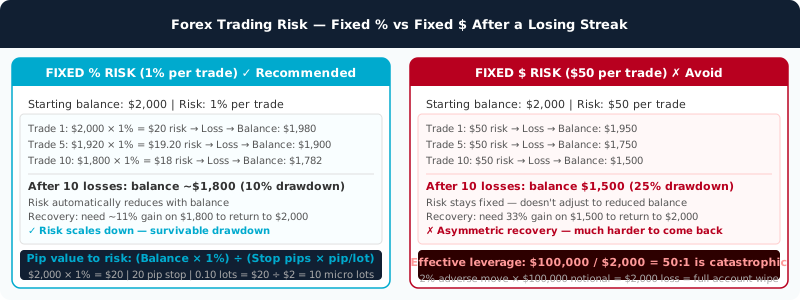
Tip 1: Risk a Fixed Percentage Per Trade, Not a Fixed Dollar Amount
Position size (lots) = (Account balance × risk%) ÷ (stop distance in pips × pip value per lot)
Why fixed percentage beats fixed dollar risk:
- Fixed 1% on $2,000: 10 losses = $200 = 10% drawdown, balance $1,800. Recovery: +11%
- Fixed $50 on $2,000: 10 losses = $500 = 25% drawdown, balance $1,500. Recovery: +33%
Fixed dollar risk creates asymmetric recovery problems that compound during losing streaks. Fixed percentage risk automatically scales down with your drawdown — you cannot blow a losing streak into a catastrophic loss.
Tip 2: Know Your Pip Value Before You Enter
| Lot size | Units | Pip value (EUR/USD) | 30 pip stop = risk |
|---|---|---|---|
| Micro (0.01) | 1,000 | $0.10/pip | $3.00 |
| Mini (0.1) | 10,000 | $1.00/pip | $30.00 |
| Standard (1.0) | 100,000 | $10.00/pip | $300.00 |
Calculate the dollar value of your stop before placing the order — not after. Know this number every time. See: How to Calculate Pips
Tip 3: Set the Stop Loss Before Entering, Not After
Decide exactly where your trade idea is invalidated before entering. Place the stop loss with the entry order. If you enter without a pre-set stop, you have no exit plan when the trade goes against you — and it will, eventually. Most blown accounts trace to one or two trades held through large losses while the trader waited for price to “come back.”
A stop loss is not pessimism. It is a pre-committed maximum acceptable loss. Place it at a level where your trade thesis is wrong — not an arbitrary distance from entry.
Tip 4: Check the Economic Calendar Before Every Session
High-impact news events (NFP, CPI, central bank rate decisions, GDP) create brief but extreme conditions: spreads widen 5×–20×, stops gap past their levels, price can move 50–200 pips in seconds. For a new trader this is not opportunity — it is a random coin flip at 10× normal transaction costs.
Rule: Do not open new trades within 30 minutes before a red-flag event. Check the calendar before opening your charting platform each session. Free calendars: Investing.com, ForexFactory, Trading Economics.
Tip 5: Keep Effective Leverage Below 10:1
Effective leverage = total position notional value ÷ account equity
- $2,000 account, one standard lot EUR/USD ($100,000 notional) = 50:1 effective leverage
- A 2% adverse move on $100,000 = $2,000 loss = account fully wiped
- Professional hedge funds typically run 3:1–15:1 effective leverage
- A retail trader at 50:1 effective leverage needs near-perfect timing to avoid catastrophic loss
Target: Keep effective leverage under 10:1 while developing. Under 5:1 is safer still.
Tip 6: Trade One or Two Pairs Until You Know Them Well
Every pair has a personality: EUR/USD is usually smooth and liquid with clear ranges. GBP/USD is choppier and more volatile. USD/JPY reacts strongly to risk sentiment and Bank of Japan policy. Exotic pairs gap unpredictably around local news events.
Learning one pair well — its typical daily range, how it responds to news, its behaviour at key technical levels — is more valuable than spreading attention across 10 pairs you don’t understand. Pick one pair, trade it on demo for at least a month, then add a second.
Tip 7: Keep a Trade Journal and Actually Read It
Log every trade: date, pair, direction, entry, exit, stop, target, planned RR, actual result, and — critically — whether all entry criteria were met. Then review weekly.
Most traders who review their journal for the first time discover a specific, avoidable pattern:
- “My biggest losses all came from trades where I skipped one of my entry criteria.”
- “I close winning trades 60% of the way to target but let losing trades run to stop — this turns a 1.5:1 RR strategy into effectively 0.9:1.”
You cannot see these patterns in your head. You need the data.
Tip 8: Do Not Trade to Recover Losses
After a loss, the impulse is to get back to breakeven quickly. This creates revenge trading: larger-than-normal positions, trades with incomplete criteria, staying in the market out of emotional need rather than clear setups. This is how single bad sessions become 10% drawdowns.
Rule: When you lose the equivalent of two standard trades in one day, stop trading for the day. This limits bad session damage to a manageable drawdown and physically removes the ability to revenge trade by removing access to more trades.
Tip 9: Demo Trade New Strategies for at Least 50 Trades
A strategy needs statistical validity. Two profitable demo weeks is not statistical validity — it is luck over a small sample. Fifty to one hundred completed trades gives enough data to estimate win rate, average win, average loss, and expectancy.
Expectancy = (Win rate × average win) − (Loss rate × average loss)
- Positive expectancy → strategy has theoretical edge over many trades
- Negative expectancy → strategy will lose money over enough trades, regardless of short-term results
Example: 40% win rate, 2:1 RR → (0.40 × 2) − (0.60 × 1) = +0.20 per trade (positive)
Tip 10: Understand That Most New Traders Lose — and Why
ESMA requires EU brokers to publish the percentage of retail clients who lose money. The range is typically 65–80%. This is not because forex is rigged — it is because most new traders enter with insufficient preparation, use excessive leverage, and have no tested strategy with defined risk rules.
The best edge a retail trader can build early is capital preservation. A trader who survives their first year without a major blowout has learned the market while keeping capital intact. That is when strategy refinement becomes meaningful.
Frequently Asked Questions
Related Forex Basics Guides
Build confidence with a free FXGlory demo account. Test forex strategies, learn platform tools, and practice risk management without using real funds.
Open a Free Demo Account