
Forex Trading Plan Template
A trading plan is a written set of rules that defines exactly how, when, and why you trade. It covers your strategy, risk limits, entry and exit criteria, the pairs you trade, session times, and how you review performance. Without one, most decisions under live market pressure become reactive — driven by emotion rather than pre-defined logic.
This page provides a complete 7-section template with example content for each section. Copy it, modify it for your approach, and write it down before you trade real capital.
Key Takeaways
- A trading plan defines your entry rules, exit rules, and maximum risk per trade.
- The 1% rule limits each trade loss to 1% of total account equity.
- Without a plan, traders tend to overtrade, revenge-trade, and ignore risk limits.
- Review and update your plan regularly as your skills and account size grow.
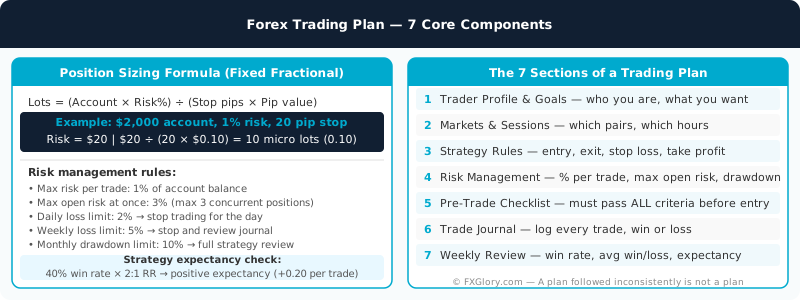
Section 1: Trader Profile and Goals
Define who you are as a trader and what you are trying to achieve. This prevents goal misalignment — a day trader with 30 minutes per day has fundamentally different needs than a swing trader who checks charts twice a day.
Section 2: Markets and Sessions
Define exactly which pairs you trade and when. Fewer pairs traded well beats many pairs traded poorly.
Section 3: Strategy Rules
Write down your specific strategy in enough detail that you could hand it to another person and they would execute trades the same way you would. Vague strategy rules (“buy when it looks like it’s going up”) are not rules.
Entry criteria — ALL must be met:
- Price is above (long) or below (short) the 50-period EMA (direction filter)
- RSI was below 40 (for long) or above 60 (for short) within the last 3 candles
- A clear structure level (support for long, resistance for short) is within 15 pips of entry
- No major news event within the next 4 hours (check economic calendar)
Stop loss: 5–10 pips beyond the structure level that triggered entry. Never moved further away from entry.
Take profit: Next significant structure level on the 4H chart. Minimum R:R before entry: 1.5:1.
Trade management: Once trade reaches 1:1 (profit = stop size), move stop to breakeven. Do not add to positions mid-trade.
Section 4: Risk Management Rules
This section is non-negotiable. Risk rules protect your capital when strategy rules fail.
Position sizing formula:
Lot size = (Account balance × Risk%) ÷ (Stop distance in pips × Pip value per lot)
Worked example: Account = $2,000 | Risk = 1% = $20 | Stop = 20 pips | Micro lot pip value = $0.10
- Risk per pip = $20 ÷ 20 pips = $1.00 per pip
- Micro lots needed = $1.00 ÷ $0.10 = 10 micro lots = 0.10 standard lots
Strategy expectancy check: 40% win rate × 2:1 RR → (0.40 × 2) − (0.60 × 1) = +0.20 per trade (positive)
Negative example: 30% win rate × 1:1 RR → (0.30 × 1) − (0.70 × 1) = −0.40 per trade (losing)
| Risk Rule | Example setting | On $2,000 account |
|---|---|---|
| Max risk per trade | 1% of account balance | $20 maximum |
| Max open risk at once | 3% (max 3 simultaneous positions) | $60 total |
| Daily loss limit | 2% — stop trading for the day | $40 |
| Weekly loss limit | 5% — stop until Monday; review journal | $100 |
| Monthly drawdown limit | 10% — full strategy review before resuming | $200 |
| Effective leverage target | 3:1–5:1 (never exceed 10:1) | Controlled via lot sizing |
Section 5: Pre-Trade Checklist
Before entering any trade, check each item. If any item fails, do not enter.
- ☐ All entry criteria are met (per strategy rules in Section 3)
- ☐ Risk:reward at entry is at least 1.5:1
- ☐ Position size calculated correctly for 1% risk
- ☐ Stop loss placed before entry (not after)
- ☐ No scheduled major news in the next 4 hours
- ☐ Daily loss limit not already hit today
- ☐ Not trading out of boredom, FOMO, or to recover a prior loss
Section 6: Trade Journal Format
A journal is the only way to identify whether your strategy is performing as expected or whether your execution is causing the problem. Log every trade — wins and losses.
Review your journal weekly. Look for patterns: Are most losses from trades where not all criteria were met? Do you exit winning trades too early? Does a particular pair or session underperform? The journal reveals these patterns — a mental log does not.
Section 7: Weekly Review Routine
Every Sunday or Monday before markets open:
- Review all trades from the prior week — did each trade follow the plan?
- Calculate win rate, average win, average loss, and expectancy for the period
- Identify the biggest execution mistake of the week and note how to avoid it
- Note upcoming high-impact events for the week (check economic calendar)
- Identify key levels on primary pairs that may become trade setups
- Confirm account drawdown is within acceptable range
Frequently Asked Questions
Related Forex Basics Guides
Build confidence with a free FXGlory demo account. Test forex strategies, learn platform tools, and practice risk management without using real funds.
Open a Free Demo Account