Forex Market Participants: Who Moves Currency Prices?
The forex market has no central exchange. It is a decentralised, over-the-counter (OTC) network where different types of participants transact with each other — each with different objectives, different trade sizes, and different levels of market influence. Understanding who these participants are explains why currency prices move the way they do.
Key Takeaways
- Central banks are the most powerful participants — they set interest rates and intervene.
- Commercial banks act as market makers and handle most of the daily trading volume.
- Retail traders make up a small fraction of total forex volume globally.
- Each participant type trades for different reasons: hedging, speculation, or conversion.
The Forex Market Hierarchy
Forex operates in a tiered structure. The largest participants transact directly with each other at the most competitive prices (the “interbank market”). Smaller participants access the market through intermediaries at slightly wider spreads.
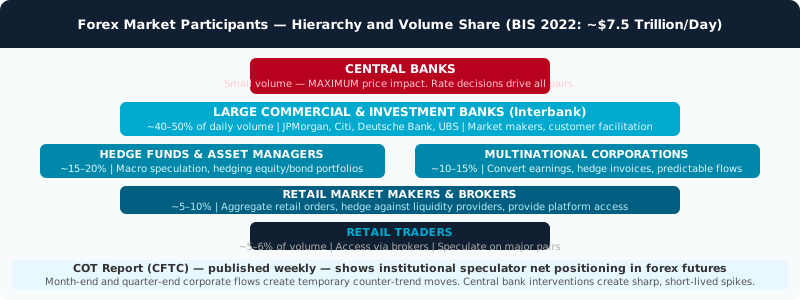
| Tier | Participant | ~Share of daily volume | Primary purpose |
|---|---|---|---|
| 1st | Central banks | Small — high impact | Monetary policy, direct currency intervention |
| 2nd | Large commercial & investment banks | ~40–50% | Market making, customer facilitation, proprietary trading |
| 3rd | Hedge funds & asset managers | ~15–20% | Macro speculation, portfolio hedging |
| 3rd | Multinational corporations | ~10–15% | Hedging business currency exposure |
| 4th | Retail market makers & brokers | ~5–10% | Aggregating and hedging retail client flow |
| 5th | Retail traders | ~5–6% | Speculation on major and minor pairs |
The BIS Triennial Central Bank Survey (2022) reported average daily forex turnover of approximately $7.5 trillion. Retail traders represent a small fraction of this — but the infrastructure (24/5 access, tight spreads on majors, micro lots) has been built specifically to serve them at scale.
Central Banks
Central banks (the Federal Reserve, European Central Bank, Bank of England, Bank of Japan, etc.) are the most powerful forex participants, though they transact infrequently relative to commercial banks.
Commercial and Investment Banks
Large banks (JPMorgan, Deutsche Bank, Citi, UBS, Barclays, HSBC) form the interbank market — the core of forex trading. They serve multiple roles simultaneously:
- Market makers: Banks continuously quote bid/ask prices. The spread between bid and ask is a source of dealing desk revenue.
- Customer facilitation: When a corporate client needs to convert €100 million for an acquisition, the bank executes that order, hedges its resulting exposure in the interbank market, and charges a spread.
- Proprietary trading: Banks trade their own capital for profit — though this has decreased since the Volcker Rule (US) restricted proprietary trading by deposit-taking banks.
Hedge Funds and Asset Managers
Large macro hedge funds (Bridgewater, Millennium, Man Group) trade currencies based on macroeconomic views — interest rate differentials, central bank policy expectations, current account balances. These trades are very large and contribute to sustained directional moves that retail traders observe as extended trends.
Asset managers (pension funds, sovereign wealth funds) trade forex primarily to hedge international equity and bond holdings. A US pension fund holding European equities is exposed to EUR/USD movement and may sell EUR/USD futures to neutralise that exposure without selling the underlying shares.
The CFTC Commitment of Traders (COT) report is published every Friday and shows the net positioning of institutional speculators in forex futures contracts as of the previous Tuesday. Key use:
- When institutional speculators are at historical extreme net long positions, the market is often “crowded long” — a reversal becomes increasingly likely as there are few new buyers left
- When at extreme net short, similarly — every institutional seller is already short, so the next move is more likely to be a short squeeze
- 3-day lag limits precise timing, but extremes in positioning provide useful trend-vs-reversal context
Multinational Corporations
A US company that sells products in Europe earns euros but reports in US dollars. When it converts those euros back to USD, it is a forex market participant. Similarly, a European company paying US dollar invoices for oil or commodities regularly buys USD by selling EUR.
Corporate forex flows tend to be predictable (monthly, quarterly settlements) and are often hedged in advance using forwards or options. Month-end and quarter-end often see unusual flows as multinationals convert earnings — creating temporary counter-trend moves before month open that experienced traders factor into their analysis.
Retail Traders
Retail traders are the smallest category by volume — yet the fastest-growing segment since 2000. The proliferation of online brokers, low minimum deposits, and mobile trading platforms has expanded retail participation significantly.
Why This Matters for Your Trading
- News trading: Central bank decisions and forward guidance are the highest-impact events. They temporarily override all technical analysis.
- Understanding large moves: Not every move has a retail-visible cause. Large institutional orders executing over time create sustained directional moves that look like breakouts from a retail chart perspective.
- Corporate flow awareness: Month-end and quarter-end often produce unusual counter-trend moves as multinationals convert earnings before the period close.
- COT data context: When institutional speculators reach historically extreme net positions, trend exhaustion becomes more likely — a useful macro filter for trend-following strategies.
Frequently Asked Questions
Related Forex Basics Guides
Build confidence with a free FXGlory demo account. Test forex strategies, learn platform tools, and practice risk management without using real funds.
Open a Free Demo Account