Forex Basics

Forex Futures Trading Explained

A forex futures contract is a standardized agreement to buy or sell a specific amount of a currency at a fixed price on a set future date. Unlike spot forex — which settles in two business days and trades over-the-counter — forex futures are exchange-traded instruments with fixed contract sizes, quarterly expiry dates, and central clearing through the CME Group.

Most retail traders use spot forex or CFDs rather than futures. Understanding the difference helps you choose the right instrument and interpret futures pricing data used by institutional traders.

Key Takeaways

  • Currency futures are standardised exchange-traded contracts with fixed expiry dates.
  • Unlike spot forex, futures trade on regulated exchanges such as the CME.
  • Futures pricing includes a cost-of-carry component that differs from spot prices.
  • Retail traders mostly use spot or CFD forex; futures suit institutional hedgers.

Spot Forex vs Forex Futures — Key Differences

Feature
Spot Forex
Forex Futures
Where traded
OTC — via retail brokers
Exchange (CME, ICE, Eurex)
Settlement
T+2 (rolled via swap continuously)
Quarterly expiry (Mar/Jun/Sep/Dec)
Contract size
Flexible (lots, mini, micro)
Fixed (e.g. 125,000 EUR per 6E contract)
Expiry
No expiry — continuous
Set date — must roll or close before delivery
Counterparty
Your retail broker
CME Clearing (central clearinghouse)
Overnight cost
Swap charged/credited daily
Built into futures price (no daily deduction)
COT data
Not available
CFTC publishes weekly institutional positioning

How the CME EUR/USD Futures Contract (6E) Works
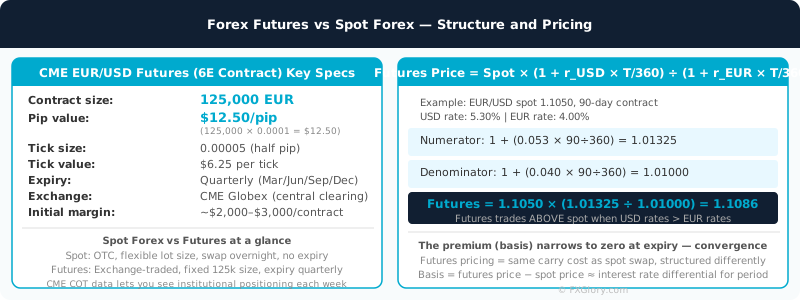
Forex futures diagram showing CME 6E contract specs with 125,000 EUR size and $12.50 pip value, plus the futures pricing formula versus spot
Left: Key CME 6E (EUR/USD futures) contract specifications. Right: Futures price calculation using interest rate parity — when USD rates exceed EUR rates, futures trade above spot. The premium (basis) converges to zero at expiry.
CME 6E (EUR/USD Futures) Contract Specifications
  • Contract size: 125,000 EUR
  • Tick size: 0.00005 (half a pip) = $6.25 per tick
  • Pip value: 125,000 × 0.0001 = $12.50/pip
  • Initial margin (approx): $2,000–$3,000 per contract (set by CME, varies with volatility)
  • Expiry: Third Wednesday of Mar/Jun/Sep/Dec
  • Trading hours: CME Globex, Sunday 17:00 – Friday 16:00 CT (nearly 24/5)
  • Settlement: Physical delivery of EUR on expiry date (most speculators roll before delivery)

Micro EUR/USD futures (M6E): 1/10th the size (12,500 EUR), pip value = $1.25 — more accessible for smaller accounts.

Why Futures Price Differs from Spot Price

Forex futures and spot forex prices are closely linked through interest rate parity. The futures price reflects the spot rate adjusted for the interest rate differential between the two currencies over the period until expiry.

Futures price = Spot × (1 + rUSD × T/360) ÷ (1 + rEUR × T/360)

Example: EUR/USD spot = 1.1050, USD 90-day rate = 5.30%, EUR 90-day rate = 4.00%

  • Numerator: 1 + (0.053 × 90÷360) = 1.01325
  • Denominator: 1 + (0.040 × 90÷360) = 1.01000
  • Futures price = 1.1050 × 1.01325 ÷ 1.01000 = approximately 1.1086

When USD rates exceed EUR rates, the futures contract trades above spot. The basis (futures − spot) converges to zero on the expiry date. This carry cost is mathematically equivalent to the daily swap in spot forex, structured differently.

Rolling a Futures Contract

Since futures expire quarterly, traders wanting continuous exposure must “roll” positions — closing the expiring contract and reopening in the next quarter’s contract. This happens most actively in the week before expiry (the “roll period”).

The cost of rolling reflects the interest rate differential for the additional period — functionally equivalent to the swap cost paid in spot forex. A trader who holds EUR/USD spot for 90 days pays the same carry cost as a futures trader rolling one quarterly contract.

Who Uses Forex Futures?

Corporations
Hedge currency exposure — lock in exchange rates for future receivables or payables
Institutional speculators
Price transparency, exchange clearing, COT positioning data for analysis
Arbitrageurs
Trade when futures price diverges from theoretical spot + interest rate fair value
Retail traders
Less common — large fixed contract size ($140k+ notional for 6E) is impractical for most retail accounts

Pros and Cons for Retail Traders

Advantages
Disadvantages
  • Exchange transparency — single central price, no broker markup variation
  • CME Clearing as counterparty — no broker credit risk
  • COT data — weekly CFTC report shows institutional positioning
  • No daily swap deduction — carry cost in price, not account balance
  • Large fixed contract size — 6E is 125,000 EUR (~$140k+ notional)
  • Exchange and clearing fees per contract, on top of broker commission
  • Must roll contracts before quarterly expiry — adds complexity
  • Limited pairs — active futures markets exist mainly for major pairs
Note for retail traders: Spot forex or CFDs remain more practical for most retail traders due to flexible micro/mini lot sizing, no roll management, and lower per-trade costs at small sizes. Forex futures become more relevant as account size grows and institutional-quality execution, clearing, and data access become priorities.

Frequently Asked Questions

Yes. CME Globex is accessible through regulated futures commission merchants (FCMs) and brokers such as Interactive Brokers or TradeStation. You need initial margin (~$2,000–$3,000 per 6E contract) plus maintenance margin. Micro EUR/USD futures (M6E, 12,500 EUR per contract) are more accessible for smaller accounts.
Neither is universally better — they suit different needs. For small retail accounts: spot forex or CFDs with flexible lot sizes are more practical. For institutional traders or those wanting exchange transparency, central clearing, and COT data: futures have real advantages. The carry cost is approximately equivalent once pricing is accounted for.
The basis is the difference between the futures price and the spot price. Under normal conditions it equals approximately the expected interest rate differential for the remaining contract period (T/360). The basis converges to zero at expiry — futures and spot prices meet on the delivery date.

Build confidence with a free FXGlory demo account. Test forex strategies, learn platform tools, and practice risk management without using real funds.

Open a Free Demo Account