Can You Trade Forex Without Leverage?
Yes — you can trade forex with 1:1 leverage, meaning your deposit equals the full value of the position you open. No rule requires leverage in forex. However, the capital requirements and return profile change dramatically when leverage is removed. This page explains what unleveraged forex trading looks like in practice, the math behind it, and who it actually suits.
Key Takeaways
- Trading without leverage means your position size equals your account balance.
- No leverage eliminates margin calls and makes losses proportional to capital.
- Unlevered forex is safer but requires much larger capital for meaningful returns.
- Some traders use 1:1 leverage as a discipline tool while learning the market.
What 1:1 Leverage (No Leverage) Means in Forex
At 1:1 leverage, the margin required to open a position equals 100% of the position’s notional value. You are not borrowing any capital — you are committing the full trade value from your own funds.
- Position size: 0.01 lot = 1,000 units
- Notional value: 1,000 × 1.1050 = $1,105
- Margin required at 1:1 (no leverage): $1,105 (100% of notional)
- Margin required at 1:100: $11.05 (1% of notional)
- Pip value in both cases: $0.10/pip — identical
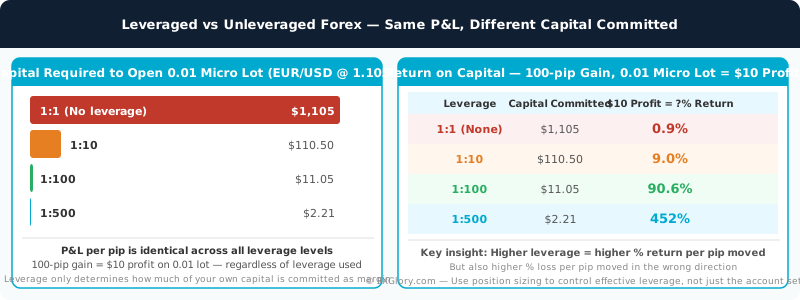
To open the same micro lot position, unleveraged trading requires $1,105 while leveraged trading at 1:100 requires $11.05. The pip value and P&L are exactly the same either way.
Capital Requirements by Lot Size at 1:1
| Lot size | Units (EUR/USD) | Notional value @ 1.1050 | Margin at 1:1 | Pip value |
|---|---|---|---|---|
| Micro (0.01) | 1,000 | $1,105 | $1,105 | $0.10/pip |
| Mini (0.10) | 10,000 | $11,050 | $11,050 | $1.00/pip |
| Standard (1.00) | 100,000 | $110,500 | $110,500 | $10.00/pip |
Unleveraged standard lot trading requires over $110,000 to open a single position. This is why unleveraged forex is primarily used by institutions and high-net-worth traders — retail account sizes make it impractical at any meaningful lot size.
Return Profile: Leveraged vs Unleveraged
The key difference between leveraged and unleveraged trading is the return percentage relative to capital committed — not the absolute P&L per pip.
Return on capital = (Profit in $) ÷ (Capital committed) × 100
100-pip gain on 0.01 micro lot = $10 profit in all cases:
- At 1:1 (capital committed $1,105): $10 ÷ $1,105 × 100 = 0.9%
- At 1:10 (capital committed $110.50): $10 ÷ $110.50 × 100 = 9.0%
- At 1:100 (capital committed $11.05): $10 ÷ $11.05 × 100 = 90.6%
| Leverage | Capital committed (micro lot) | 100-pip gain | Return on capital |
|---|---|---|---|
| 1:1 (none) | $1,105 | $10.00 | 0.9% |
| 1:10 | $110.50 | $10.00 | 9.0% |
| 1:100 | $11.05 | $10.00 | 90.6% |
For unleveraged forex to generate meaningful returns, EUR/USD would need to move thousands of pips — and you would need very large capital at full notional value. In a year where EUR/USD moves 1,000 pips net, a fully unleveraged position on $1,000,000 yields approximately $100,000 — about 10%. Comparable to other long-term asset classes, but requiring enormous capital.
How to Set Leverage to 1:1
Most retail forex brokers allow you to choose your account leverage:
- Log in to your client portal or contact your broker’s support team
- Navigate to account settings → leverage settings
- Set leverage to 1:1
- At 1:1, available margin limits the maximum position size to your full deposit at notional value
Alternatively, you can achieve the same effective risk profile with higher nominal leverage by sizing positions very small. A 1:500 leverage account with positions sized at 0.2% of account value behaves identically to 1:1 leverage in practice. The nominal leverage ceiling is rarely the limiting factor for disciplined traders.
Pros and Cons of Unleveraged Forex
- No margin call risk — position only closes if notional value goes to zero (essentially impossible for major pairs)
- Unlimited theoretical holding period without liquidation risk from margin
- No leverage calculations required — position size equals capital committed
- Reduced emotional pressure — amplified losses are eliminated
- Large capital required — micro lot at 1:1 needs $1,105; standard lot needs $110,500
- Low % returns — 1,000-pip move ≈ 9–10% return on full capital
- Opportunity cost — capital locked in one position cannot be deployed elsewhere
- Swap still applies to all overnight positions regardless of leverage setting
Who Should Consider Unleveraged Forex?
- Institutions and corporations hedging real currency exposure — they hold the underlying currency anyway
- Long-term investors with large capital who want modest currency exposure similar to unleveraged stocks
- Traders who have repeatedly blown accounts and want to force capital discipline while developing their strategy
- Risk-averse traders who want forex exposure but cannot tolerate the amplified volatility of standard leverage
For the vast majority of retail traders: using leverage responsibly — effective leverage 3:1 to 10:1 through conservative position sizing — is more practical than 1:1 leverage. The goal is not to avoid leverage entirely; it is to use it conservatively.
Frequently Asked Questions
Related Forex Basics Guides
Build confidence with a free FXGlory demo account. Test forex strategies, learn platform tools, and practice risk management without using real funds.
Open a Free Demo Account