Bid and Ask Price in Forex
Every forex quote shows two prices simultaneously: the bid and the ask. You sell at the bid and buy at the ask. The difference between them — the spread — is the cost of entering any trade. This page explains exactly how bid/ask pricing works, what determines the spread size, and how to factor it into your P&L calculations.
Key Takeaways
- The bid is the price brokers buy from you; the ask is the price they sell to you.
- The spread is the ask minus the bid, measured in pips.
- You pay the spread on every trade entry — it is the immediate cost of trading.
- Tighter spreads on major pairs like EUR/USD mean lower entry costs per trade.
Bid Price and Ask Price Defined
Bid price: The price the market (your broker) will buy the base currency from you. You sell at this price. It is always the lower of the two prices.
Ask price (offer price): The price the market will sell the base currency to you. You buy at this price. It is always the higher of the two prices.
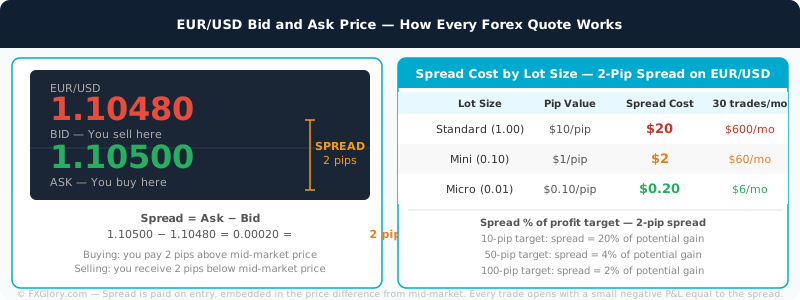
- Click BUY → you enter at 1.10500 (the ask)
- Click SELL → you enter at 1.10480 (the bid)
- Spread = 1.10500 − 1.10480 = 0.00020 = 2 pips
Rule: Bid is always below ask. If you buy at the ask and immediately sell at the bid, you lose the spread. This is why every new trade opens with a small negative P&L equal to the spread cost.
How Spread Becomes the Cost of a Trade
When you open a buy trade at the ask price, your position is immediately valued at the bid price for exit purposes. The difference is your unrealised cost.
Entry cost = Spread in pips × Pip value per lot × Number of lots
EUR/USD: Bid 1.10480 / Ask 1.10500 — you buy 0.10 mini lot at 1.10500 (ask):
- Immediately after entry, the bid is 1.10480 — your exit price
- Instant floating loss = 2 pips × $1.00/pip = $2.00
- Price must rise at least 2 pips to 1.10520 before you break even on exit
The spread is not a separate charge on your account statement — it is embedded in the price you transact at. You never “see” it as a line item, which is why traders sometimes underestimate its cumulative impact over many trades.
Spread Cost by Lot Size
| Lot size | Pip value (EUR/USD) | 2-pip spread cost | 3-pip spread cost |
|---|---|---|---|
| Standard (1.00) | $10.00/pip | $20.00 | $30.00 |
| Mini (0.10) | $1.00/pip | $2.00 | $3.00 |
| Micro (0.01) | $0.10/pip | $0.20 | $0.30 |
The practical point: a 2-pip spread on a mini lot = $2 cost per trade regardless of whether you hold for 1 minute or 1 month. This $2 must be exceeded by your P&L for the trade to be profitable.
Cumulative Spread Cost and Overtrading
Spread costs accumulate with every trade. Consider 30 trades per month on EUR/USD with mini lots (0.10) and a 2-pip spread:
- 30 trades × $2.00 spread = $60.00/month in spread costs
- On a $2,000 account: that is 3% of account per month in costs before any P&L
- Your strategy must generate 3% monthly just to break even on trading costs
A swing trader executing 5 trades/month on the same account: 5 × $2 = $10/month — one-sixth the cost. More trades ≠ more profit. More trades = more spread cost that must be overcome.
Fixed vs Variable Spreads
Fixed spread: The spread stays constant regardless of market conditions. Common with dealing desk (market maker) brokers. Predictable cost, but usually wider than the best variable spreads during normal conditions.
Variable (floating) spread: The spread changes with market conditions — tighter during high-liquidity periods, wider during low-liquidity or high-volatility events. Common with ECN/STP brokers. Can be very tight (0.1–0.3 pips on EUR/USD during London/NY sessions) but widens significantly at news events or overnight.
When Spreads Widen — Times to Avoid Trading
| Situation | Typical spread impact | Why it happens |
|---|---|---|
| Major economic news (NFP, CPI, rate decisions) | Can widen 5×–30× momentarily | Liquidity providers pull orders; uncertainty spikes |
| Asian session (midnight–7am UK time) | 1.5×–3× wider on EUR/USD | Lower interbank volume reduces liquidity |
| Market open Sunday evening | Temporarily wide until liquidity builds | Weekend gap; thin market at open |
| End-of-day NY close (5 PM NY) | Slightly wider around rollover | Settlement and rollover processing |
Spread as a Percentage of Your Target
The spread should always be considered relative to your profit target distance:
| Trade target (pips) | Spread (pips) | Spread as % of target | Verdict |
|---|---|---|---|
| 10 pips | 2 | 20% | Very high cost ratio — needs ultra-tight spread to work |
| 20 pips | 2 | 10% | Manageable but tight for scalping |
| 50 pips | 2 | 4% | Acceptable for intraday swing trades |
| 100 pips | 2 | 2% | Low spread impact for swing/position trades |
A 10-pip scalp with a 2-pip spread: price must move 12 pips to produce 10 pips of net profit. This is why scalping requires ECN accounts with 0.1–0.5 pip spreads and a commission — regular retail spreads make very short-term scalping mathematically very difficult.
Frequently Asked Questions
Related Forex Basics Guides
Build confidence with a free FXGlory demo account. Test forex strategies, learn platform tools, and practice risk management without using real funds.
Open a Free Demo Account