
Can You Really Make Money Trading Forex?
The honest answer is yes — but most retail traders lose money. This guide does not tell you what you want to hear. It gives you the verified statistics, explains the math that separates profitable traders from losing ones, and shows what consistent profitability actually requires.
Key Takeaways
- Most retail forex traders lose money — fewer than 30% are consistently profitable.
- Consistent profitability requires a positive expectancy strategy and strict risk rules.
- Account size, discipline, and experience matter more than leverage.
- Treating forex as a business, not a lottery, is what separates the minority who profit.
What the Statistics Actually Say
Retail brokers regulated in the EU and UK are required by law to disclose the percentage of their retail clients who lose money. These disclosures consistently show that 65–80% of retail forex accounts lose money. The range is consistent across hundreds of brokers over many years.
This does not mean forex is a scam or rigged. It means trading is a skill — and most beginners attempt it without sufficient preparation, capital, or realistic expectations.
The 20–35% who do not lose money are not smarter or luckier. They typically:
- Risk a fixed, small percentage of capital per trade (1–2%)
- Follow consistent, rules-based strategies they have tested
- Do not overtrade or chase losses
- Have a written trading plan they follow without deviation
- Have experienced multiple losing periods without abandoning their system
Expected Value — The Math of Profitability
You do not need a win rate above 50% to be profitable. You need a positive expected value (EV) — your average winner must be large enough relative to your average loser that the math works in your favour over many trades.
Expected Value (EV) = (Win Rate × Avg Win) − (Loss Rate × Avg Loss)
Three examples using a $30 risk / $60 target (1:2 risk/reward):
| Win Rate | Avg Win | Avg Loss | EV per Trade | Verdict |
|---|---|---|---|---|
| 50% | $60 | $30 | (0.5×$60) − (0.5×$30) = +$15 | ✓ Profitable |
| 40% | $60 | $30 | (0.4×$60) − (0.6×$30) = +$6 | ✓ Profitable |
| 35% | $60 | $30 | (0.35×$60) − (0.65×$30) = +$1.50 | ✓ Barely profitable |
The same win rates with 1:1 risk/reward ($30 risk / $30 target):
| Win Rate | EV per Trade | Verdict |
|---|---|---|
| 50% | (0.5×$30) − (0.5×$30) = $0 | Break even (minus spread costs → losing) |
| 40% | (0.4×$30) − (0.6×$30) = −$6 | ✗ Losing |
| 60% | (0.6×$30) − (0.4×$30) = +$6 | ✓ Profitable |
A 40% win rate with 1:2 RR (+$6/trade) outperforms a 60% win rate with 1:1 RR (+$6/trade) — and far outperforms a 50% win rate with 1:1 RR ($0/trade). Risk/reward ratio is as important as win rate.
Break-Even Win Rate by Risk/Reward Ratio
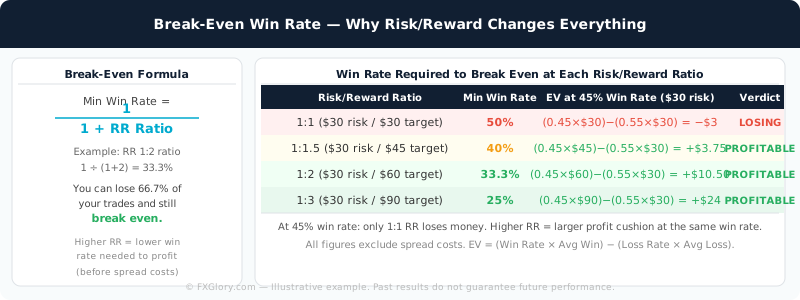
The break-even win rate is the minimum win rate required to avoid losing money at a given risk/reward ratio. Below this rate, you will lose over time regardless of other factors.
Break-Even Win Rate = 1 ÷ (1 + RR Ratio)
Example: 1:2 RR → 1 ÷ (1+2) = 33.3%. You need to win at least 33.3% of trades to break even.
What Realistic Returns Look Like
Most beginners set unrealistic targets — “I want to make $1,000/month from $500.” The math makes this impossible without catastrophic risk. Here is what reasonable performance looks like on a $5,000 account:
- Risk per trade: 1% of $5,000 = $50 max loss
- Risk/reward: 1:2 → avg win = $100
- 20 trades/month, 45% win rate
- Wins: 9 trades × $100 = $900
- Losses: 11 trades × $50 = $550
- Monthly profit: $900 − $550 = $350 (+7% monthly)
7% monthly sounds achievable — but maintaining a 45% win rate, 1:2 RR, and 20 trades per month consistently requires genuine skill. In practice, months with 10–15% drawdowns are normal even for profitable traders.
Professional hedge fund performance is typically 10–30% per year — not per month. Any strategy promising consistent monthly returns of 20–50% is either a scam or relying on unsustainable risk levels. The income math is equally important:
| Target Monthly Income | Assumed Monthly Return | Required Trading Capital |
|---|---|---|
| $500/month | 5% | $10,000 |
| $1,000/month | 5% | $20,000 |
| $3,000/month | 5% | $60,000 |
| $5,000/month | 5% | $100,000 |
Formula: Required Capital = Monthly Target ÷ Monthly Return. Example: $3,000 ÷ 5% = $60,000. These are illustrative only — actual returns are variable and never guaranteed.
Why Most Traders Lose
| Cause | What It Means | Consequence |
|---|---|---|
| Overtrading | Taking trades without clear setups | Each negative-EV trade accelerates account erosion |
| No stop-loss | Holding losing trades hoping for recovery | Unlimited downside — one bad trade can destroy the account |
| Risk too large | Risking 10–20% per trade | At 20% risk, four consecutive losses remove 59% of account: 1 − (0.80)⁴ = 59% |
| Revenge trading | Increasing size after losses | Compounds losses rather than recovering them |
| Undercapitalised | Trading $100–200 expecting income | 1% risk = $1–2 per trade — meaningful returns are mathematically impossible |
| No edge | Trading on intuition or random signals | Random outcomes → EV ≤ 0 before spread costs |
What Separates Consistently Profitable Traders
- Fixed risk per trade — never more than 1–2% of account equity
- Defined strategy with a written edge — specific entry/exit rules, not discretionary guesses
- Risk/reward minimum of 1:1.5 or higher on every trade taken
- Trade journal maintained — every trade recorded and reviewed for patterns
- Demo trading first — months of practice before risking real capital
- Drawdown acceptance — treating losing streaks as part of the process, not failure
Frequently Asked Questions
Related Forex Basics Guides
Build confidence with a free FXGlory demo account. Test forex strategies, learn platform tools, and practice risk management without using real funds.
Open a Free Demo Account