Forex Basics

How to Read Forex Quotes

Every forex trade starts with a quote — two prices displayed for every currency pair. This page explains exactly what those numbers mean, what you pay to enter a trade, and how quotes relate to pips, spread, and P&L.

Key Takeaways

  • A forex quote always shows two currencies: the base and the quote currency.
  • The number in the quote tells you how much quote currency buys one base unit.
  • The bid is the sell price; the ask is the buy price you pay to enter.
  • EUR/USD at 1.1050 means one euro buys 1.1050 US dollars.

What a Forex Quote Looks Like

Open any forex platform and you will see something like this in the Market Watch:

PairBid (Sell)Ask (Buy)Spread
EUR/USD1.104801.105002.0 pips
GBP/USD1.267101.267302.0 pips
USD/JPY149.480149.5103.0 pips

Two prices are always shown. You never trade at a single mid-market price — the two-price structure is how forex brokers present every pair.

Base Currency and Quote Currency

A forex pair always has two components:

  • Base currency — the first currency in the pair (EUR in EUR/USD)
  • Quote currency (counter currency) — the second currency (USD in EUR/USD)

The exchange rate tells you how much of the quote currency one unit of the base currency costs:

  • EUR/USD = 1.1050 → 1 euro costs 1.1050 US dollars
  • USD/JPY = 149.50 → 1 US dollar costs 149.50 Japanese yen
  • GBP/CHF = 1.1320 → 1 British pound costs 1.1320 Swiss francs

Bid vs Ask — Which Price You Use

PriceWhat It RepresentsWhen You Use It
BidThe price the broker buys the base currency from youWhen you SELL the pair
AskThe price the broker sells the base currency to youWhen you BUY the pair

Simple rule: you buy at the Ask, you sell at the Bid. The broker always profits from the difference (the spread).

Trade entry example — EUR/USD Buy

EUR/USD quote: Bid 1.10480 / Ask 1.10500

  • You click BUY → you enter at 1.10500 (the ask)
  • The trade immediately shows a floating loss equal to the spread: (1.10500 − 1.10480) ÷ 0.0001 = 2 pips
  • Price must rise at least 2 pips above your entry just to break even
  • If you close immediately (without price moving), you sell at the bid: 1.10480 → loss of 2 pips

How to Calculate the Spread

Spread (pips) = (Ask − Bid) ÷ Pip Size

EUR/USD: (1.10500 − 1.10480) ÷ 0.0001 = 2 pips

USD/JPY: (149.510 − 149.480) ÷ 0.01 = 3 pips
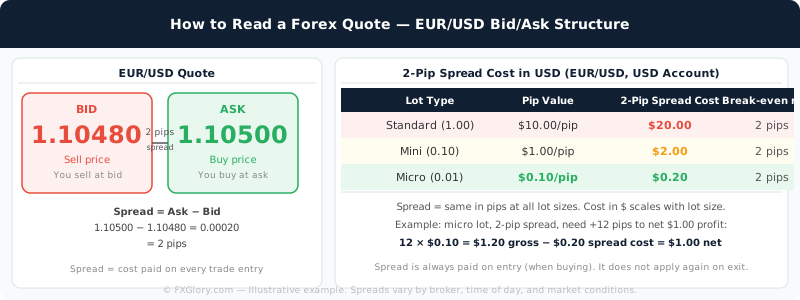
Forex bid ask quote diagram for EUR/USD showing bid 1.10480, ask 1.10500, 2-pip spread, and spread cost by lot size
EUR/USD quote: bid 1.10480 / ask 1.10500 = 2-pip spread. Spread cost in USD scales with lot size: $0.20 on micro lot, $2.00 on mini lot, $20.00 on standard lot.
Lot SizePip Value (EUR/USD USD acc.)2-Pip Spread CostPips Needed to Net $1.00 Profit
Standard (1.00)$10.00/pip$20.003 pips (3×$10=30; 30−20=$10 net, or 12 pips for exactly $100 net)
Mini (0.10)$1.00/pip$2.003 pips to net $1 (3×$1=3; 3−2=$1 net)
Micro (0.01)$0.10/pip$0.2012 pips: (12×$0.10)−(2×$0.10) = $1.20−$0.20 = $1.00 net

Calculating Pip Movement from Quotes

To convert a price movement into pips, divide by the pip size:

Pips = (Price at Close − Price at Open) ÷ Pip Size

EUR/USD moved from 1.1000 to 1.1085: (1.1085 − 1.1000) ÷ 0.0001 = 85 pips

USD/JPY moved from 149.20 to 150.50: (150.50 − 149.20) ÷ 0.01 = 130 pips

Cross Rates — Pairs Without USD

EUR/JPY, GBP/CHF, EUR/GBP are cross rates — pairs between two non-USD currencies. Their exchange rate is mathematically derived from two USD-based rates:

EUR/JPY ≈ EUR/USD × USD/JPY

Example: EUR/USD = 1.1050, USD/JPY = 149.50 → EUR/JPY ≈ 1.1050 × 149.50 = 165.20

Actual EUR/JPY quotes may differ slightly due to liquidity and timing, but they cannot deviate significantly — arbitrage would immediately correct any meaningful discrepancy.

How Quote Direction Affects Trade Direction

Pair TypeExampleWhen You BuyYou Profit When
USD as quote currencyEUR/USDBuy EUR, sell USDEUR strengthens (price rises)
USD as quote currencyGBP/USDBuy GBP, sell USDGBP strengthens (price rises)
USD as base currencyUSD/JPYBuy USD, sell JPYUSD strengthens (price rises)
USD as base currencyUSD/CHFBuy USD, sell CHFUSD strengthens (price rises)

Frequently Asked Questions

The 5th decimal (called a pipette or fractional pip) is one-tenth of a pip. When EUR/USD shows 1.10485, the “5” at the end is 0.5 pipettes. A spread of “5” in 5-decimal display equals 0.5 pips. The full pip remains at the 4th decimal place.
A tight (narrow) spread means the pair is highly liquid — EUR/USD typically shows 0.5–2 pip spreads during major sessions. A wide spread indicates lower liquidity: exotic pairs, overnight/weekend hours, or high-impact news events. Wide spreads increase entry cost and require larger price moves to profit.
Always buy at the ASK (the higher price) and sell at the BID (the lower price). The difference between them is the spread — your immediate transaction cost. Remember: Buy = Ask. Sell = Bid.
The quote price itself does not change because you are holding. However, a swap (rollover fee) is applied to your account at the daily rollover time (5 PM New York) — a debit or credit based on the interest rate differential between the two currencies. See: Forex Swap Explained

Build confidence with a free FXGlory demo account. Test forex strategies, learn platform tools, and practice risk management without using real funds.

Open a Free Demo Account