Forex Basics

Forex vs CFDs: What Is the Difference?

The terms "forex trading" and "CFD trading" are used interchangeably by many beginners — but they describe different things. Forex is a market. A CFD is a type of contract. Understanding the distinction matters because most retail traders are trading forex via CFDs without realising it, and the structural implications affect regulation, settlement, and counterparty risk.

Key Takeaways

  • Spot forex involves exchanging currencies; CFDs are contracts on price movements.
  • Forex CFDs do not deliver actual currency — profits and losses settle in cash.
  • Both products use leverage and are subject to overnight swap charges.
  • Most retail brokers offer forex via CFDs rather than true spot delivery.

What Is the Forex Market?

Forex (foreign exchange) is the global market for trading currencies — the largest financial market in the world, processing over $7 trillion in daily volume (BIS, 2022). Participants include central banks, commercial banks, multinational corporations, hedge funds, and retail traders.

The forex market is primarily over-the-counter (OTC) — there is no central exchange. Trades are executed directly between participants through a network of banks and brokers. In its purest form, a “spot forex” trade is an agreement to exchange one currency for another at the current rate, settled in two business days (T+2).

What Is a CFD?

A CFD (Contract for Difference) is a financial contract between a trader and a broker. The contract tracks the price of an underlying asset and settles the difference between the opening and closing price in cash. You never receive or deliver the underlying asset.

CFDs exist for a wide range of underlying assets: currency pairs, stock indices (S&P 500), individual equities (Apple), commodities (Gold, Crude Oil), and cryptocurrencies. CFDs are always leveraged instruments with cash settlement only.

How Retail Forex Trading Is Usually CFD Trading

When you open a “forex” account with a retail broker and trade EUR/USD on MT4 or MT5, you are almost certainly trading a forex CFD — not direct interbank spot forex.
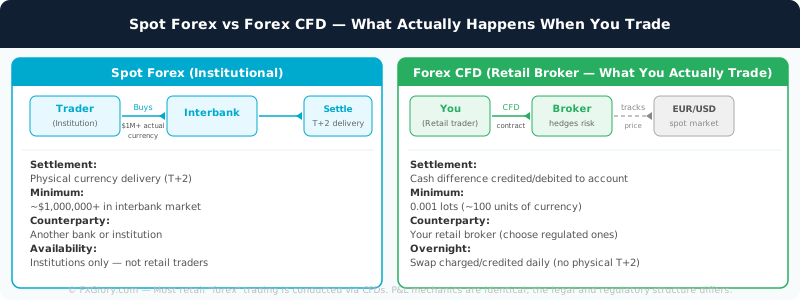
Spot forex vs forex CFD diagram showing institutional interbank trading with physical delivery versus retail CFD contract with cash settlement
Left: Institutional spot forex — physical T+2 delivery, $1M+ minimum. Right: Retail forex CFD — your broker is the counterparty, the underlying spot rate is tracked, and profit/loss is settled in cash. Retail traders access the market exclusively through CFDs.
What actually happens when you “buy EUR/USD” at a retail broker
  • Your broker creates a CFD contract tracking the EUR/USD exchange rate
  • Profit and loss are settled in your account currency (USD) as a cash difference
  • You never actually exchange euros for dollars
  • Positions are rolled over daily via swap — not physically settled T+2
  • Position size is defined in lots (contracts) — not actual currency held

The price you see tracks the real EUR/USD interbank market — but your trade is a CFD contract with your broker.

Spot Forex vs Forex CFD — Key Differences

Feature
Spot Forex (Institutional)
Forex CFD (Retail Broker)
Settlement
Physical T+2 currency delivery
Cash settlement — no delivery
Minimum size
~$1,000,000+ in interbank market
From 0.001 lots (~100 units)
Overnight cost
Actual interest rate differential
Broker’s swap rate (may include markup)
Counterparty
Another bank or institution
Your retail broker
Regulation
Varies by jurisdiction
CFD-specific retail regulation applies
Ownership
You hold actual currency (T+2)
You hold a contract — no currency held

Forex CFD vs Equity CFD

Feature
Forex CFD
Equity CFD
Market hours
24/5 (follows global forex sessions)
Restricted to exchange hours of the underlying
Expiry
No expiry — rolls continuously via swap
May have expiry dates (some brokers)
Dividends
No dividends apply
Dividend adjustments may apply to long positions
Typical daily range
Major pairs: 50–150 pips/day
Varies by stock; gapping on news is common

Why the Distinction Matters

Counterparty risk: When you trade a forex CFD with a retail broker, your broker is your counterparty. If the broker becomes insolvent, your open positions close and you become a creditor. This is why choosing regulated brokers with client fund segregation is critical — your deposits should be ring-fenced from the broker’s operational capital.

Regulatory note: CFDs are banned for retail investors in the United States and Canada. US traders must use CFTC-regulated Forex Dealer Members or CME futures contracts. If you are in the US and being offered forex CFDs, that is a regulatory compliance issue.

Price accuracy: Forex CFD prices track the underlying spot market closely but are technically the broker’s quoted price, which may include a small spread markup. Reputable STP/ECN brokers pass interbank prices through with transparent spreads or commissions.

Practical impact: For most retail traders, the distinction does not materially affect your trading. The P&L mechanics — pips, pip value, lot size, spread — are identical regardless of whether you call it “spot forex” or “forex CFD.” The structural issues (broker regulation, counterparty risk, jurisdiction compliance) matter when choosing a broker.

Frequently Asked Questions

In retail practice, almost all forex trading is conducted via CFDs. The terms are used interchangeably. The structural difference is that a CFD is a contract tracking price — not a direct currency exchange. Your profit and loss calculations work exactly the same either way.
US regulators (SEC, CFTC) have not approved CFDs for retail trading. US residents must use CFTC-regulated Forex Dealer Members for retail forex, or exchange-traded futures on the CME. The concern is investor protection — CFDs lack the standardisation and clearing mechanisms of exchange-traded instruments.
With negative balance protection (mandatory for retail clients at EU/UK/AU regulated brokers): no. Your maximum loss is limited to your deposit. Without negative balance protection (some offshore brokers): theoretically yes, in extreme gaps. Always confirm your broker’s negative balance protection policy before depositing.

Build confidence with a free FXGlory demo account. Test forex strategies, learn platform tools, and practice risk management without using real funds.

Open a Free Demo Account