

What Is An Anti-Martingale Forex Strategy?
Anti-Martingale, also called reverse Martingale, is a trade-to-trade position-sizing method. Its distinguishing feature is how the result of an earlier trade affects the size of the next one, rather than how an entry signal is generated.
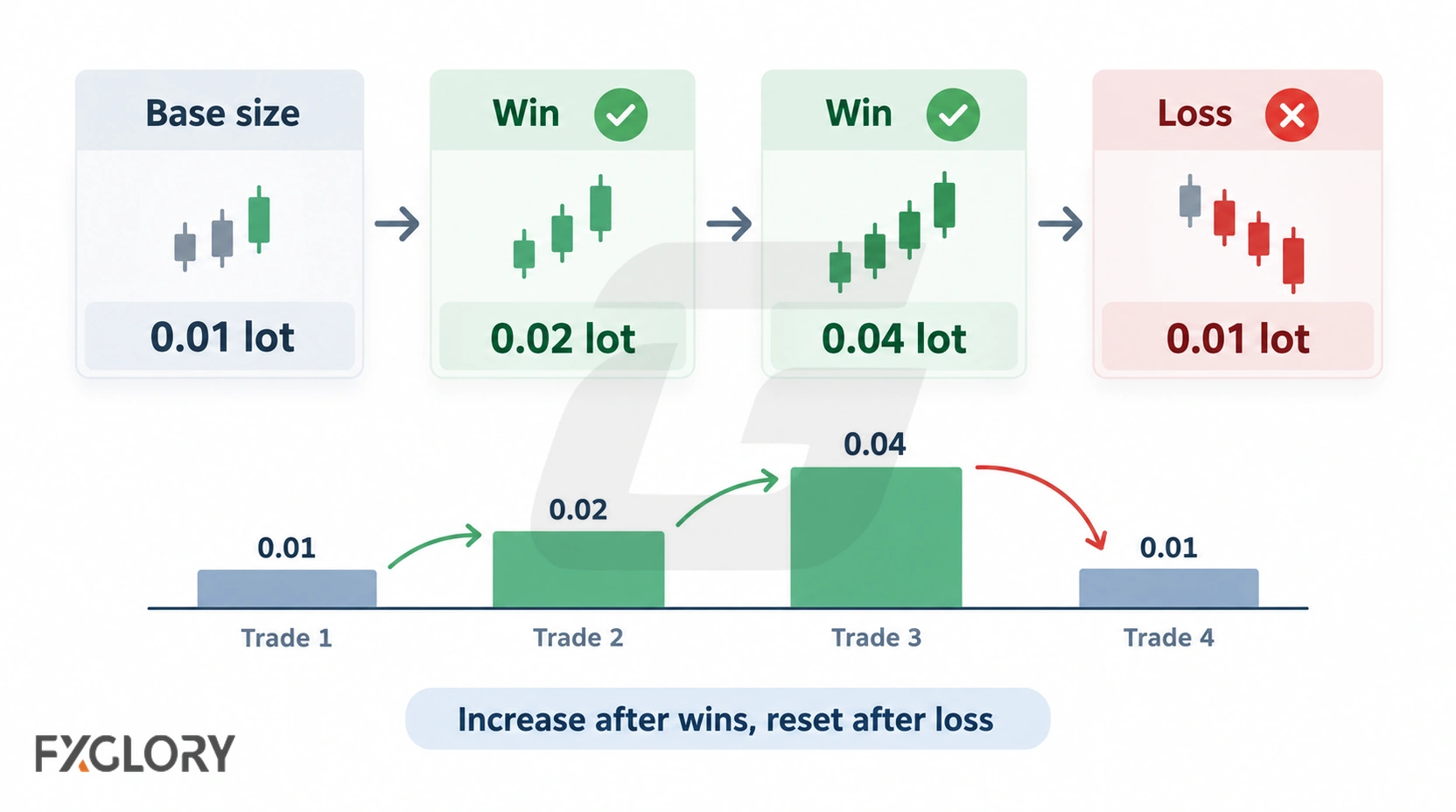
The aim is to concentrate exposure during favorable sequences rather than escalate bets to recover losses. Whether that improves account results depends on the underlying strategy, the order of returns, and the limits imposed on larger trades.
Anti Martingale is a money-management rule, not a complete trade plan. It does not decide the currency pair, direction, entry, invalidation, stop, target, or exit. Those rules belong inside a full forex trading system.
Anti Martingale vs Martingale
The key distinction is what triggers a size increase. The classic Martingale strategy escalates after losses; reverse Martingale escalates after wins. Both require limits, but they concentrate exposure at different points in a trade sequence.
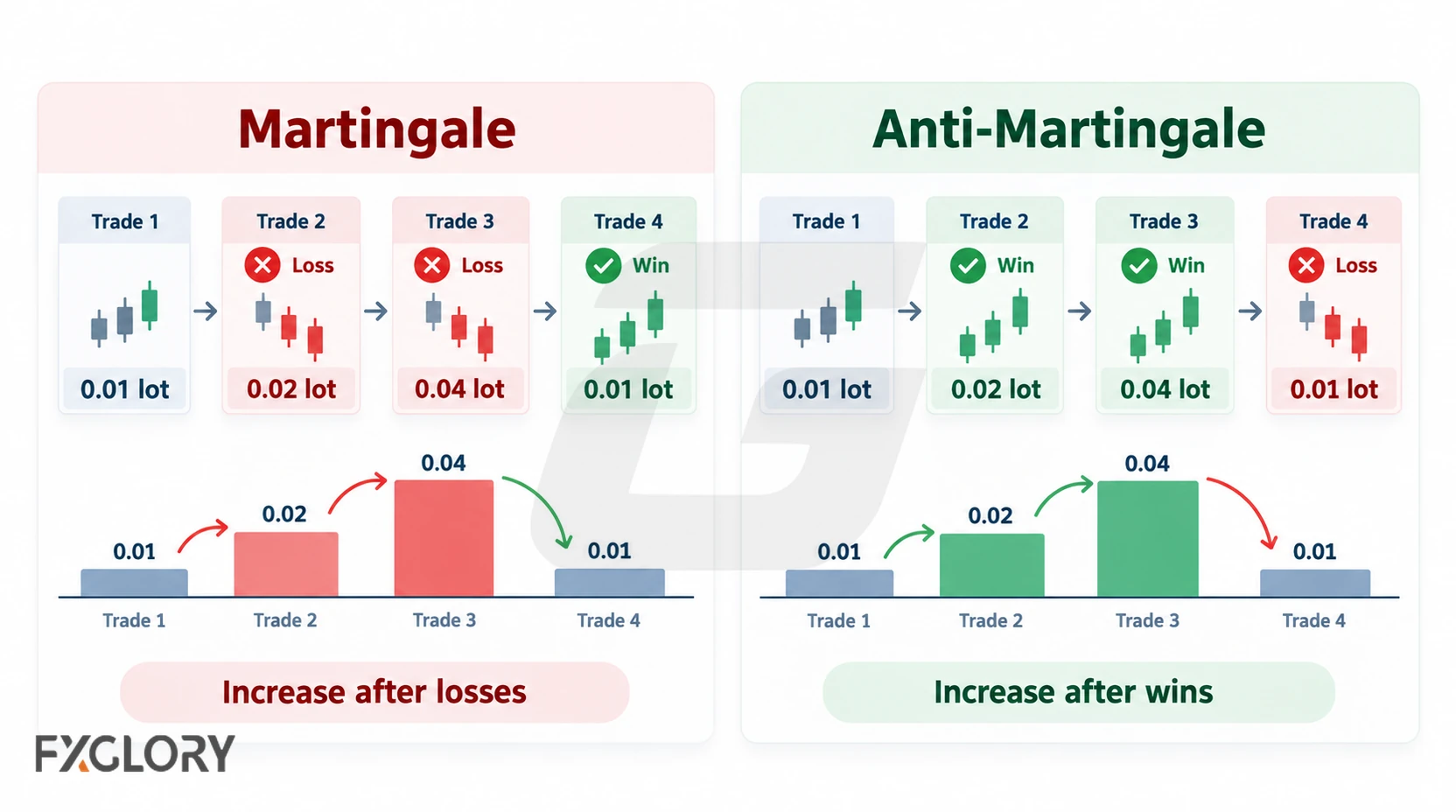
Martingale: increases size after losses to recover. It usually resets or returns to base size after a win. Its main risk is that exposure grows while the trade idea is already losing.
Anti Martingale: reduces or resets size after losses and increases size only after wins. Its main risk is that exposure may be largest just before the winning run ends.
A loss-led progression can escalate exposure during a drawdown; a win-led progression can concentrate it after gains. The comparison describes the timing of exposure, not which method is safe or profitable.
How Reverse Martingale Position Sizing Works
The illustrative ladder below uses doubling, which is easy to calculate but can quickly exceed account risk limits. Its lot sizes are examples, not recommended trading amounts.
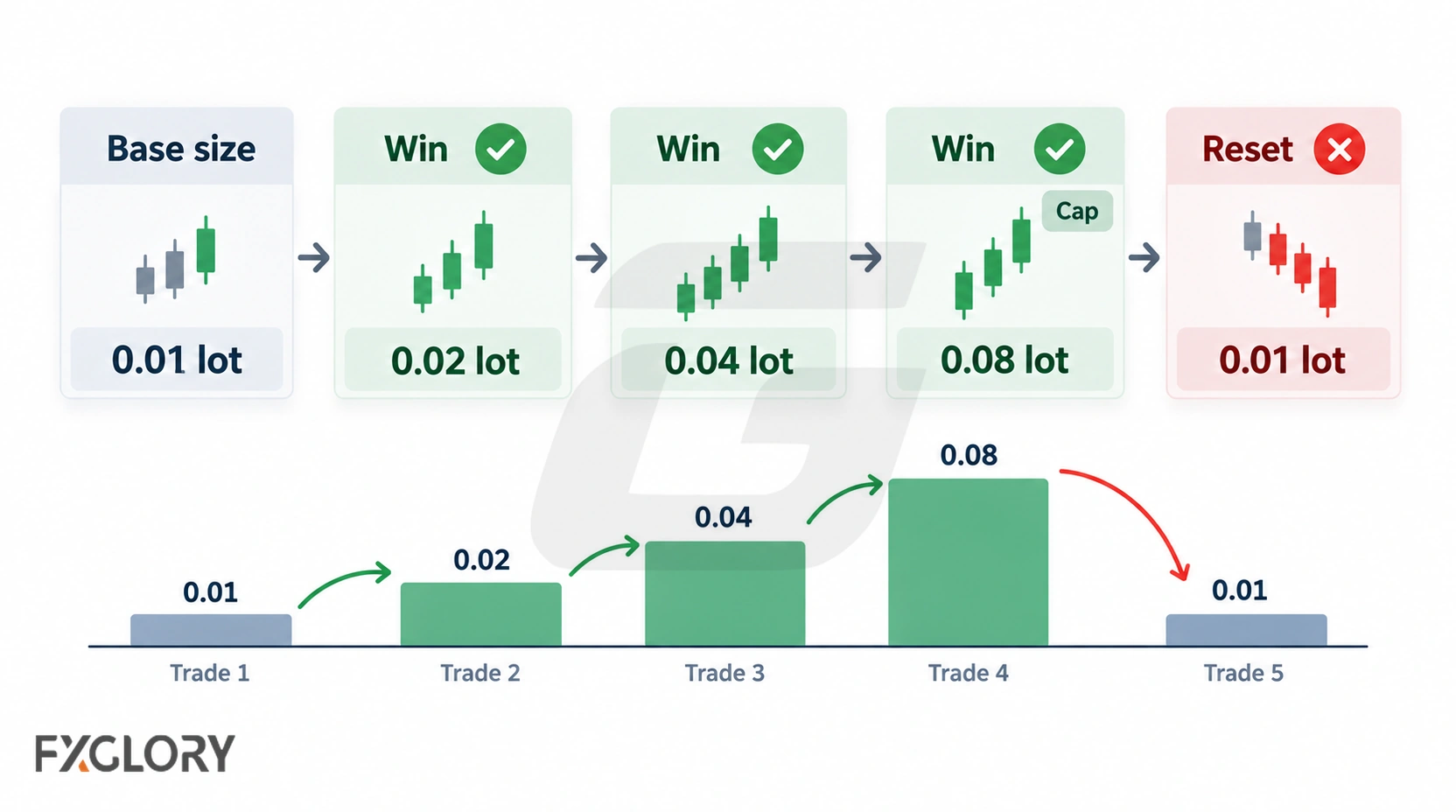
- Start: the sequence begins at the base size, such as 0.01 lot.
- First valid win: the next trade may increase to 0.02 lot if the written scaling rule allows it.
- Second valid win: the next step is 0.04 lot if the scale cap permits it.
- Third valid win: a further step could reach 0.08 lot, but the trade is skipped or size is capped if monetary risk or margin limits would be exceeded.
- Loss or reset condition: size returns to the base level, such as 0.01 lot, or to the reduced size defined in the plan.
These are lot-size steps, not fixed cash-risk steps: trades with different stop distances or pip values can have different potential losses even when their lots follow the same multiplier. Maximum size and reset conditions must be fixed in advance.
Strict vs Flexible Anti-Martingale Rules
A strict anti-Martingale rule doubles size after a win and reduces size after a loss. That version is easy to explain, but it can be too aggressive for a leveraged forex account if the next trade has a wider stop, weaker structure, or higher margin requirement.
A flexible version may use smaller increases, fixed scale steps, equity-based caps, or a faster reset rule. These choices can limit escalation, but even a modest multiplier may exceed a monetary-risk cap if the next trade requires a wider stop or has a different pip value.
- Strict anti-Martingale: size may double after each win and reduce after a loss. This is easy to define, but exposure can jump too quickly after a short winning run.
- Flexible anti-Martingale: size rises by a capped step and resets by rule. This is easier to control, but a smaller increase can still be too large if the next setup is weak.
- Equity-based scale rule: size changes only after account equity changes by a defined amount. This still needs caution because closed profit can create false confidence if market conditions have changed.
Sizing Logic Is Not A Trading Edge
The most important anti Martingale mistake is assuming a winning trade makes the next trade more likely to win. A winning streak may come from a strong trend, but it may also come from short-term variance, favorable timing, or a market condition that is about to change.
Changing size does not improve the entry signal or, by itself, make the next trade more likely to win. It changes how gains and losses are weighted in money terms. If a strategy has a genuine, repeatable relationship between prior results and subsequent returns, that weighting can change account-level outcomes; a short winning streak alone does not establish such a relationship.
Test that hypothesis against a stable-sizing baseline using the same signals, with spread, slippage, swap where applicable, and realistic sizing constraints. A negative-expectancy entry method should not be presented as profitable merely because a progression was applied to its historical wins.
Anti Martingale vs Pyramiding
Anti Martingale and pyramiding are related, but they are not the same. Anti Martingale is a broader sizing rule that can apply from one completed trade to the next. Pyramiding usually means adding to an existing winning position while the original position remains open.
- Anti Martingale changes the next trade size after wins or losses.
- Pyramiding adds exposure inside an existing winning trade while the first position remains open.
With pyramiding, several entries may be exposed to the same reversal at once; a completed-trade anti-Martingale sequence instead changes the size of later entries. For managing added positions and combined exits, review the entry and exit strategy.
Winning Streaks, Trend Quality, And False Confidence
Anti Martingale logic depends on the idea that a favorable run may continue long enough to justify larger size. That is why it is often discussed with trend-following or continuation methods.
But a streak is not the same as a trend. Recent gains can make a trader feel safer or more confident even when conditions are deteriorating. Review higher-timeframe context, pullback quality, support or resistance, volatility, and invalidation instead of using winning trades as proof of momentum. A trend trading strategy can supply a separate market-condition framework.
Multiple time frame review can also help. If the lower chart shows a sequence of wins while the higher chart is near a major obstacle, increasing size may be more dangerous than the recent results suggest. A multiple time frame analysis routine can separate short-term momentum from higher-timeframe risk.
The Give-Back Problem
The give-back problem is easiest to see in a sequence where later positions are bigger than earlier ones. A large loss can outweigh several earlier smaller wins, even if the trader followed the progression rule exactly.
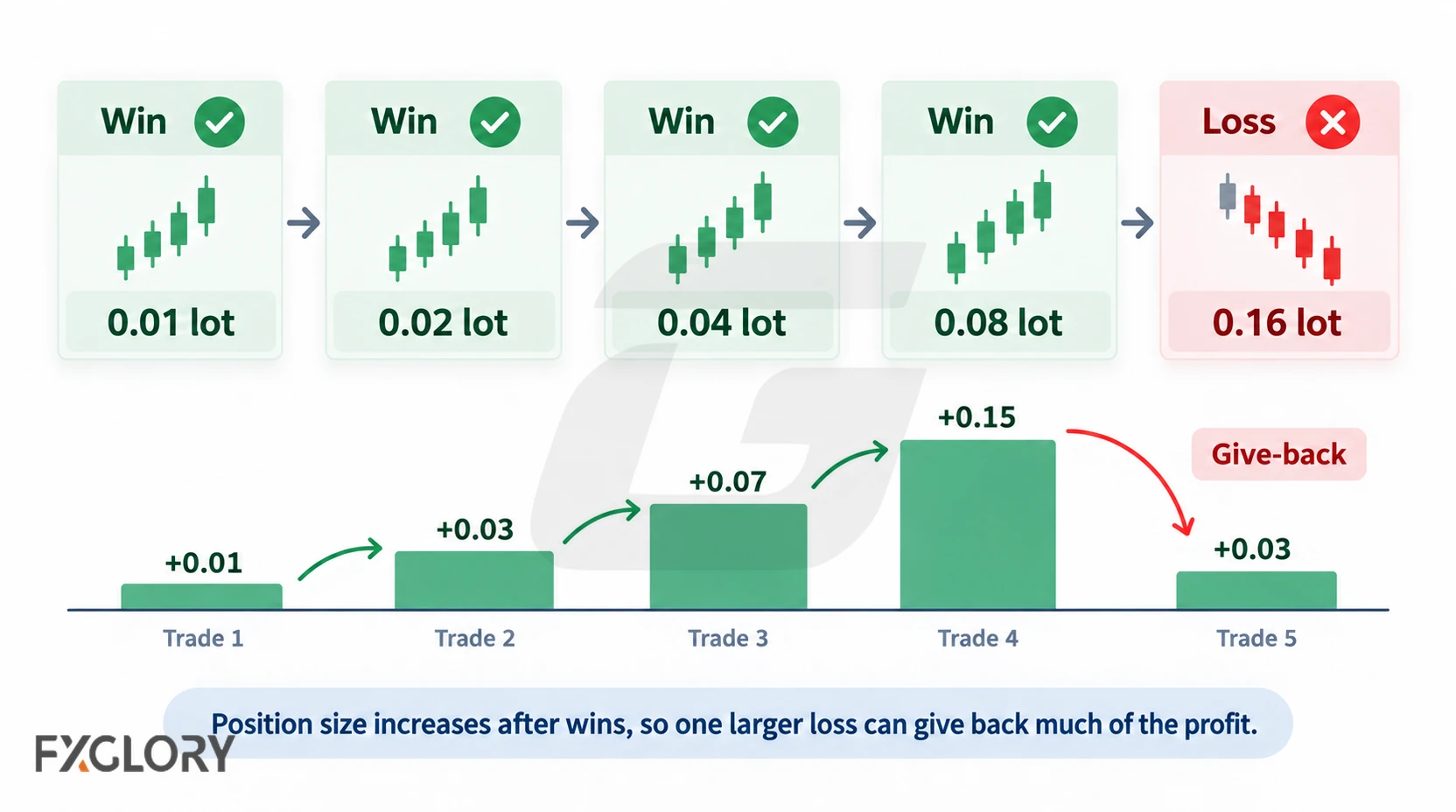
Hypothetical calculation: Suppose identical per-lot price moves would produce a gain or loss of one base-risk unit at 0.01 lot. A 0.01-lot win earns +1 unit, a 0.02-lot win earns +2 units, and a 0.04-lot loss costs −4 units. The sequence finishes at −1 base-risk unit before costs (+1 + 2 − 4). This assumes equal pip-value and equal-sized winning and losing price moves; real stop distances and fills may differ.
Drawdown Recovery And Reduced Size
Anti-Martingale reduces size after losses, which can help slow account damage during a losing period. The trade-off is that the account may also recover more slowly because each later trade is smaller after the drawdown.
This matters because drawdown recovery is not symmetrical. A 10% loss does not need a 10% gain to return to the starting balance; it needs a larger percentage gain from the lower account level. Reducing size after losses can protect capital, but it can also make recovery slower if the trader does not have a valid setup and a realistic review plan.
- If account equity falls, review whether the base setup still has an edge before scaling again.
- If risk per trade becomes smaller, further damage may slow down, but recovery may also take longer.
- If a new trend appears, any size increase still needs a capped rule and a fresh entry trigger.
Position Size, Margin, Leverage, And Costs
Lot size and money at risk are not interchangeable. Approximate planned stop-loss risk = lots × pip value per lot × stop distance in pips, plus execution costs not already reflected in that distance. Pip value can vary with the pair, account currency, and exchange rates. Doubling lots only doubles the pre-cost planned risk when stop distance and pip value stay the same; actual losses can exceed the estimate because stops are not guaranteed fills.
Spread, slippage, and swap where applicable can affect larger positions as well. Review spread conditions before assuming a scaled trade has adequate target room after costs.
Margin is a separate constraint, not a measure of stop-loss risk. Check required margin with the FXGlory margin calculator, and review leverage conditions and trading account conditions before considering a larger position.
Reset, Stop, And Profit-Protection Rules
An anti Martingale rule should define when size increases, when it stops increasing, and when it resets. Without these rules, the method becomes emotional scaling after good results.
- Scale trigger: define what counts as a valid win. Do not increase size after any random profitable trade.
- Maximum scale level: define how many size increases are allowed before the sequence must stop.
- Reset rule: define when size returns to base level, including after a loss, after a time limit, or after market conditions change.
- Profit protection: use trailing stops, partial exits, or time exits to manage an individual trade; use a sequence-level give-back limit, size cap, or reset to limit exposure of previously accumulated gains.
- Invalidation: define where the next trade is wrong before the larger size is placed.
Neither a trade-level stop nor a sequence-level threshold guarantees that previously closed gains will remain intact: the next losing trade may slip beyond its planned exit. Use the risk management strategy to set monetary-risk and drawdown limits separately from margin requirements.
When Anti Martingale May Fit Better
Anti-Martingale may be worth testing where independently defined trend or continuation setups produce clusters of favorable outcomes. Such clustering must be demonstrated rather than inferred from a recent winning streak.
- Comparable setups recur in a market regime that can be identified without looking ahead.
- Trade-order analysis shows whether favorable outcomes actually cluster after costs.
- Higher-timeframe obstacles and changing volatility are assessed separately from the win sequence.
- The resulting account-level drawdown and exposure remain acceptable under capped scaling.
It may fit poorly when the market is choppy, range-bound, news-driven, or close to a major support/resistance area that could reverse price quickly.
When Anti Martingale Fails
Anti Martingale usually fails when traders treat a winning streak as proof that risk can be increased. It can also fail when position size grows faster than the quality of the setup.
- The scale cap is missing: a long run can produce outsized late-sequence exposure. Set a maximum size and cash-risk limit.
- The market becomes choppy: wins and losses alternate. Avoid scaling without continuation structure.
- Overconfidence enters: size increases outside the written rule. Use fixed maximum exposure limits.
- The stop is widened: risk grows through both size and stop distance. Keep stop logic independent from confidence.
- Costs increase: spread, slippage, or swap weakens the larger trade. Recheck cost before every scaled entry.
Anti Martingale Decision Sequence
A reverse Martingale plan needs a decision sequence before size changes. The sequence should make it possible to stop before exposure grows too far.
- Check the base setup: continue only if the setup has written rules and can be reviewed without scaling.
- Check market condition: continue only if trend, momentum, or structure still supports continuation.
- Check the previous win: scale only if the win came from the planned setup, not from luck or rule-breaking.
- Check the next entry: the larger trade still needs its own trigger, stop, target, and invalidation.
- Check the larger size: margin, leverage, spread, and drawdown limits must still fit before the position is increased.
- Check the reset rule: the sequence must stop at the written maximum level, loss, time limit, or market-condition change.
No-Trade Conditions
An anti Martingale setup should be skipped when the sizing rule is more convincing than the trade setup. If the only reason to increase size is that the previous trade won, the plan is not strong enough.
- Skip if the base strategy has not been tested with stable position size.
- Skip if the next trade lacks its own trigger and invalidation point.
- Skip if a larger position would strain margin or free equity.
- Skip if the market is choppy and does not support continuation logic.
- Skip if spread or slippage makes the larger trade unrealistic.
- Skip if the trader cannot define how gains are protected.
- Skip if the size increase is caused by overconfidence after recent wins.
Testing And Review Before Live Trading
Test the same chronological entry and exit signals twice: first with stable position sizing as a benchmark, then with a capped anti-Martingale rule. Apply comparable spread, slippage, and swap assumptions and account for differing stop distances. This isolates the effect of the sizing progression rather than attributing a different entry method to it.
Compare net cash results, returns relative to capital, maximum drawdown, worst sequence give-back, margin use, and performance across market regimes. As a separate labeled stress test, examine whether changing the order of hypothetical returns alters the outcome; reordered trades are not actual historical trading results.
- Base setup: pair, direction, timeframe, setup type, and invalidation.
- Scale rule: multiplier, maximum levels, reset rule, and base size.
- Market condition: trend, range, volatility, event risk, and higher-timeframe obstacle.
- Risk data: stop distance, position size, margin, spread, slippage, and drawdown.
- Sequence result: net gain or give-back at each scale step, including resets and maximum adverse sequence result.
- Rule quality: whether size was increased by rule or emotion.
Anti Martingale Checklist
- The base strategy has been reviewed without scaling first.
- The market condition supports continuation, not only recent wins.
- The next trade has its own entry, stop, target, and invalidation.
- Maximum scale levels are written before the sequence begins.
- The reset rule is clear after a loss, time limit, condition change, or target.
- Margin, leverage, spread, and slippage are checked before each larger trade.
- The plan defines how to protect gains before size increases again.
- The planned cash risk from lot size, pip value, stop distance, and costs stays within the preset limit.