
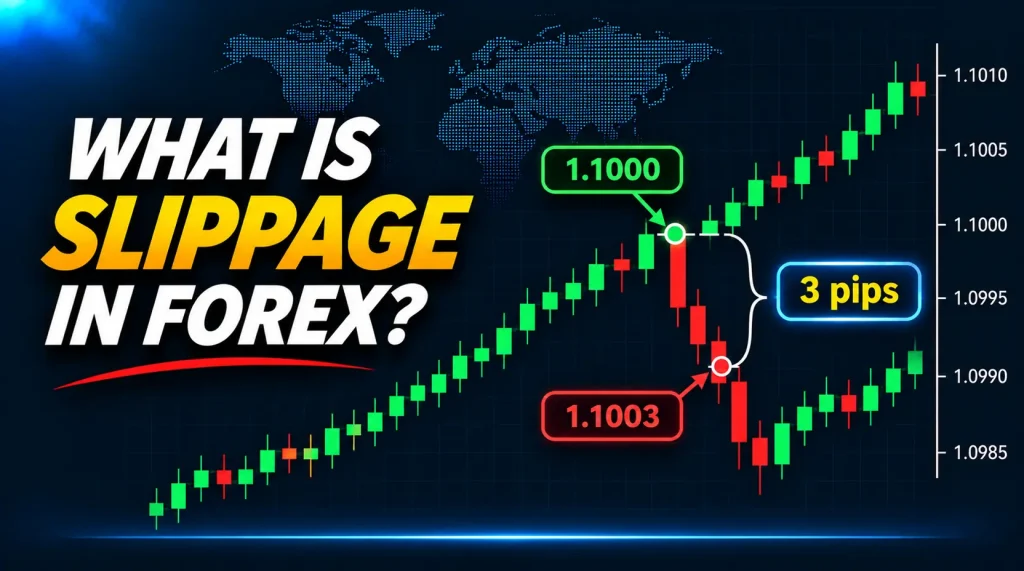
Forex slippage is the difference between the price you expected or requested for a trade and the price at which it actually executes. It can produce a better fill, a worse fill or no difference. Slippage matters because the order's final execution price—not the price you saw before clicking—determines the position's starting cost or closing result.
This guide explains how slippage arises, how to calculate it from comparable prices, how it differs from the spread and what traders can do to manage execution uncertainty. All prices below are hypothetical EUR/USD illustrations, not FXGlory trading records, measured average slippage or promises about any account. For the quote basics, see Bid and Ask Price in Forex.
What Is Slippage in Forex Trading?
An order is submitted when a particular quote is visible or an intended price is set. By the time the order is executed, the price available for that transaction may differ. Slippage measures that fill-price difference, not the entire movement of a candle or the difference between Bid and Ask. For a market buy, compare the expected buying price (Ask) with the actual buying fill; for a sell, compare the expected selling price (Bid) with the actual selling fill.
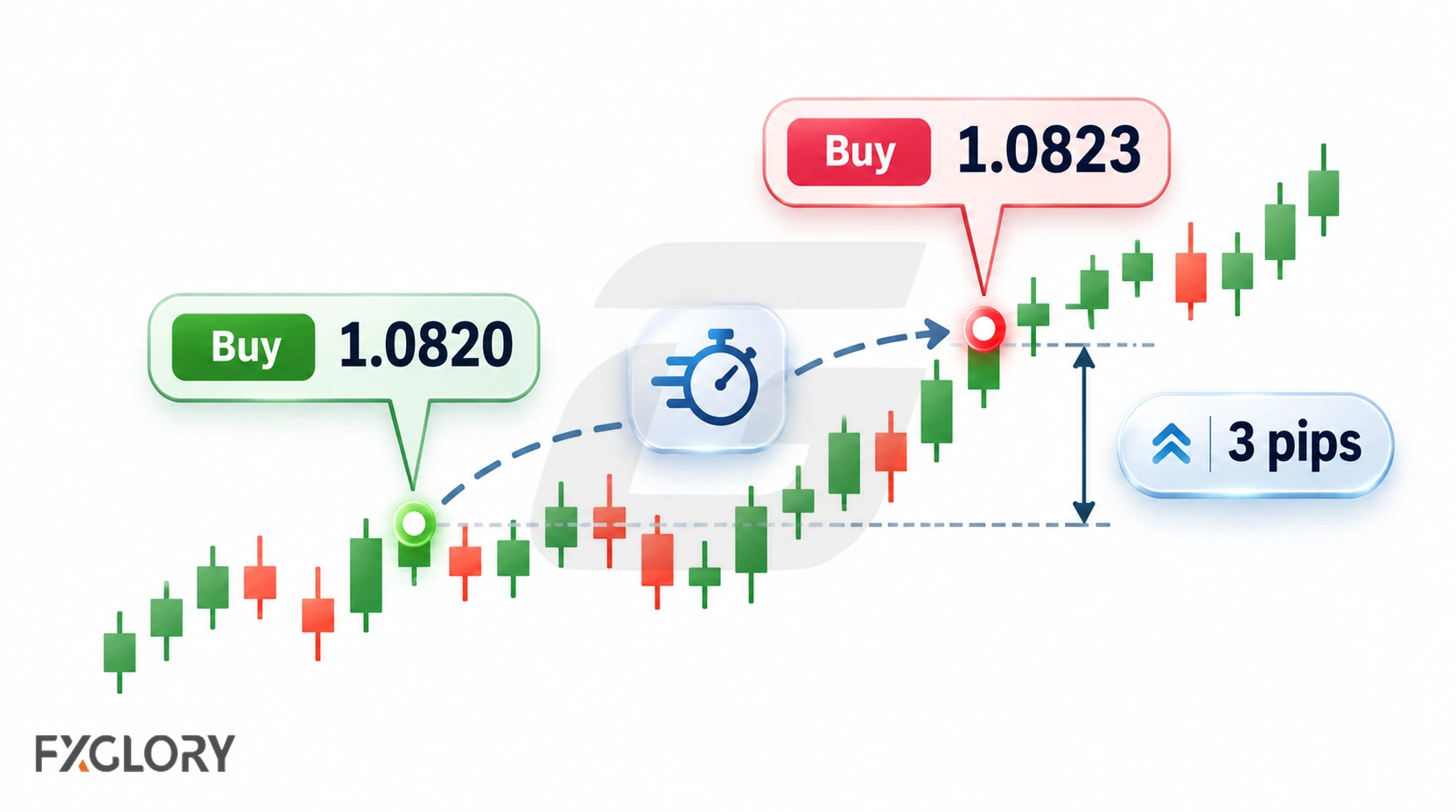
For example, if a trader expects to buy EUR/USD at Ask 1.0820 and receives a fill at Ask 1.0823, the purchase costs 0.0003 USD more per euro than anticipated, or 3 pips of adverse slippage. If the same buy fills at 1.0819 instead, it is 1 pip more favorable. That difference does not reveal whether a broker made an error: the applicable execution rules and available market prices must be checked.
Positive, Negative and Zero Slippage
Calling slippage “positive” or “negative” depends on whether the executed price improves or worsens the transaction. The direction reverses between buying and selling:
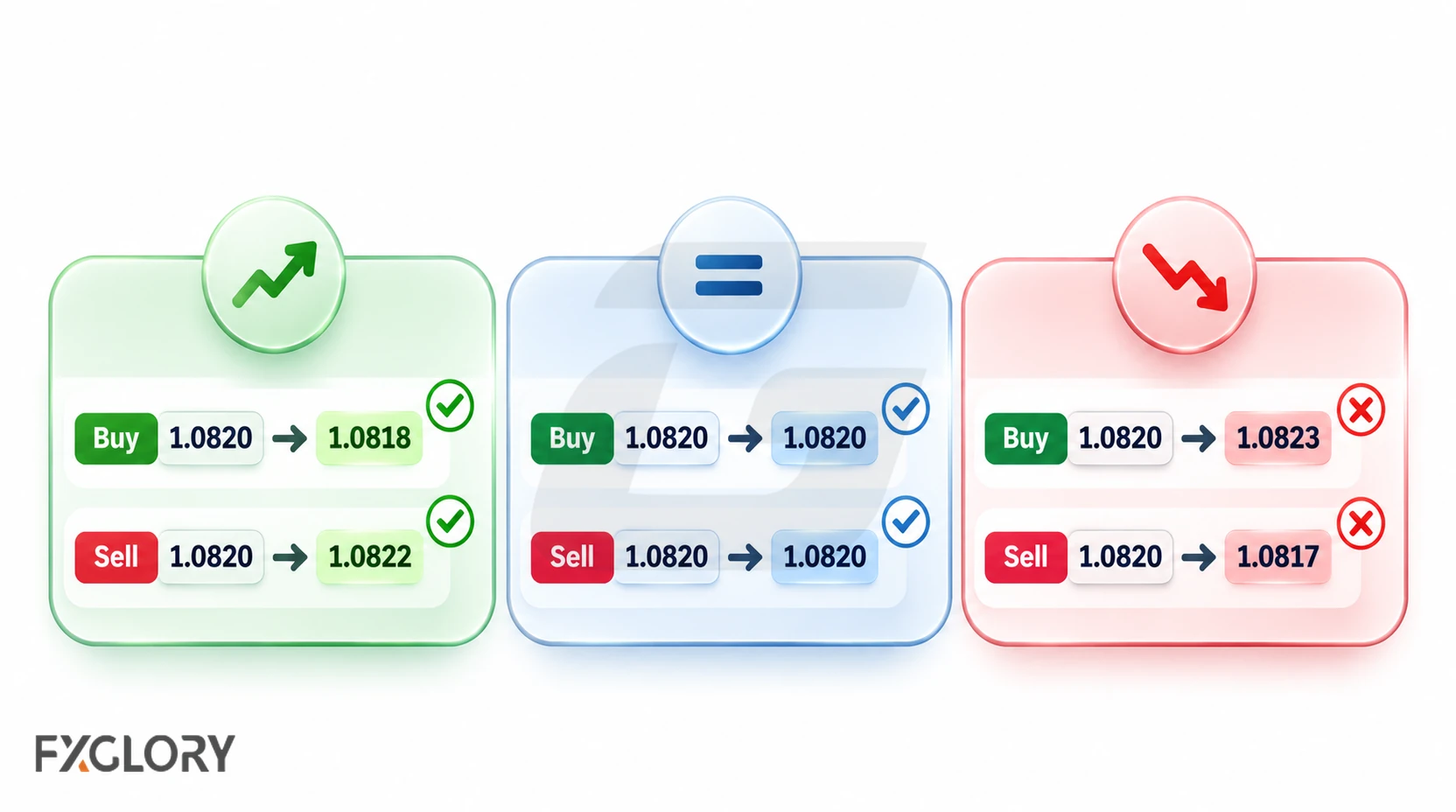
- Buy order: A lower fill is favorable; a higher fill is unfavorable.
- Sell order: A higher fill is favorable; a lower fill is unfavorable.
- Zero slippage: The execution matches the appropriate expected price.
A favorable entry does not guarantee the position will make a profit. Likewise, negative slippage is a worse execution relative to the reference quote; it is not automatically evidence of manipulation. Stop orders and market orders may have different fill behavior, so a price comparison should always include the order type.
What Causes Slippage in Forex?
Slippage usually occurs because the price or available quantity changes between the relevant reference and execution. Several conditions can contribute, sometimes at the same time.
Rapid news-driven price changes
Inflation releases, employment reports, central-bank decisions and unexpected headlines can cause quotes to update quickly. A requested or expected quote may no longer be executable by the time the order reaches its execution stage. The impact varies by instrument, order type and available quotes.
Limited liquidity or depth at a price
Liquidity is not merely how active the forex market is overall. What matters to a particular order is the price and quantity available through the relevant execution arrangement at that moment. When little volume is available at the best quote, an order may receive a different price or several fills, depending on its size and permitted execution policy. FXGlory's Forex Liquidity lesson covers market depth in more detail.
Price gaps and thin trading windows
At a weekend reopening, holiday period or abrupt price jump, the next available quote may be far from an earlier stop trigger. A gap can create adverse slippage even when an order was entered well in advance. No prior-day chart level guarantees the next executable price.
Order size and execution arrangements
Larger orders may be harder to execute at a single quoted price if depth is limited. Broker execution modes, fill policies and order restrictions also matter. For example, MetaTrader documents distinct instant, request, market and exchange execution modes, but the modes and options actually available are determined by the broker and symbol. Without specific account evidence, do not assume FXGlory offers a particular execution setting or a fixed slippage limit.
How to Calculate Forex Slippage in Pips and Dollars
Use a like-for-like reference price. For a market buy, compare intended Ask with actual buy fill; for a sell, compare intended Bid with actual sell fill. Do not calculate “slippage” by subtracting a Bid reference from an Ask execution, because that mixes the spread into the result.
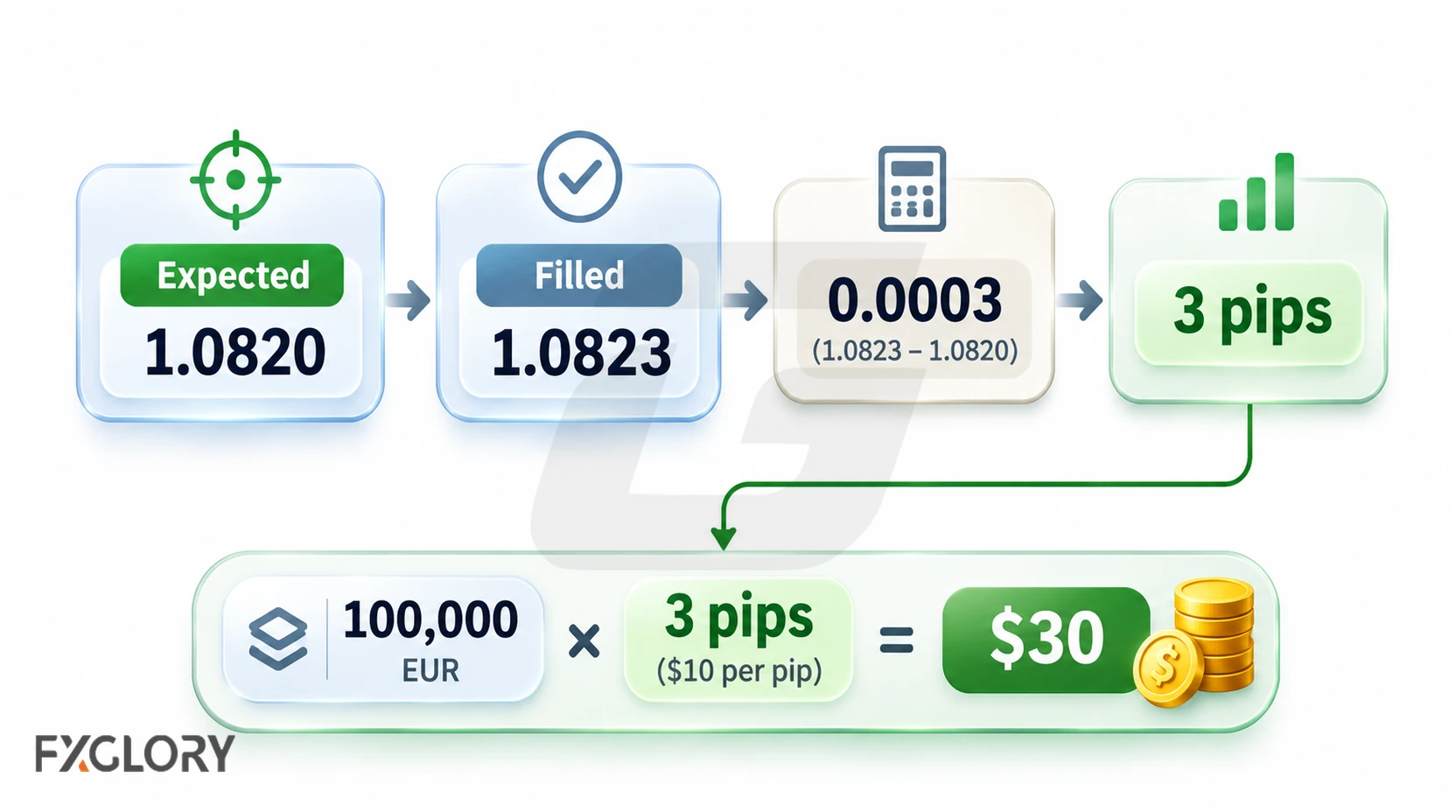
For a typical four-decimal pip convention in EUR/USD, 1 pip = 0.0001 USD per euro. Assume a hypothetical transaction size of 100,000 EUR, an account measured in USD, a constant unit quantity, and no commissions or other charges. The change in USD transaction value for one pip is 100,000 EUR × 0.0001 USD/EUR = USD 10.
| Order | Expected price | Filled price | Difference | Execution impact |
|---|---|---|---|---|
| Buy | Ask 1.0820 | 1.0823 | 3 pips | Unfavorable by USD 30 |
| Buy | Ask 1.0820 | 1.0819 | 1 pip | Favorable by USD 10 |
| Sell | Bid 1.0820 | 1.0818 | 2 pips | Unfavorable by USD 20 |
| Sell | Bid 1.0820 | 1.0822 | 2 pips | Favorable by USD 20 |
| Buy | Ask 1.0820 | 1.0820 | 0 pips | No fill-price difference |
The adverse buy calculation is (1.0823 − 1.0820) ÷ 0.0001 = 3 pips; 3 pips × USD 10 per pip = USD 30. The favorable buy calculation is (1.0820 − 1.0819) ÷ 0.0001 = 1 pip, or USD 10 better. The monetary comparison describes an entry or exit fill difference; it is not the full trade's profit or loss.
If the illustrative quantity were 10,000 EUR instead, the same 3-pip adverse buy difference would equal USD 3, assuming the same prices and conventions. Real contract size, volume steps, quote currency, account currency and fill details must be checked for the actual symbol.
Slippage vs Spread, Swap and Requotes
These terms describe different mechanisms that can appear together. A trader who counts the same quoted-price difference twice may overestimate execution costs.
| Concept | What it measures | Practical distinction |
|---|---|---|
| Spread | Ask minus Bid at a particular quote | Difference between concurrent buy and sell prices, even without slippage |
| Slippage | Expected versus actual fill price for the same transaction side | Can be positive, negative or zero |
| Swap / financing | Adjustment for holding a position across the applicable cutoff | Not caused simply by a worse entry fill |
| Requote | A replacement quoted price offered instead of immediate execution under relevant rules | The order may require acceptance or be rejected; it is not the same as a completed fill |
A buy at Ask 1.0823 rather than an expected Ask 1.0820 has a 3-pip entry fill difference. The spread already separates simultaneous Bid and Ask quotes. If an account's trade profit or loss is calculated from actual Ask entry and Bid exit fills, the spread is reflected in those transaction prices; do not subtract it again as the same cost. See Why Forex Spreads Widen for quote changes and stop-trigger examples.
How Order Types Affect Slippage Risk
Order types exchange one kind of certainty for another. Always verify which types and execution policies are supported for the actual account, instrument and platform.
Market order Requests execution at available market pricing. Execution may be prompt in normal conditions, but the exact final fill price may differ from the displayed quote; applicable execution policies can also affect whether an order fills. Limit order Specifies a maximum acceptable purchase price or minimum acceptable sale price. This provides price protection for an executed fill, but the order can remain unfilled, fill only partly where supported, or be rejected according to applicable rules. Stop order and ordinary stop-loss Uses a trigger price. After activation, a market-style execution request may fill beyond that level if prices gap or move rapidly. A standard stop does not guarantee the exit price or the maximum cash loss. Stop-limit order When supported, activation submits a limit order rather than accepting any available price. The trade-off is that no execution may occur if the market moves past the acceptable range.Some providers offer special guaranteed-stop products with separate conditions, but availability and charges cannot be assumed. This lesson does not claim FXGlory offers guaranteed stops, stop-limit orders on every instrument or any specific deviation setting.
How to Reduce Slippage in Forex Trading
There is no generally reliable way to eliminate market-related slippage from all live orders. Traders can, however, consider several practical controls and their costs:
- Check important event times. Review the economic calendar and avoid placing time-sensitive market orders around a release when the execution uncertainty is unacceptable for your plan. Unscheduled events are still possible.
- Understand liquidity conditions. Consider the pair, trading session and depth available through the relevant provider. “Major currency pair” does not imply guaranteed liquidity at every moment.
- Match order type to the objective. A limit price may protect an entry price but sacrifice execution. A market order may provide access to available liquidity but not a fixed fill price.
- Account for size. An intended large position may require more depth than an otherwise comparable small order. Do not assume one quote reflects executable volume for every trade size.
- Budget for adverse fills. A position-size estimate based on an exact stop fill can understate tail losses. Keep exposure and account margin in view, especially through news or weekend gaps.
- Keep an execution journal. Save order type, symbol, direction, expected price reference, actual fill(s), timestamp, quote side, position size and applicable charges. Evaluate patterns from a consistent sample rather than one isolated event.
Technical improvements such as a stable connection can help avoid preventable transmission problems, but cannot promise a particular market fill. Backtests and demo accounts may use different data or execution assumptions from live trading; a strategy should explicitly model spreads, realistic slippage and non-fills instead of assuming ideal fills.
Why Can a Stop-Loss Fill Beyond Its Trigger?
Imagine a hypothetical long EUR/USD position of 100,000 EUR opened at Ask 1.0830, with an ordinary stop-loss intended to sell when Bid reaches 1.0800. If the actual sell-to-close execution occurs at Bid 1.0788 after a sudden gap, it is 12 pips worse than the stop trigger. Under these assumptions, the planned gross price loss at 1.0800 would have been (1.0830 − 1.0800) × 100,000 = USD 300; the actual gross price loss at 1.0788 would be (1.0830 − 1.0788) × 100,000 = USD 420.
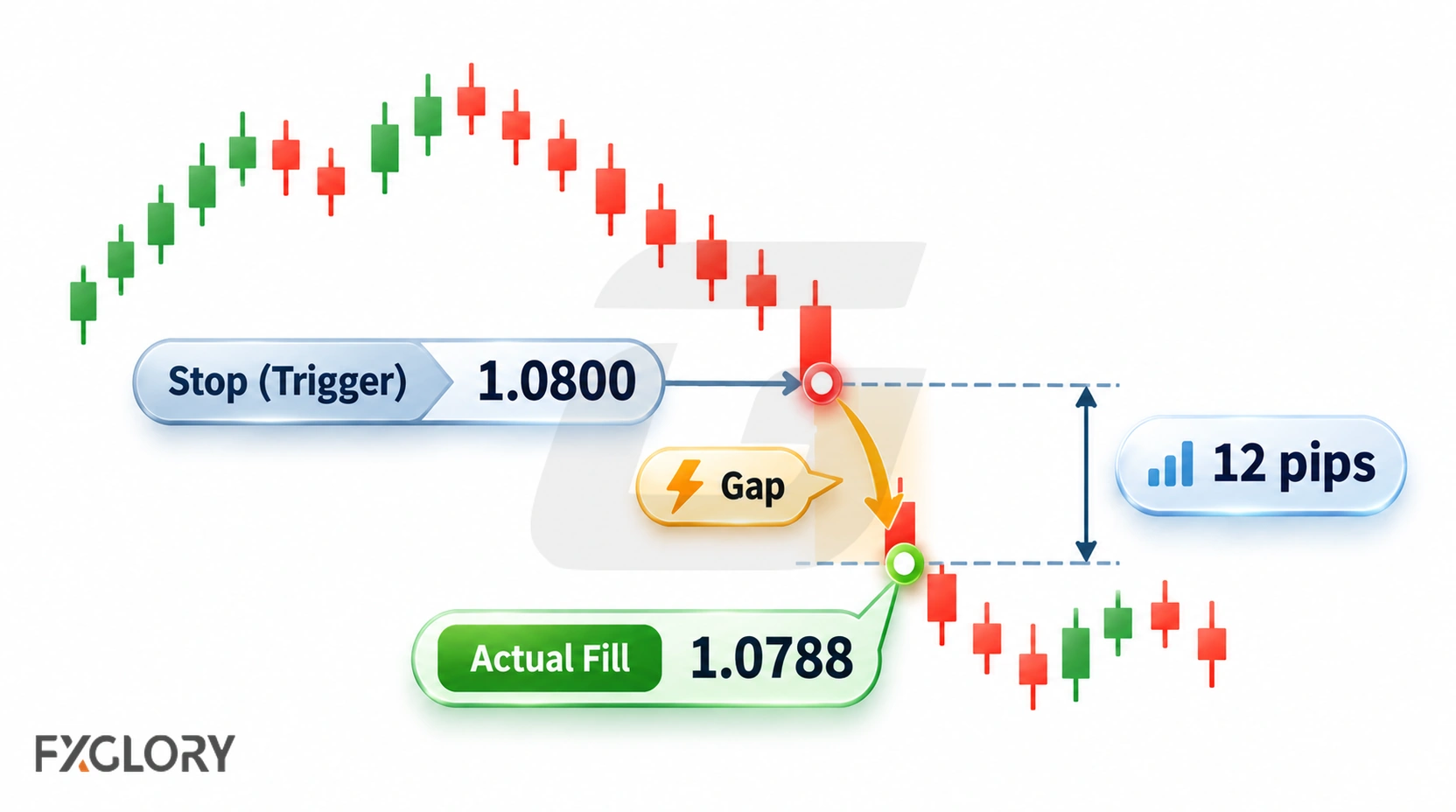
The USD 120 difference reflects additional adverse exit slippage of 12 pips at USD 10 per pip. Both gross price results already use actual buy-at-Ask and sell-at-Bid prices, so no second spread deduction belongs in the comparison. Commissions, swaps and other charges are excluded. These are invented prices, not a historical gap or a guaranteed possible maximum.
The relevant mechanics depend on the platform and execution arrangement. For a long position in typical MetaTrader forex quote conventions, Bid is relevant to its sell-to-close stop. A stop level indicates when the exit instruction should activate, not an irrevocable promise of a particular fill. A gap can produce a larger loss than the original cash risk estimate, especially with leverage.
Forex Slippage: A Practical Review Checklist
- Compare expected and filled prices using the same transaction side and unit convention.
- Separate spread, slippage, commission and financing; avoid double counting.
- Identify whether the order required a price, a trigger or immediate execution.
- Check news, thin trading periods, gaps, order size and applicable symbol conditions.
- Allow for stop-loss fills beyond planned levels; a trigger is not a loss guarantee.
- Record actual execution outcomes before making claims about causes or typical slippage.
Key lesson: Forex slippage is an execution-price difference, not simply a wide spread or an unfavorable candle. A clear quote-side calculation and realistic order-type expectations make it easier to judge costs and risk. Better preparation may reduce exposure to slippage, but cannot eliminate all execution uncertainty.