

What Is Trading Tilt In Forex?
Trading tilt in forex is a state of emotional overload in which emotion begins overriding the trading plan. Instead of evaluating each decision on its own, the trader starts reacting to a loss, win, missed move, frustration, perceived unfairness, boredom, performance pressure, or stress outside the market.
Tilt can affect entries, position size, stops, exits, pair selection, and the point at which a session should end. The first response is not to argue with the emotion. It is to apply a circuit breaker: stop adding new risk, step away from the order screen, record the trigger, and follow the pre-written rule for when trading may resume.
This page supports the broader trading behavior and psychology guide by focusing on tilt as the emotional state that can lead to several different rule-breaking behaviors.
How Tilt Changes Trading Decisions
A useful way to identify tilt is to look for changes from the trader's normal process. The trader may still point to a chart pattern or market idea, but the actual decision starts changing because of emotion: an entry is rushed, size is increased, a stop is widened, another pair is added, or a daily limit suddenly feels negotiable.
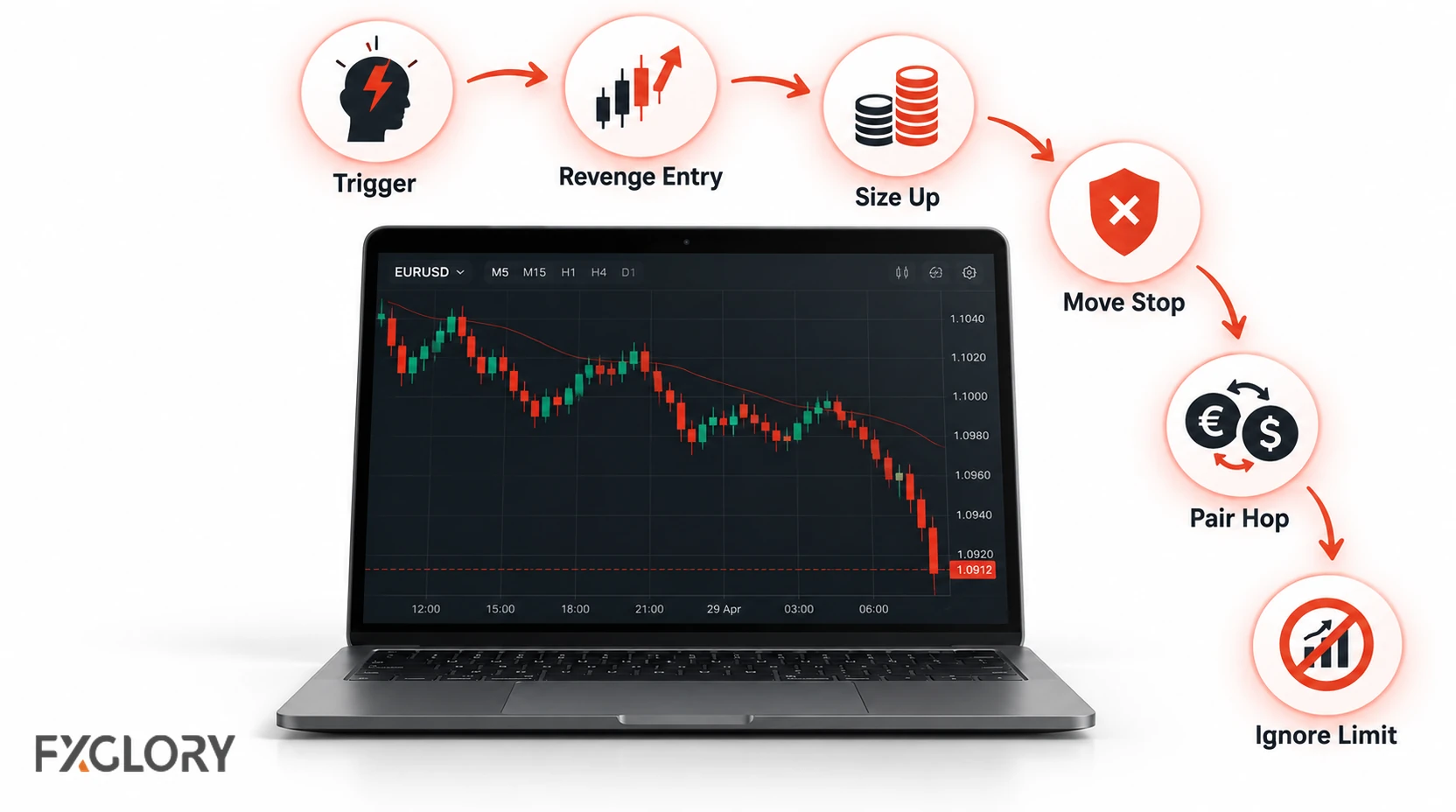
| Process Area | Controlled Decision | Tilt-Driven Change |
|---|---|---|
| Entry | The setup satisfies the written criteria. | The trader lowers the entry standard because acting feels urgent. |
| Position size | Size follows the normal risk rule. | Size increases after a win, loss, or strong emotional reaction. |
| Stop and exit | Management follows pre-defined invalidation and exit rules. | Stops or targets are changed mainly to avoid discomfort. |
| Exposure | Existing currency exposure is reviewed before another trade is added. | Several positions are opened without checking how much of the same market idea they share. |
| Session limit | The trader stops when the pre-defined boundary is reached. | The limit is renegotiated because the trader wants recovery, more profit, or another chance. |
Trading Tilt vs Revenge Trading, FOMO, Overtrading, Greed, And Boredom
Tilt overlaps with several trading behaviors, but they are not interchangeable. Tilt describes the broader emotional state; the other terms describe particular triggers or actions that may occur within it.
| Concept | Main Meaning | Relationship To Tilt |
|---|---|---|
| Trading tilt | Emotion is overriding normal decision quality and rule-following. | The broader state. |
| Revenge trading | Trying to recover a recent loss or lost profit. | A common behavior during loss-related tilt. |
| FOMO trading | Entering because of fear of missing a move. | Can appear when urgency becomes part of tilt. |
| Overtrading | Repeated activity beyond plan limits. | Can be a frequency pattern produced by tilt. |
| Greed or overconfidence | Wanting more profit or exposure after success. | Can contribute to win tilt and oversizing. |
| Boredom | Discomfort with inactivity or waiting. | Can lower setup standards and create forced trades. |
For the focused behaviors, review revenge trading after a loss, FOMO trading in forex, and overtrading beyond plan limits.
Why Trading Tilt Happens
Tilt often begins when a market event becomes emotionally personal. A loss feels like something that must be repaired, a winning streak feels like permission to press harder, a missed trade feels like failure, or a stop-out feels unfair. The next trade then carries an emotional task in addition to a market thesis.
- Loss pressure: The trader wants the next trade to recover the previous loss.
- Win pressure: Recent success makes larger size or weaker setups feel justified.
- Perceived unfairness: A stop-out, slippage, or reversal creates an urge to fight the outcome.
- Entitlement: Effort, patience, or previous accuracy creates the feeling that a winning trade is deserved.
- Missed-trade regret: The trader chases after failing to enter at the planned level.
- Boredom: Long periods without a setup make activity feel necessary.
- External stress: Financial, work, or personal pressure reduces the ability to tolerate uncertainty.
The presence of emotion is not itself proof of tilt. The warning sign is that the emotion starts changing entry criteria, risk, trade management, or the ability to stop.
Types Of Trading Tilt
Naming the trigger can make the correct circuit breaker easier to choose. These categories are practical review labels, not medical diagnoses.
| Tilt Type | Typical Trigger | Common Decision Change | Possible Control |
|---|---|---|---|
| Loss tilt | A losing trade, losing streak, or drawdown. | Immediate re-entry, revenge trading, or larger size. | Cooldown after losses or a consecutive-loss stop. |
| Win tilt | A profitable trade or strong session. | Oversizing, weaker setups, or continuing after the plan is complete. | Fixed size cap and session-end rule. |
| Injustice tilt | A stop-out, slippage, spread frustration, or a reversal immediately after exit. | Fighting the pair or changing stops to avoid being wrong again. | No re-entry until a fresh setup independently qualifies. |
| Entitlement tilt | Feeling owed a result after effort, waiting, or previous accuracy. | Forcing a trade because the trader believes a win is deserved. | Require the normal checklist without exceptions. |
| Boredom tilt | Long screen time without valid setups. | Lower standards, repeated pair switching, or unnecessary timeframe changes. | Use alerts and step away until planned conditions appear. |
| Pressure tilt | External stress, financial urgency, or a strong need to perform. | Trading to relieve non-market pressure. | No live trading when the pre-session state is outside acceptable limits. |
Warning Signs Of Trading Tilt
Tilt often shows itself through a cluster of behavioral and physical changes before the financial damage becomes obvious.
- The next trade has to fix the session: Recovery becomes part of the entry reason.
- Position size changes emotionally: Recent wins or losses alter exposure outside the normal rule.
- You re-enter immediately after a stop-out: The previous result still controls the next decision.
- You move stops or targets without a rule: Trade management becomes an attempt to avoid discomfort.
- You keep changing pairs, indicators, or timeframes: The trader keeps altering the view until another trade feels justifiable.
- You take profit too early for emotional relief: Fear overrides the planned exit logic.
- You hold a losing trade beyond the plan: Accepting the planned loss feels too difficult.
- You continue after a hard limit: The session boundary has lost authority.
- Your physical state changes: Tension, rapid breathing, restless clicking, tunnel vision, or difficulty stepping away can signal that decision quality is deteriorating.
- Being flat feels unacceptable: No position starts to feel like a failure rather than a valid outcome.
Why Forex Can Make Tilt Worse
Forex does not cause tilt, and leverage does not make market prices move more. The danger is that a tilted trader can change exposure quickly, add correlated positions, or keep trading through costs and execution conditions that were not part of the original plan.
| Forex Factor | Why It Matters During Tilt | What To Review |
|---|---|---|
| Leverage | Leverage can allow greater notional exposure with less margin. If a tilted trader increases position size, a given price move can have a larger account-level profit-or-loss impact. | Keep position size and total exposure within the pre-defined risk rule. |
| Margin | Additional or larger positions can increase required margin and reduce free margin. Margin is a funding requirement, not the same as the intended trade loss. | Check required margin separately from stop-based trade risk. |
| Spreads | Repeated entries increase transaction costs. | Include current spread conditions in the trade review. |
| Slippage and execution | Fast conditions can produce different execution prices than expected. | Avoid assuming an exact fill when emotion is already pushing for speed. |
| Correlated pairs | Several positions may depend on the same currency move. | Review combined currency exposure before adding another trade. |
| Swaps | An impulsive short-term trade may remain open longer than intended. | Know applicable holding costs before leaving positions open. |
| Fast order access | Low-friction order entry can turn an urge into exposure immediately. | Use a pre-entry pause and hard session rules. |
FXGlory's margin calculator can help estimate required margin before a position is added, and the spreads page can help review trading-cost conditions. These tools support planning; they do not determine whether a tilted trade should be taken.
Quick Pre-Trade Tilt Check
A short pre-trade check creates friction between emotion and order entry. Thirty seconds may be enough for a simple check, but the pause should be longer whenever the trader cannot answer clearly or a cooldown rule has already been triggered.
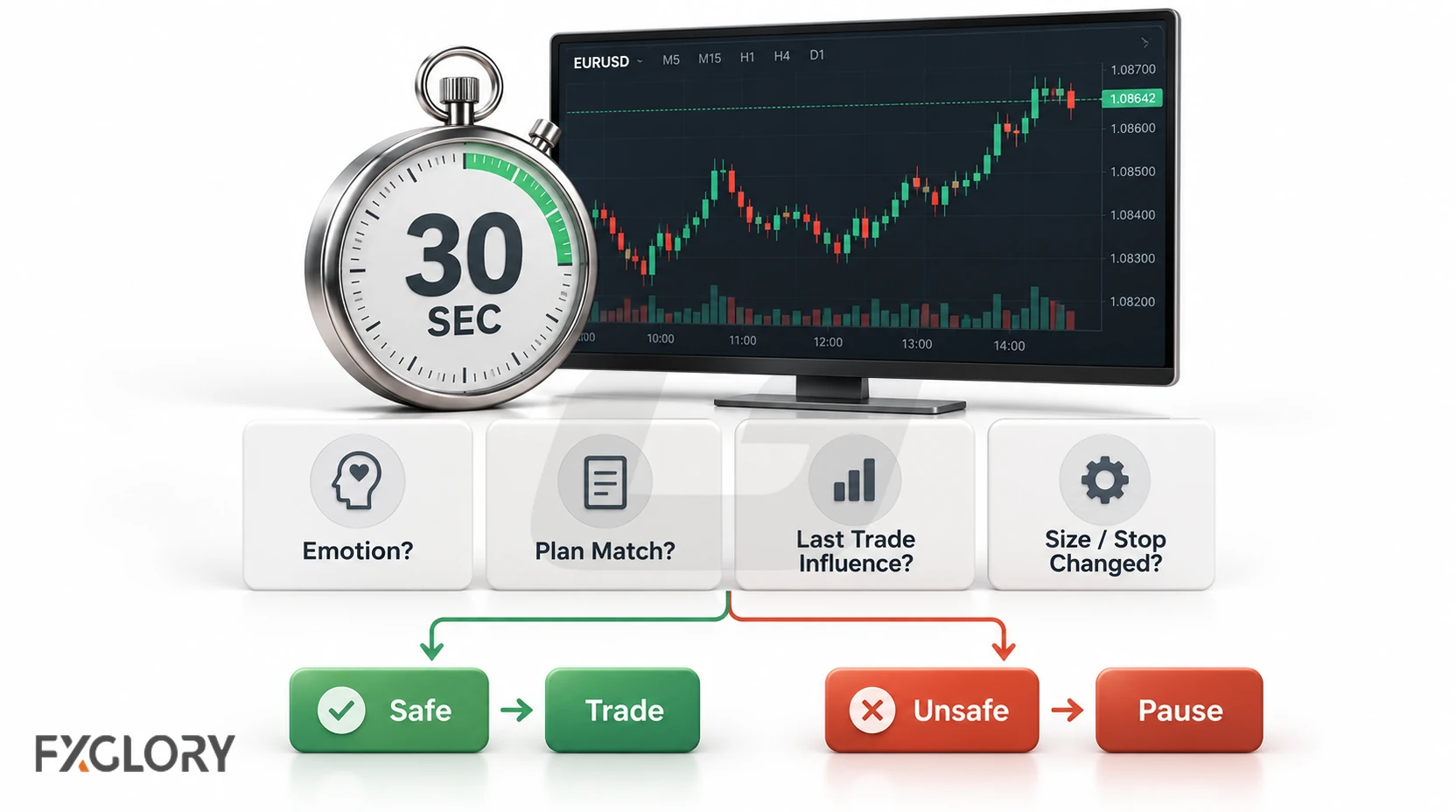
| Question | What It Tests | If The Answer Is Unsafe |
|---|---|---|
| What emotion is present right now? | Anger, urgency, fear, frustration, overconfidence, or external stress. | Pause before adding new risk. |
| Did the previous trade change this decision? | Loss tilt, win tilt, or regret. | Use the planned cooldown. |
| Does the setup meet the same rules I would use in a neutral state? | Rule drift. | Skip the trade if the criteria are being relaxed. |
| Have size, stop, pair, or timeframe changed because of emotion? | Execution and exposure drift. | Return to the original rule or end the session. |
| Can I accept no trade? | Urgency and inability to stay flat. | If no trade feels unacceptable, do not place a live order. |
Green, Yellow, Red Pre-Session Rating
A simple self-rating can help decide whether normal trading, reduced scope, or no live trading fits the session. It is a trading-rule filter, not a medical assessment.
| State | Typical Signs | Possible Trading Rule |
|---|---|---|
| Green | Prepared, rested, focused, and able to accept missing a trade. | Use the normal plan and normal risk limits. |
| Yellow | Distracted, tired, rushed, frustrated, or unusually eager. | Reduce complexity, trade count, or live exposure according to the plan, and skip marginal setups. |
| Red | Angry, desperate, exhausted, highly pressured, or unable to accept no trade. | No live trading; review, study, use demo practice, or wait for another planned session. |
FXGlory's demo account path can be used to rehearse circuit breakers and rule-following without live capital risk.
Circuit Breaker Rules For Trading Tilt
A circuit breaker is a rule that pauses or ends trading before the trader has to negotiate with emotion. The trigger and response should be written before the session begins.
| Trigger | Action | What It Protects Against |
|---|---|---|
| Consecutive losses reach the planned threshold | Mandatory cooldown or session stop. | Loss tilt and immediate recovery trades. |
| Daily loss limit reached | End live trading for the session. | Escalating a normal drawdown into a larger one. |
| Position size increased emotionally | Stop and review the risk decision. | Oversizing while decision quality is lower. |
| Stop changed outside the plan | No new orders until review. | A planned risk framework becoming uncontrolled. |
| Immediate same-pair re-entry after a stop-out | Require a cooldown and a fresh qualifying setup. | Fighting the previous outcome. |
| Winning streak creates rule drift | Return to the fixed size cap or end the session at the planned boundary. | Win tilt and giving back gains through weaker decisions. |
| External stress exceeds the pre-session limit | Reduce scope or do not trade live. | Using trading to solve a non-market problem. |
| The trade cannot be explained clearly | Do not enter; record the urge instead. | Emotion being disguised as analysis. |
Use the trading plan template to turn circuit breakers into written rules. For monetary risk boundaries, pair it with the forex risk management guide.
What To Do When You Are Already Tilted
When tilt is already active, more chart analysis is not automatically useful. If analysis is being used only to justify another order, the trader needs friction and a clear stop condition instead.
- Stop adding new risk: Do not add, reverse, resize, or open correlated positions while the state is active.
- Step away from order entry: Remove immediate access to the buy and sell controls.
- Name the trigger: Record whether the state followed a loss, win, missed move, stop-out, boredom, outside stress, or another pressure.
- Check hard limits: If a daily loss, trade-count, size, or stop rule has already been breached, follow the session-end rule.
- Use alerts instead of constant monitoring: If specific levels matter, let the alert bring attention back to the chart rather than watching every tick.
- Define the next allowed setup: A new trade must satisfy the same written criteria used in a neutral state.
- Review strategy changes later: Do not rewrite the method while reacting to the current session.
Journal Fields That Reveal Tilt
A journal is most useful when it identifies where the emotional state first changed the process, not only how much money the session made or lost.
| Journal Field | What To Record | What It Reveals |
|---|---|---|
| Pre-session state | Green, yellow, or red according to the trader's own rules. | Whether decision pressure existed before the first order. |
| Trigger | Loss, win, missed trade, perceived unfairness, boredom, outside stress, or performance pressure. | What tends to start the pattern. |
| Tilt type | Loss, win, injustice, entitlement, boredom, or pressure tilt. | Which circuit breaker may be most relevant. |
| First rule change | Entry, size, stop, target, cooldown, exposure, trade count, or session limit. | Where the process first departed from the plan. |
| Size and exposure | Position size and overlapping currency exposure before and after the trigger. | Whether emotion changed account-level exposure. |
| Previous-trade influence | How the last result affected the next decision. | Whether the session became reactive. |
| Circuit-breaker result | Whether the planned stop or cooldown activated and was followed. | Whether the protection system works in practice. |
For a fuller review process, use the forex trading journal guide. A structured format is also available in the trading journal template.
What To Do The Day After A Tilt Session
The next session can carry its own pressure because the trader may want to recover money, confidence, or a sense of control. The review should therefore focus on process rather than setting a recovery target.
- Find the first rule break: Identify where the session first moved outside the plan.
- Separate planned trades from tilted trades: Do not judge the strategy using decisions that did not follow it.
- Identify the trigger and tilt type: Connect the event to the relevant circuit breaker.
- Check size and exposure changes: Look for oversizing or several positions that expressed the same currency view.
- Review whether the circuit breaker activated: If it was ignored, focus on making the rule harder to bypass rather than adding more analysis.
- Change one control only when the evidence supports it: Tighten a cooldown, size cap, loss limit, setup rule, or session boundary rather than rewriting the whole strategy after one emotional session.
- Start the next session without a recovery target: The goal is controlled execution, not immediate financial repair.
Sources Used For Risk Context
For broad forex risk context, the CFTC and NASAA warn that retail off-exchange forex trading is extremely risky and that traders should be cautious with high-return, low-risk, get-rich-quick, or pressure-based claims: CFTC/NASAA forex investor alert.
FXGlory's own Risk Disclosure explains trading, leverage, order-execution, one-click trading, stop-loss, and platform risks that can become more important when a trader is acting emotionally.
This page discusses trading tilt as a behavioral and risk-control problem. It does not provide personal financial advice, mental-health guidance, trading signals, or a promise that any rule can prevent losses.