
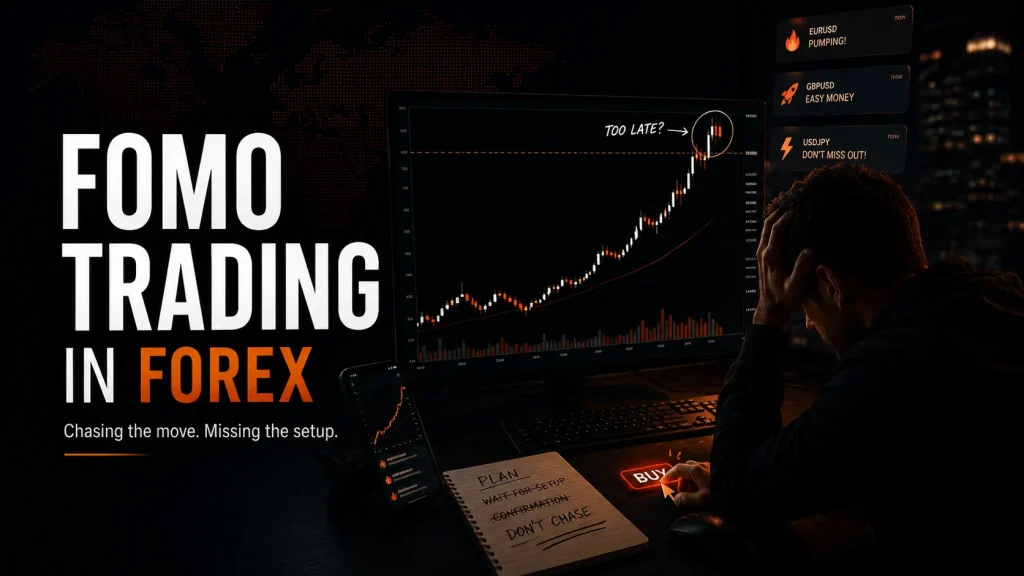
What Is FOMO Trading In Forex?
FOMO trading in forex happens when fear of missing a move starts driving the entry more than the trading plan. The trader may see price accelerating, regret an earlier missed entry, or react to outside commentary and decide that acting now matters more than checking whether the trade still qualifies.
A fast market does not automatically make an entry impulsive. A valid trade can develop quickly. The distinction is whether the setup, invalidation, position size, and risk logic still come from rules that existed before the urge to chase appeared.
This page supports the broader trading psychology guide by focusing on one pre-entry behavior: fear of missing out.
What FOMO Trading Means
FOMO means fear of missing out. In trading, it is the pressure to participate because a move appears to be getting away, other traders seem involved, or missing the opportunity feels unacceptable.
The problem is not noticing momentum or responding quickly to a valid setup. It begins when urgency changes the decision process: the trader accepts a worse entry, skips confirmation, increases size, changes the stop, or alters the analysis mainly to avoid being left out.
| FOMO Feature | What Changes | Why It Matters |
|---|---|---|
| Urgency | The need to act becomes stronger than the need to validate the setup. | Normal entry checks can be skipped. |
| Late entry | Price is already beyond the original entry area. | The stop, target, and potential reward may no longer fit the original plan. |
| Outside influence | A signal, post, chat, or another trader's result becomes the main reason to participate. | The trader may copy direction without understanding the risk. |
| Exposure change | Position size increases because the move looks unusually strong or urgent. | The account takes more exposure at the same time decision quality may be weaker. |
| Emotional relief | Entering reduces the discomfort of being left out. | The order may be solving an emotion rather than expressing a planned trade. |
Valid Opportunity vs FOMO Trade
Some trading plans include breakouts, momentum, or event-aware setups, so speed alone does not define FOMO. The useful distinction is whether the trade still stands on its own after the market has moved.
| Valid Opportunity | FOMO Trade |
|---|---|
| The setup fits criteria written before the move. | The setup is created after price has already moved. |
| The current entry still supports the planned invalidation and exit logic. | The stop or target is changed simply to make the late entry fit. |
| Position size follows the normal risk rule. | Size increases because the opportunity feels exceptional. |
| Outside commentary can be ignored without changing the decision. | Other traders' opinions or results are necessary to justify the entry. |
| Missing the trade is an acceptable outcome. | Missing the move feels like a mistake that must be corrected immediately. |
Why FOMO Happens In Forex Trading
FOMO often combines scarcity, comparison, and regret. A trader may believe there will not be another suitable setup, see other people celebrating a move, or replay an earlier entry that was missed. Those thoughts can make the current candle feel more important than it is.
Recent results can intensify the pressure. After losses, a trader may feel behind and see a fast move as a chance to recover the day. After wins, overconfidence can make the next opportunity seem easier than it is. In both cases, the risk is that recent emotion changes the standards for entry.
- Scarcity: The trader assumes this may be the last good opportunity.
- Comparison: Other traders' apparent success makes waiting feel costly.
- Regret: A missed earlier entry creates pressure to join at a worse price.
- News urgency: Fast movement after a headline makes immediate action feel necessary.
- Recovery pressure: The trader wants the next move to repair an earlier loss.
- Winning-streak confidence: Recent success lowers the normal level of caution.
Warning Signs Of FOMO Trading
FOMO is easiest to interrupt before the order is placed. Warning signs usually appear as changes from the trader's normal entry process.
- Chasing a sharp candle: The entry is taken well after the planned area because price appears to be escaping.
- Skipping confirmation: A required trigger, candle close, or condition is ignored because waiting feels too slow.
- Increasing position size: The move looks strong, so the position becomes larger than the normal rule allows.
- Changing timeframes to justify the trade: The planned timeframe does not provide an entry, so the trader keeps switching charts until one appears to support the desired decision.
- Copying outside ideas without context: The direction is known, but the invalidation, position size, and exit logic are not.
- Adjusting the stop to fit a late entry: Stop placement becomes a compromise rather than a planned invalidation point.
- Re-entering after an early exit: Regret about missing further movement becomes the reason for a second entry.
- Feeling relief immediately after clicking: The order removes the discomfort of missing out even before the trade has proved valid.
FOMO Trading vs Revenge Trading, Overtrading, Greed, And Tilt
These behaviors can overlap, but they start from different triggers. Separating them makes the review more useful.
| Behavior | Main Trigger | Key Difference |
|---|---|---|
| FOMO trading | Fear of missing a move | The trader joins because the opportunity feels as if it is disappearing. |
| Revenge trading | A recent loss or lost profit | The trader tries to restore a previous result. |
| Overtrading | Weak filtering, boredom, habit, FOMO, or revenge | It describes excessive trade frequency rather than one specific emotional trigger. |
| Greed | Wanting more profit | Greed focuses on increasing gain; FOMO focuses on avoiding the feeling of being left out. |
| Tilt | Emotional overload after stress, surprise, fatigue, or loss | Tilt is a broader state; chasing a trade can be one behavior during it. |
| Normal opportunity awareness | A setup that matches the plan | The trader can still skip the trade if entry conditions are no longer acceptable. |
If a chased trade loses and the next decision becomes recovery-focused, the behavior can shift into revenge trading after a loss. For the broader distinction between planned trading and emotional wagering, review when forex trading can become gambling-like.
Why Forex Can Make FOMO Riskier
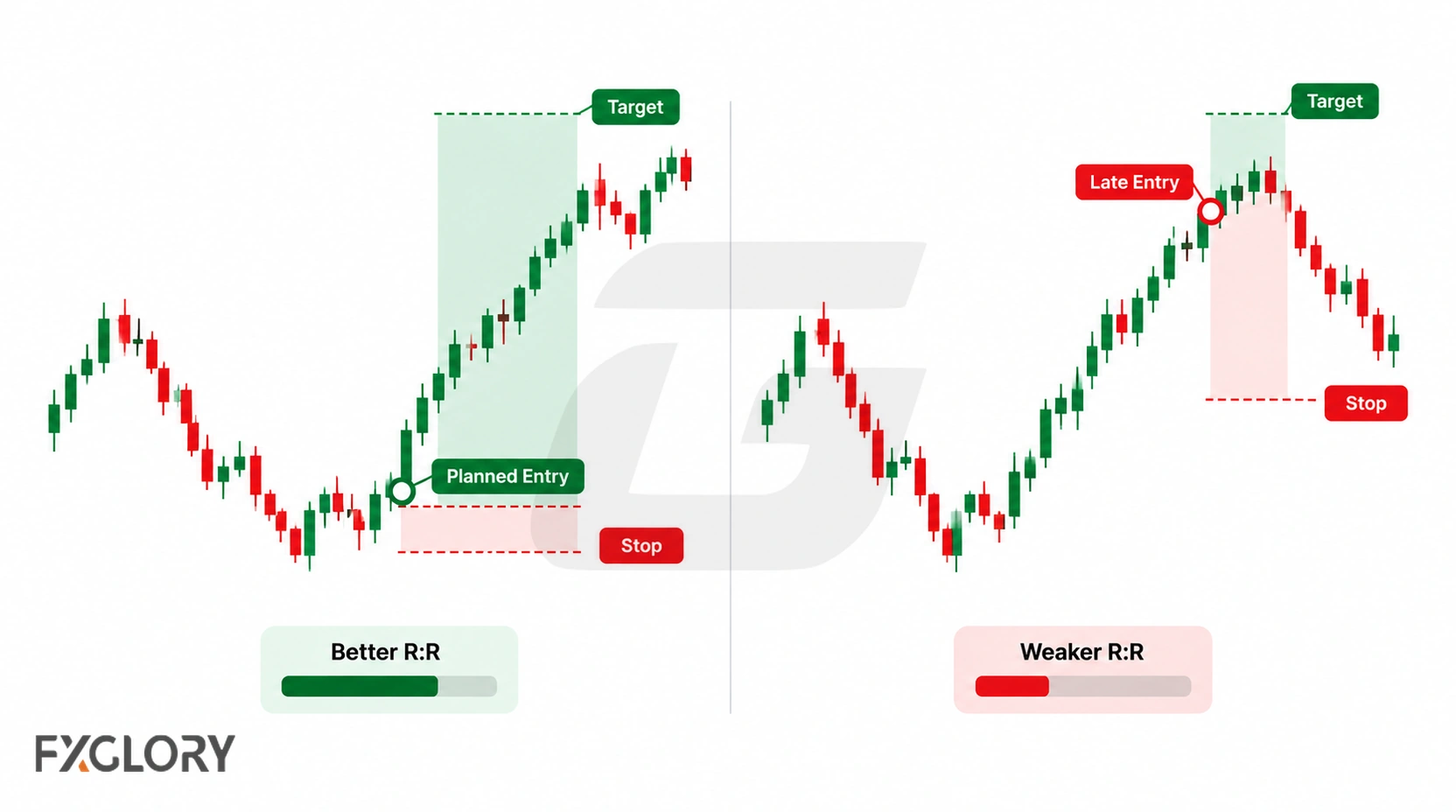
A late entry changes more than the entry price. It can alter the distance to invalidation, the remaining potential reward, transaction-cost sensitivity, and the amount of exposure a trader takes relative to the original plan.
| Forex Factor | How FOMO Can Distort It | What To Review |
|---|---|---|
| Entry and stop distance | Chasing can leave the trader farther from the original invalidation point. | Check whether the current entry still supports the intended stop logic. |
| Potential reward | Part of the expected move may already have occurred before entry. | Recalculate the trade from the current price rather than the missed price. |
| Spreads and execution | Fast conditions can make costs and execution differences more important. | Review current spread and avoid assuming an exact fill. |
| Position size and leverage | Leverage does not make the market move more, but a trader can use it to take greater notional exposure. Increasing size during FOMO can therefore increase the account impact of a given price move. | Keep position size within the normal risk rule instead of increasing exposure because the move looks strong. |
| Margin | A larger position can require more margin and reduce free margin. Margin is not the same as the amount at risk on the trade. | Check required margin separately from the trade's stop-based risk. |
| Correlation | Chasing several pairs can create overlapping exposure to the same currency. | Review combined currency exposure across open positions. |
Before urgency changes position size, FXGlory's margin calculator can help estimate required margin before an order, while the spreads page can help review trading-cost conditions. These tools support planning; they do not determine whether a trade is appropriate.
The 2-Minute FOMO Delay Rule
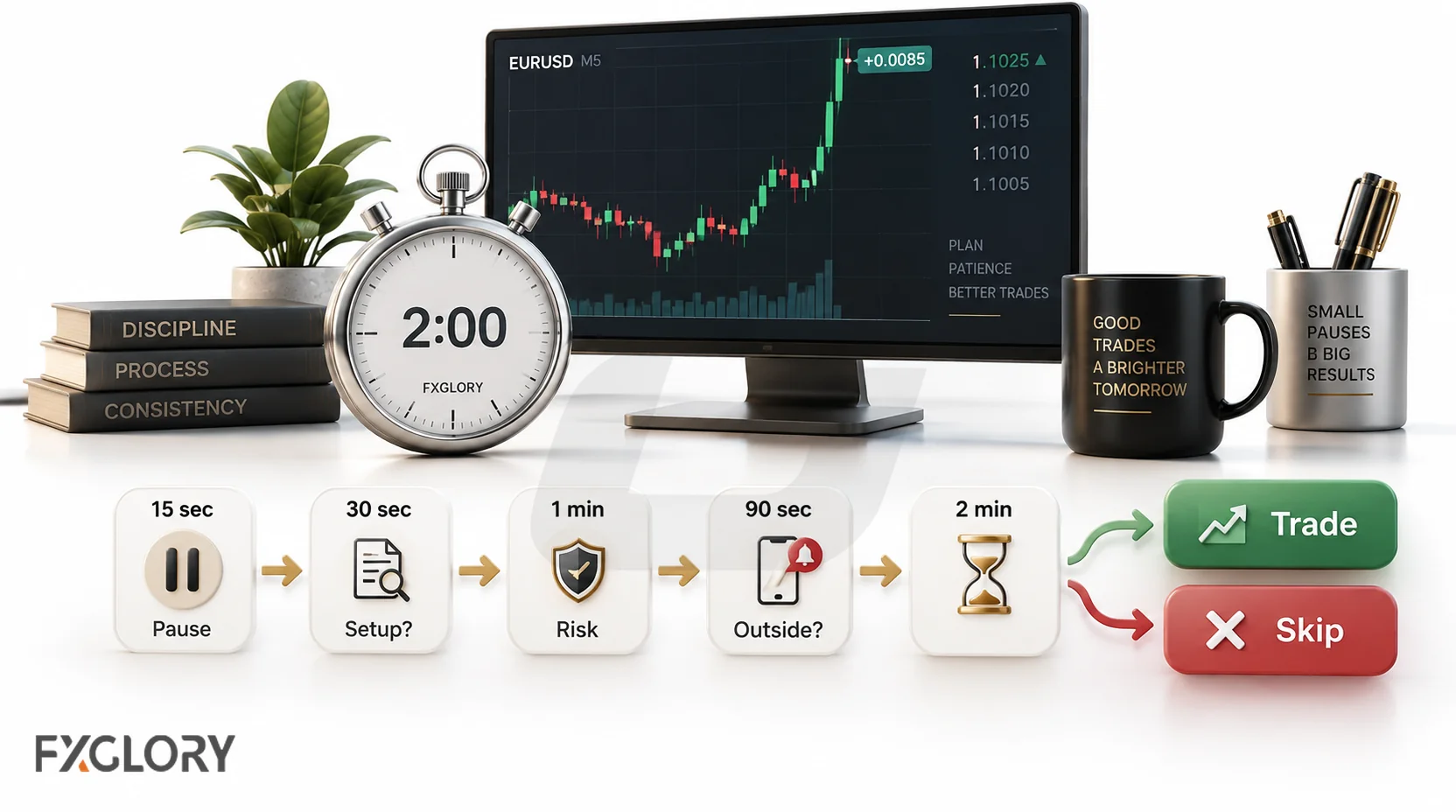
A two-minute delay is an example of an interruption rule, not a universal trading standard. Its purpose is to create enough time between urge and order to check whether the current trade still meets the plan. A trader can use a longer delay if the strategy or emotional state requires it.
| Point In The Delay | Action | Purpose |
|---|---|---|
| Start | Stop interacting with the order ticket. | Interrupt the automatic click. |
| Setup check | Confirm that the market condition and entry logic existed before the urge intensified. | Separate a prepared setup from a chase. |
| Risk check | Review current entry, invalidation, position size, spread, and exit logic. | Make sure the trade still works from the current price. |
| Influence check | Identify whether a signal, post, chat, headline, or another trader's result is adding pressure. | Separate outside urgency from the trader's own method. |
| Decision | Trade only if the current setup still satisfies the written rules; otherwise mark it as missed. | Make the plan, not the fear of missing out, decide. |
Pre-Entry FOMO Checklist
A checklist is useful when it tests the current trade rather than trying to recreate the entry that has already passed.
- Current entry: Is price still inside an entry area allowed by the method?
- Invalidation: Is there a clear level or condition that shows the trade idea is wrong?
- Position size: Does size still follow the normal risk rule without being increased because the move looks strong?
- Potential reward: Has so much of the move already occurred that the original trade structure has materially changed?
- Outside influence: Can the trade be explained without relying on a signal, screenshot, chat room, or another trader's result?
- Missed-trade tolerance: Can the trader accept skipping the order if the current conditions no longer qualify?
These checks belong in a written plan. Use the trading plan template to document entry and no-trade rules, and the risk management guide to structure position and loss limits.
Social Media And Signal-Driven FOMO
Social media can compress context into a result. A screenshot may show profit without showing earlier losses, risk taken, drawdown, invalidation, or whether the trade was even posted before the move. Signal messages can create similar pressure when they provide direction without enough information to evaluate the trade independently.
| Outside Trigger | FOMO Risk | Practical Rule |
|---|---|---|
| Profit screenshot | The trader compares results without seeing the risk behind them. | Do not use another person's result as an entry reason. |
| Signal message | Direction arrives without the trader's own setup and risk context. | Skip the trade unless it independently fits the written method. |
| Fast market commentary | Commentary can make a move feel more time-sensitive than the plan allows. | Use information as context, not as a substitute for entry and risk rules. |
| Chat-room excitement | Group enthusiasm can make participation feel compulsory. | Reduce outside input during trading windows if it repeatedly changes decisions. |
| After-the-fact chart | A completed move looks obvious once the outcome is visible. | Save it for review instead of treating it as a late live entry. |
Journal Fields That Reveal FOMO Trading
A journal can show whether FOMO is occasional or systematic. The useful evidence is the difference between the planned decision and the actual one.
| Journal Field | What To Record | What It Reveals |
|---|---|---|
| Planned vs actual entry | The original entry area and the price actually used. | How often the trader accepts a worse price after hesitation or urgency. |
| Trigger source | Own analysis, news, social media, signal, chat, or another trader's result. | Whether outside influence is associated with impulsive trades. |
| Emotion before entry | Urgency, regret, comparison, excitement, or pressure. | Which state most often precedes rule changes. |
| Position-size change | Normal planned size versus actual size. | Whether exposure rises when FOMO is active. |
| Rule changed | Entry, stop, timeframe, delay, source, or trade-count rule. | Which control needs reinforcement. |
| Missed-trade origin | Whether the order followed an earlier missed or early-exited setup. | Whether regret is creating new trades. |
For a fuller review process, use the forex trading journal guide. A structured sheet is also available in the trading journal template.
Missed-Trade Review: Turn Regret Into A Rule
A missed trade is usually more useful as review data than as a late entry. Reviewing it after the session separates a genuine process problem from the normal reality that not every move will be captured.
| Review Question | Why It Matters | Possible Process Change |
|---|---|---|
| Did the move actually match the written setup? | Prevents hindsight from turning every large move into a missed opportunity. | No change if the trade was never valid. |
| Why was the intended entry missed? | Separates good discipline from avoidable preparation problems. | Add an alert or improve session preparation if appropriate. |
| How different was the later price from the planned entry? | Shows what chasing would have changed. | Define a maximum acceptable deviation or no-chase rule if the method supports one. |
| Was outside information involved? | Identifies whether comparison or commentary amplified regret. | Limit distracting channels during trading windows. |
| What should remain unchanged? | Not every missed move requires a new rule. | Keep the plan stable when the original decision was correct. |
Rules That Help Prevent FOMO Trading
Prevention rules work best when they are decided before the market accelerates.
| Rule | Example Structure | What It Controls |
|---|---|---|
| No-chase rule | If price leaves the method's permitted entry area, the trade is logged as missed. | Late entries after the original setup is gone. |
| Delay rule | A short pause is required before an impulsive market order during fast movement. | Automatic clicking. |
| Normal-size rule | Position size cannot increase because the move appears unusually strong. | Emotion-based exposure increases. |
| Outside-source rule | A signal or social-media idea must independently satisfy the trader's own setup and risk criteria. | Copied trades without context. |
| Timeframe rule | Timeframes are changed only according to the method, not repeatedly after an urge appears. | Using another chart to rationalize a desired entry. |
| Missed-trade rule | Missed entries are reviewed after the session rather than chased live. | Regret-driven orders. |
| Trade-count rule | The session has a pre-defined maximum number of entries. | FOMO expanding into repeated overtrading. |
What To Do After A FOMO Trade Already Happened
A FOMO trade should be treated as a process event, whether it wins or loses. A profitable outcome does not prove that the impulsive entry was good, and a losing outcome does not automatically reveal which rule failed.
- Do not immediately add another trade: First separate the completed decision from any urge to recover or keep chasing.
- Record the trigger: Note whether the order followed a missed entry, sharp candle, news, signal, social media, comparison, or regret.
- Compare plan with execution: Review the planned entry, actual entry, position size, invalidation, and exit logic.
- Identify the first rule change: Find the earliest point where urgency altered the normal process.
- Review the result later: Decide whether a plan change is justified only after the emotional pressure has passed and enough evidence exists.
Sources Used For Risk Context
For broad forex risk context, the CFTC and NASAA warn that retail off-exchange forex trading is extremely risky and caution against high-return, low-risk, get-rich-quick, or pressure-based claims: CFTC/NASAA forex investor alert.
FXGlory's own Risk Disclosure explains trading, leverage, order-execution, one-click trading, stop-loss, and platform risks that can become more important when decisions are rushed.
This page discusses FOMO trading as a behavioral and risk-control problem. It does not provide personal financial advice, mental-health guidance, trading signals, or a promise that any rule can prevent losses.