
What Is Revenge Trading In Forex?
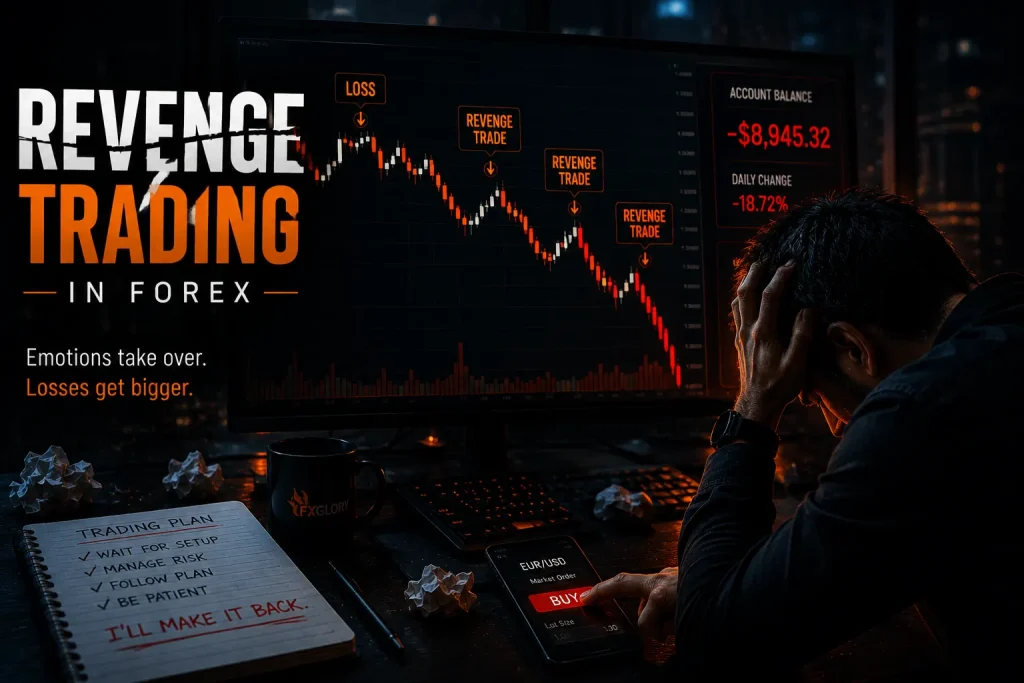
Revenge trading in forex happens when recovering a recent loss or lost profit becomes the main reason for the next trade. Instead of asking whether a fresh setup meets the trading plan, the trader starts trying to restore money, confidence, or a previous account result.
The safest immediate response to that urge is procedural: stop placing new orders, cancel anything that was added impulsively, step away from the screen, record what happened, and wait until the next decision can be checked against the original plan.
This page supports the broader trading psychology guide by focusing on one specific after-loss behavior: revenge trading.
What Revenge Trading Means
Revenge trading is a loss-recovery behavior. The previous result changes the objective of the next decision: the trader is no longer evaluating a setup on its own merits and is instead trying to undo what just happened.
The trigger does not have to be a large closed loss. A small stop-out, lost open profit, or a winning session that turns negative can create the same urge. The behavior can also move to another currency pair or instrument; what defines revenge trading is the recovery motive, not the symbol being traded.
| Feature | What Changes | Why It Matters |
|---|---|---|
| Objective | The goal shifts from following the plan to recovering a previous result. | The next trade is evaluated through the loss rather than independently. |
| Timing | The trader feels pressure to act before fully reviewing the setup. | Urgency can bypass normal entry checks. |
| Exposure | Position size or total currency exposure increases outside the usual rule. | A normal price move can have a larger account-level impact. |
| Trade management | Stops, exits, or trade count are changed to avoid accepting the loss. | The original risk framework no longer controls the position. |
Planned Re-Entry vs Revenge Re-Entry
A trade after a loss is not automatically a revenge trade. Some strategies allow another entry when a new trigger appears. The useful distinction is whether the new trade can stand on its own under rules that existed before the loss.
| Planned Re-Entry | Revenge Re-Entry |
|---|---|
| A fresh setup satisfies criteria written before the session. | The previous loss creates the need for another trade. |
| Position sizing follows the normal risk rule. | Size is increased to recover faster. |
| The trader waits for the required trigger and timing conditions. | The trader enters early or immediately because waiting feels intolerable. |
| Existing cooldown, trade-count, and loss-limit rules remain active. | Those safeguards are negotiated away after the loss. |
Why Revenge Trading Happens After Losses
A loss can create a strong need to remove discomfort quickly. That discomfort may be interpreted as unfairness, failure, embarrassment, or a threat to the day's financial goal. Another trade can then feel like a way to erase both the monetary result and the emotion attached to it.
Anger is only one possible trigger. Shame can make a trader hide a mistake by trying to repair it immediately. Urgency can appear when the session is negative. Fear can make stopping feel like accepting defeat. Financial pressure can make an ordinary losing trade feel unacceptable.
- Anger: The trader wants to prove the market or previous decision wrong.
- Shame: The trader tries to fix a rule break before acknowledging it.
- Urgency: Ending the session negative starts to feel unacceptable.
- Fear: Stopping feels like making the loss permanent.
- Overconfidence: The trader assumes one larger trade can repair the session.
- Financial pressure: Money needed for another purpose becomes attached to the next result.
The presence of emotion is not itself the problem. The risk rises when emotion starts determining entry, size, direction, stop placement, or whether the session should continue.
Revenge Trading vs Overtrading, FOMO, Tilt, Averaging Down, And Gambling
Several behaviors can look similar on a chart but begin from different triggers. Separating them helps a trader review the correct problem.
| Behavior | Main Trigger | Key Difference |
|---|---|---|
| Revenge trading | A recent loss or lost profit | The trader tries to restore the previous result. |
| Overtrading | Weak filtering, boredom, excitement, or habit | Too many trades can occur without a preceding loss. |
| FOMO trading | Fear of missing a move | The trader chases an opportunity rather than a previous loss. |
| Tilt | Emotional overload after stress, surprise, fatigue, or loss | Tilt is a broader state; revenge trading is one possible behavior during it. |
| Averaging down | Adding to a losing position | It becomes revenge-like when additions break pre-defined exposure or risk rules. |
| Gambling-like trading | Excitement, loss-chasing, or emotional relief | Revenge trading becomes gambling-like when recovery replaces a structured decision process. |
For the broader distinction between structured trading and loss-chasing, read when forex starts to look like a wager instead of a process.
Warning Signs Of Revenge Trading
The clearest signs are changes from the trader's normal process immediately after a loss or lost profit.
- Break-even fixation: The trader focuses on recovering a specific amount rather than waiting for a qualifying setup.
- Unplanned re-entry: Another position is opened before the normal review or cooldown is complete.
- Size escalation: Position size increases because the previous trade lost.
- Direction flipping: A buy becomes an immediate sell, or vice versa, without a fresh reason from the trading method.
- Stop changes: The trader widens or removes a stop mainly to avoid accepting another loss.
- Exposure stacking: A second pair is opened without recognizing that it may express the same currency view.
- Plan exceptions: Setup, session, news, or trade-count rules suddenly feel negotiable.
- Difficulty stopping: The session becomes about emotional relief instead of planned execution.
Why Forex Can Make Revenge Trading Worse
Forex does not cause revenge trading, and leverage does not make market prices move more. The danger comes from how quickly an emotional decision can change account exposure and trading conditions.
| Forex Factor | Why It Matters After A Loss | What To Review |
|---|---|---|
| Leverage | Leverage can allow greater notional exposure with less margin. If exposure is increased after a loss, a given price move can have a larger account-level profit-or-loss impact. | Compare intended notional exposure and position size with the pre-trade risk rule. |
| Margin | A larger position can require more margin and reduce free margin. Margin is a funding requirement, not the same as the amount the trader is willing to lose. | Check required margin separately from stop-based trade risk. |
| Spreads | Frequent short-term re-entries add transaction costs, and spreads can vary with market conditions. | Include current trading costs in the setup review. |
| Slippage and fast movement | An order can execute at a different price than expected, especially around fast or thin conditions. | Avoid making emotional assumptions about exact entry or exit prices. |
| Correlated exposure | Different pairs can still depend on the same currency move. | Review total currency exposure across open positions. |
| Fast timeframes | Another apparent setup can appear within seconds. | Use the pre-written interruption rule before reopening the platform. |
Before emotion changes position size, FXGlory's margin calculator can help estimate required margin before an order, while the spreads page can help review trading-cost conditions. These tools support planning; they do not determine whether a trade is appropriate.
The First 5 Minutes After A Loss
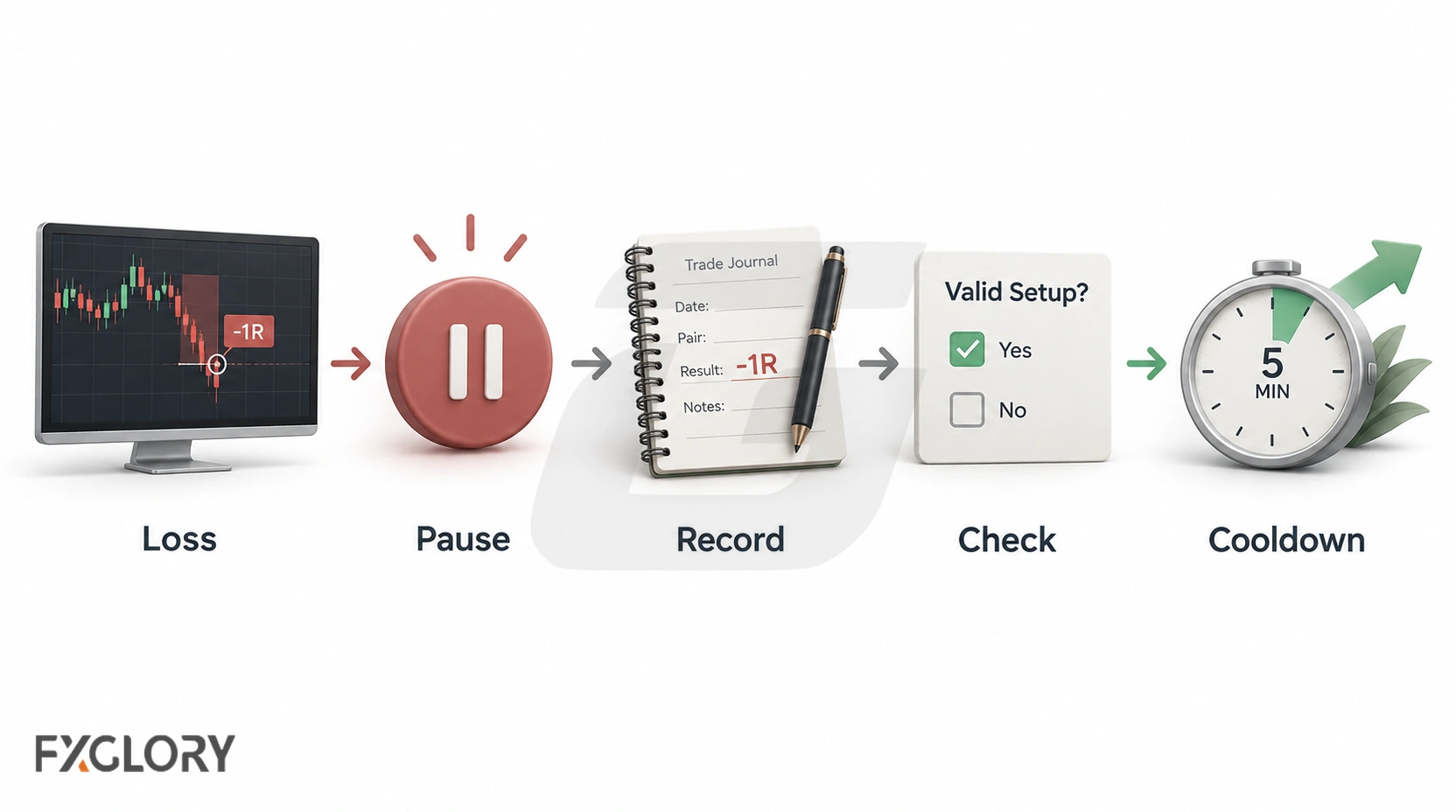
A short reset can separate the completed trade from the next decision. Five minutes is an example workflow, not a universal minimum; a trader's written plan may require a longer break or the end of the session.
| Time | Action | Purpose |
|---|---|---|
| First 30 seconds | Stop interacting with the order ticket and cancel any order added impulsively after the loss. | Create a physical interruption. |
| Minutes 1-2 | Record the result, planned risk, and whether the trade followed its rules. | Turn the loss into review data rather than a recovery target. |
| Minutes 2-3 | Check the session's daily loss, trade-count, and cooldown conditions. | Determine whether trading is still permitted under the plan. |
| Minutes 4-5 | Leave the screen and let the defined cooldown continue. | Reduce the pressure for immediate action. |
| After the break | Return only if the plan still permits trading and a new setup independently satisfies its criteria. | Separate permission to trade from the desire to recover. |
How To Stop Revenge Trading Mid-Session
If the urge is already active, a written interruption sequence is more useful than a vague promise to be disciplined.
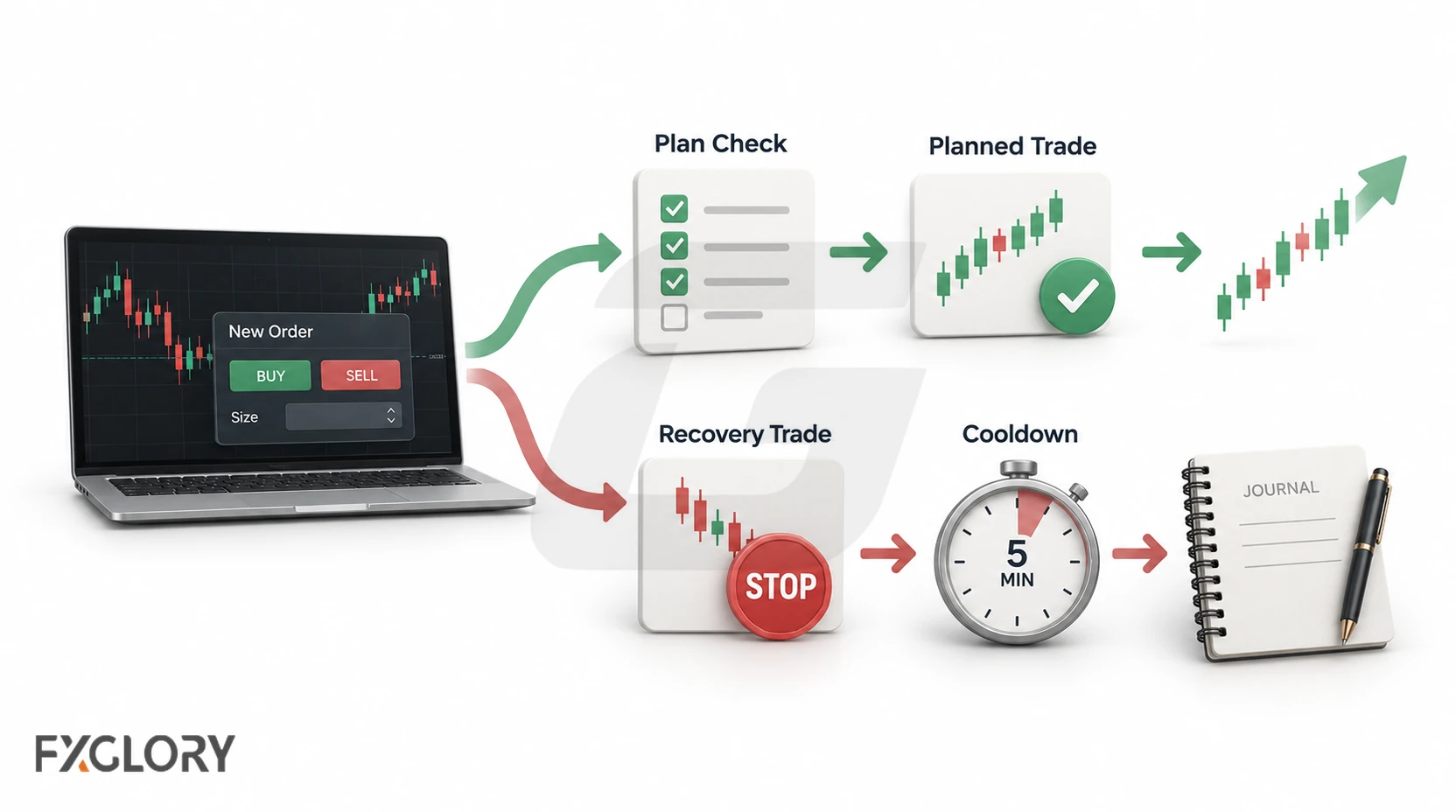
- Name the trigger: Write whether the urge followed a stop-out, lost profit, rule break, missed move, or other frustration.
- Freeze exposure changes: Do not add, reverse, resize, or open another correlated position while reviewing the state.
- Apply the session rules: Check the daily loss limit, trade-count limit, cooldown, and any rule that ends trading after a violation.
- Separate setup from recovery: A new market signal does not cancel a broken risk rule.
- End the session when required: If a hard stop condition has been reached, close the platform rather than searching for an exception.
If this pattern repeats, review the broader process habits in process quality instead of one-trade recovery.
How To Avoid Revenge Trading In Forex
Prevention works best when the rules are written before a loss occurs. The aim is to reduce the number of decisions that must be improvised during stress.
| Rule | Example Structure | What It Controls |
|---|---|---|
| Daily loss limit | Trading ends when the pre-set session loss threshold is reached. | Loss-chasing after the account reaches its planned limit. |
| Consecutive-loss rule | A defined break follows a specified number of consecutive losses. | Acceleration after repeated frustration. |
| No size increase after loss | The next permitted trade cannot use larger position size simply because the previous trade lost. | Recovery-based exposure changes. |
| Cooldown rule | A fixed break follows a large loss, emotional spike, or rule violation. | Immediate reactive entries. |
| Trade-count limit | The session has a maximum number of entries. | Repeated attempts to force a recovery. |
| Independent setup check | Every new trade must satisfy the same pre-session entry criteria. | Lowering standards after a loss. |
| Stop-adjustment rule | A stop can be changed only for reasons defined in the original method. | Widening risk because another loss feels unacceptable. |
These controls belong in the written plan rather than in memory. Use the trading plan template to document cooldowns and stop conditions, and the risk management guide to structure position and loss limits.
Journal Fields That Reveal Revenge Trading
A journal is most useful when it records the link between the previous result and any change in behavior. Profit and loss alone cannot show that pattern.
| Journal Field | What To Record | Why It Helps |
|---|---|---|
| Previous result | Closed loss, lost open profit, or session drawdown before the next decision. | Shows whether the pattern follows a specific type of setback. |
| Time to next order | Minutes between the loss and the next submitted order. | Reveals whether reactive entries cluster immediately after losses. |
| Emotion | Anger, shame, urgency, fear, overconfidence, or financial pressure. | Identifies the trigger most associated with rule breaks. |
| Position-size change | Normal size versus the size used after the loss. | Shows whether exposure increases during recovery attempts. |
| Rule status | Which entry, risk, cooldown, stop, or trade-count rule was followed or broken. | Identifies the control that needs reinforcement. |
| Session outcome | What happened after the first rule break, including whether trading stopped. | Measures the cost of continuing versus interrupting the pattern. |
For a fuller review process, use the forex trading journal guide. A structured sheet is also available in the trading journal template.
What To Do After A Revenge Trade Already Happened
Once a revenge trade has occurred, the priority is to stop the sequence rather than repair it with another market decision.
- End new trading for the required period: Follow the session-stop or rule-violation condition already written in the plan.
- Record the trigger: Note what happened immediately before the revenge trade.
- Identify the first process break: Find the earliest point where entry, size, stop, cooldown, or loss-limit rules changed.
- Compare planned and actual exposure: Review position size, total currency exposure, and any extra risk created by the rule break.
- Review later: Analyze the event after the emotional pressure has passed rather than using another trade as the review.
Sources Used For Risk Context
For broad forex risk context, the CFTC and NASAA warn that retail off-exchange forex trading is extremely risky and that traders should be cautious with high-return, low-risk, get-rich-quick, or pressure-based claims: CFTC/NASAA forex investor alert.
FXGlory's own Risk Disclosure explains trading, leverage, order-execution, one-click trading, stop-loss, and platform risks that can become more important when a trader is acting emotionally.
This page discusses revenge trading as a behavioral and risk-control problem. It does not provide personal financial advice, mental-health guidance, trading signals, or a promise that any rule can prevent losses.