What Is a Pip in Forex Trading?
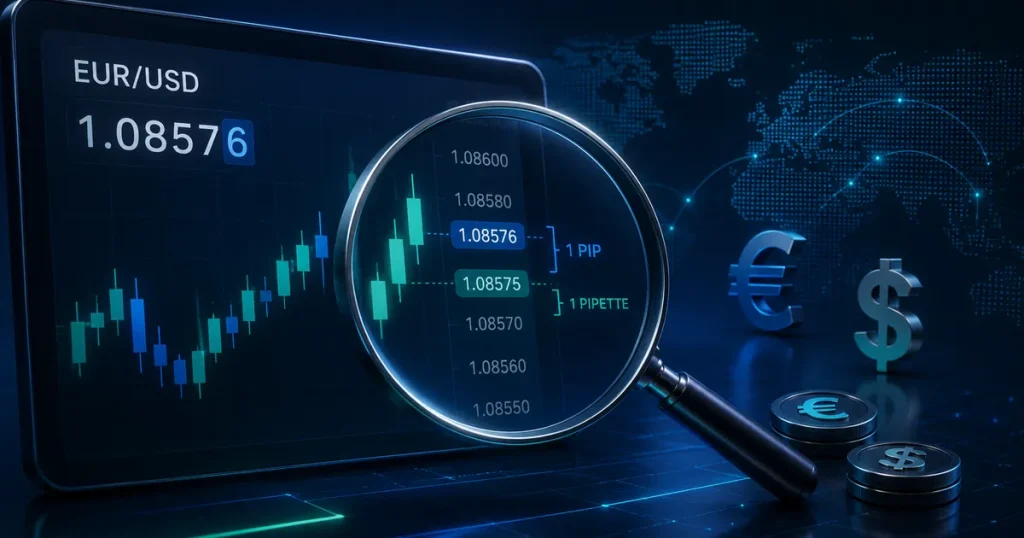
A pip is a standard unit used to measure price movement in a forex currency pair. Traders use pips to describe how far a pair has moved, how wide a spread is, where a stop loss is placed, and how large a target is.
For most forex pairs, one pip is usually the fourth decimal place, or 0.0001. For many Japanese yen pairs, one pip is usually the second decimal place, or 0.01.
For example, if EUR/USD moves from 1.1000 to 1.1050, that is a 50-pip move. If USD/JPY moves from 150.00 to 150.50, that is also a 50-pip move.
Quick Answer: What Is a Pip in Forex?
This means a pip is useful for reading charts, comparing spreads, setting stop losses, planning targets, and reviewing trade results. But the pip count alone is not enough to know profit or loss. To understand the money impact, you need pip value and position size.
What Are Pips in Forex Trading?
Pips in forex trading are the small units used to count exchange-rate movement. Instead of describing every movement with long decimal numbers, traders use pips as a shorter and clearer measurement.
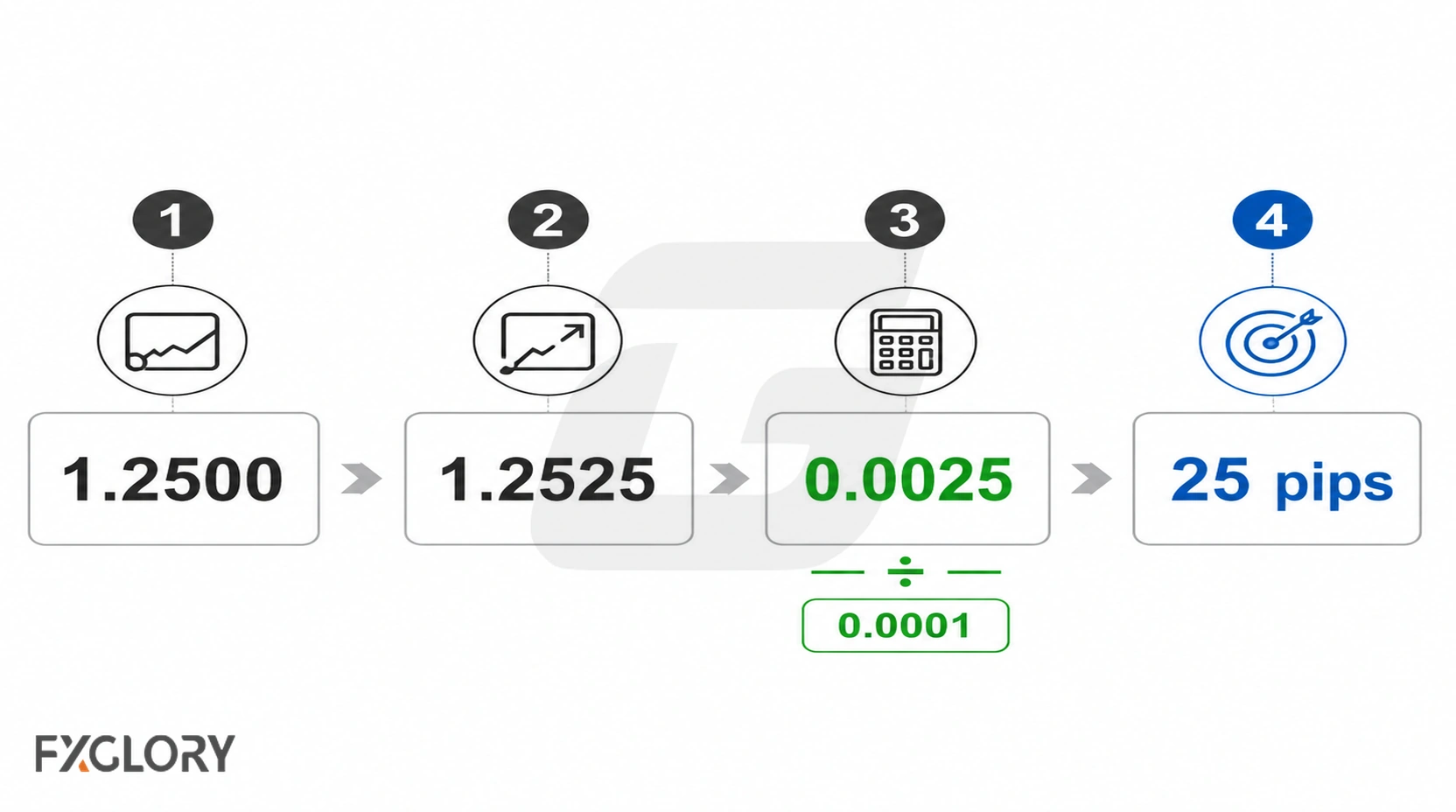
For example, a move from 1.2500 to 1.2525 on EUR/USD is usually described as a 25-pip move. A move from 149.20 to 149.45 on USD/JPY is also usually described as a 25-pip move.
Pips are used in several parts of forex trading:
- Price movement: How far a pair moved up or down.
- Spread: The difference between the bid price and ask price.
- Stop loss: The distance between entry and the planned exit if the trade goes wrong.
- Target: The distance between entry and the planned profit area.
- Trade review: How much the trade moved in favor of or against the trader.
What Does Pip Stand For in Forex?
Pip is often explained as percentage in point or price interest point. In day-to-day forex trading, the exact phrase matters less than the practical meaning: a pip is the standard way traders measure small movements in currency pairs.
Beginners often ask what pip means because forex prices can have several decimal places. Pips make those small price changes easier to talk about. Instead of saying EUR/USD moved from 1.1000 to 1.1050, a trader can say it moved 50 pips.
Where Is the Pip? Decimal Places Explained
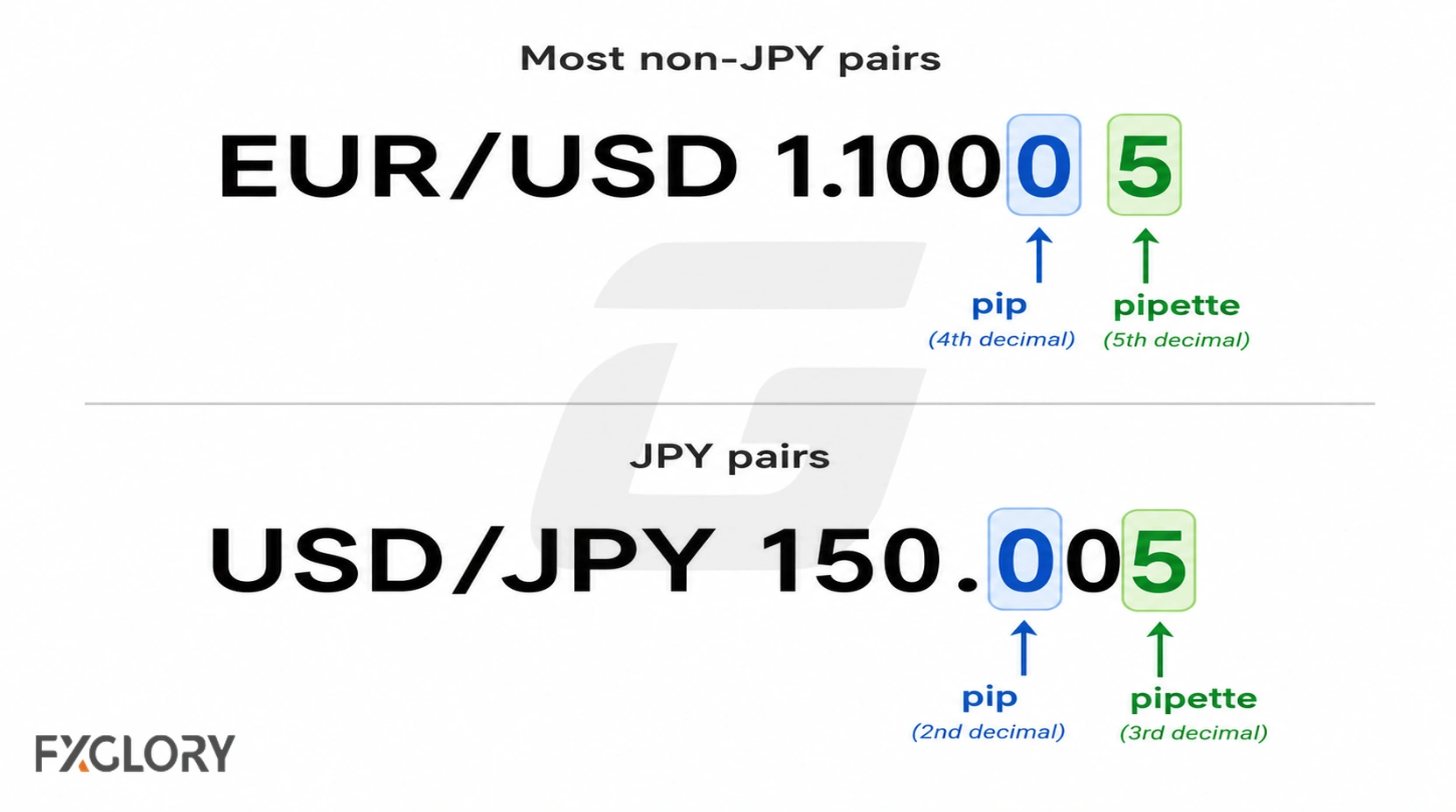
The easiest way to understand pips is to look at where the pip digit appears in the quote. Most non-JPY pairs use the fourth decimal place as the pip. Many JPY pairs use the second decimal place as the pip.
| Pair Type | Example Quote | Pip Digit | Pipette Digit | 1-Pip Move Example |
|---|---|---|---|---|
| Most non-JPY pairs | 1.1000 | Fourth decimal | Fifth decimal if shown | 1.1000 to 1.1001 |
| Most non-JPY pairs with pipette | 1.10005 | Fourth decimal | Fifth decimal | 1.10000 to 1.10010 |
| Many JPY pairs | 150.00 | Second decimal | Third decimal if shown | 150.00 to 150.01 |
| Many JPY pairs with pipette | 150.005 | Second decimal | Third decimal | 150.000 to 150.010 |
Pip Example Using EUR/USD
EUR/USD is commonly quoted with four or five decimal places. When using the standard four-decimal pip convention, one pip is 0.0001.
Imagine EUR/USD moves from 1.1000 to 1.1050. The difference is 0.0050. Since one pip is 0.0001, the move is 50 pips.
- Starting price: 1.1000
- Ending price: 1.1050
- Difference: 0.0050
- Pip size: 0.0001
- Move: 50 pips
If a trader bought EUR/USD at 1.1000 and exited at 1.1050, the price moved 50 pips in the trader's favor before considering spread, execution, swap, or other trading conditions. If the trader sold EUR/USD instead, the same 50-pip rise would have moved against the trade.
Pip Example Using USD/JPY
JPY pairs are usually read differently. For many yen pairs, one pip is the second decimal place, or 0.01.
Imagine USD/JPY moves from 150.00 to 150.50. The difference is 0.50. Since one pip is 0.01, the move is 50 pips.
- Starting price: 150.00
- Ending price: 150.50
- Difference: 0.50
- Pip size: 0.01
- Move: 50 pips
This is why beginners should not count every pair the same way. EUR/USD and USD/JPY can both move 50 pips, but the decimal place used to count that movement is different.
Pips vs Pipettes in Forex
A pipette is one-tenth of a pip. Many modern trading platforms show fractional pip pricing, which means the quote includes one extra decimal place beyond the standard pip position.
For many non-JPY pairs, one pip is 0.0001 and one pipette is 0.00001. For many JPY pairs, one pip is 0.01 and one pipette is 0.001.
| Pair Type | Common Pip Position | Common Pipette Position | Example |
|---|---|---|---|
| Most non-JPY pairs | Fourth decimal | Fifth decimal | 1.1000 to 1.1001 = 1 pip |
| Many JPY pairs | Second decimal | Third decimal | 150.00 to 150.01 = 1 pip |
If EUR/USD is quoted as 1.10005, the final digit is a pipette. If USD/JPY is quoted as 150.005, the final digit is also a pipette. Pipettes allow platforms to show more precise pricing, but beginners should first understand full pips before working with fractional pips.
How to Count Pips
To count pips, first identify whether the pair is usually measured at the fourth decimal place or the second decimal place. Then compare the entry price with the exit price, target, or stop-loss level.
- Check the pair: Is it a JPY pair or a non-JPY pair?
- Find the pip position: Most non-JPY pairs use 0.0001; many JPY pairs use 0.01.
- Subtract the prices: Compare the start and end prices.
- Convert the difference into pips: Divide the price difference by the pip size.
- Check direction: A pip move can be favorable or unfavorable depending on whether the trade was a buy or sell.
For example, EUR/USD moving from 1.2500 to 1.2525 is 25 pips. USD/JPY moving from 149.20 to 149.45 is also 25 pips.
Pip vs Pip Value
A pip and pip value are related, but they are not the same thing. This is one of the most important beginner distinctions in forex trading.
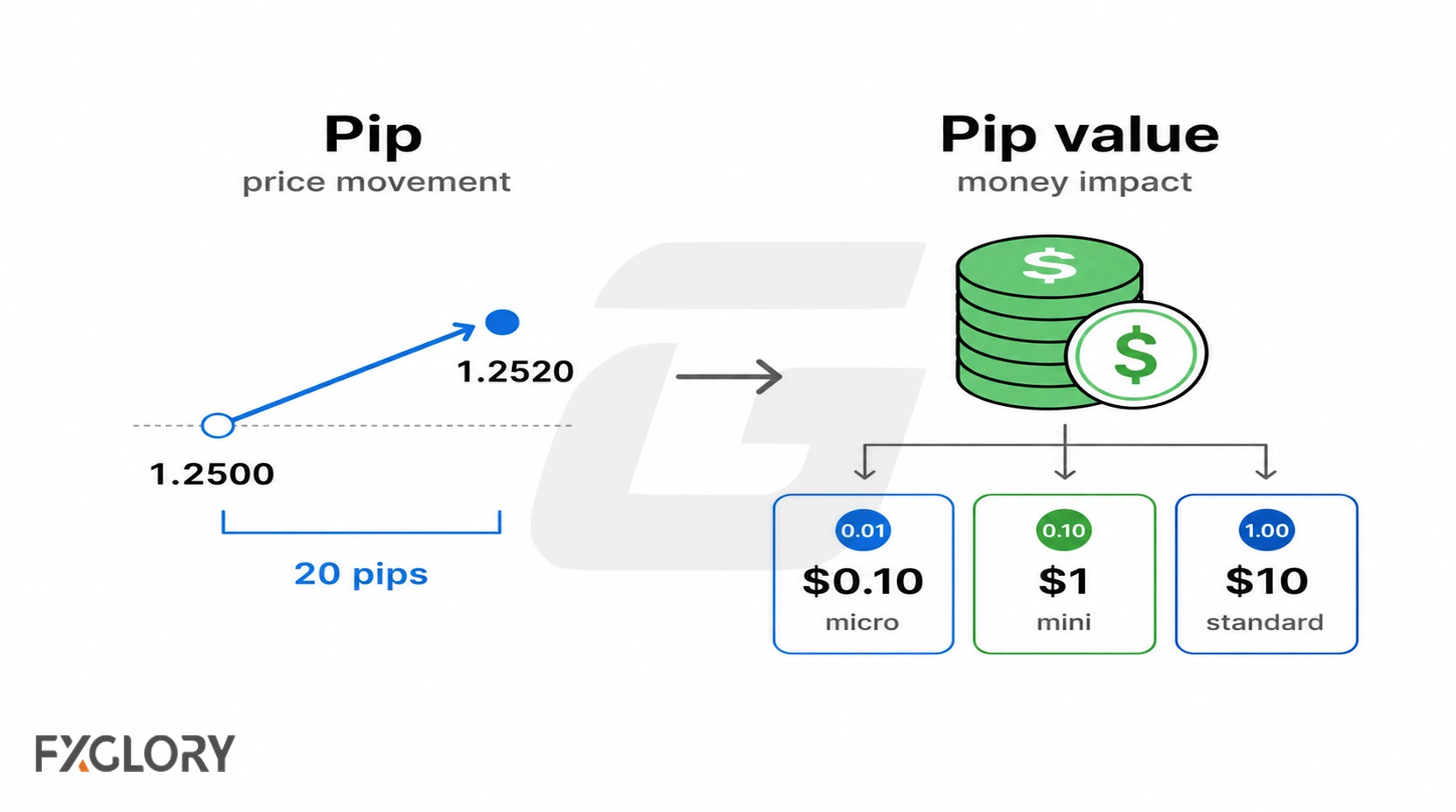
- Pip: Measures how far the price moved.
- Pip value: Measures how much money one pip is worth for a specific position.
For example, a 20-pip move describes price distance. It does not automatically tell you whether the trade gained or lost $2, $20, $200, or another amount. The money result depends on position size, pair, exchange rate, account currency, spread, and execution.
A useful beginner rule is to separate the chart question from the account question. The chart question is: how many pips did price move? The account question is: how much is each pip worth on this position size?
How to Calculate Pip Value
Pip value is the money value of a one-pip move. The basic calculation starts with the pip size and position size, but beginners should be careful about the currency the result is expressed in.
For many non-JPY pairs where USD is the quote currency, such as EUR/USD, simplified examples are easier to understand because the pip value is already expressed in U.S. dollars when the account currency is also USD.
Example using EUR/USD and a standard lot:
- Pip size: 0.0001
- Position size: 100,000 units
- Calculation: 0.0001 × 100,000 = 10
- Simplified pip value: About $10 per pip when the result is in USD
This does not mean every pip in every pair is always worth $10. It means that in this simplified EUR/USD standard-lot example, one pip is about $10 before costs and adjustments.
If the account currency is different from the quote currency, or if the pair has a different quote structure, the pip value may need another conversion step. This is why platform pip-value calculators and position-size tools are useful before trading live.
Pip Value and Lot Size
Lot size controls how much each pip movement can affect the trading account. This is why beginners should not learn pips separately from position sizing.
On many USD-quoted pairs, forex education examples often use the following simplified pip values:
| Lot Type | Common Unit Size | Approx Pip Value on Many USD-Quoted Pairs | What It Means |
|---|---|---|---|
| Standard lot | 100,000 units | About $10 per pip | A 10-pip move is about $100 before costs and adjustments. |
| Mini lot | 10,000 units | About $1 per pip | A 10-pip move is about $10 before costs and adjustments. |
| Micro lot | 1,000 units | About $0.10 per pip | A 10-pip move is about $1 before costs and adjustments. |
These are common simplified examples, not universal values. Actual pip value can change depending on the pair, exchange rate, account currency, and platform settings.
To understand the trade-size side of the calculation, read what is a lot size in forex.
Worked Example: Pips, Pip Value, and Trade Risk
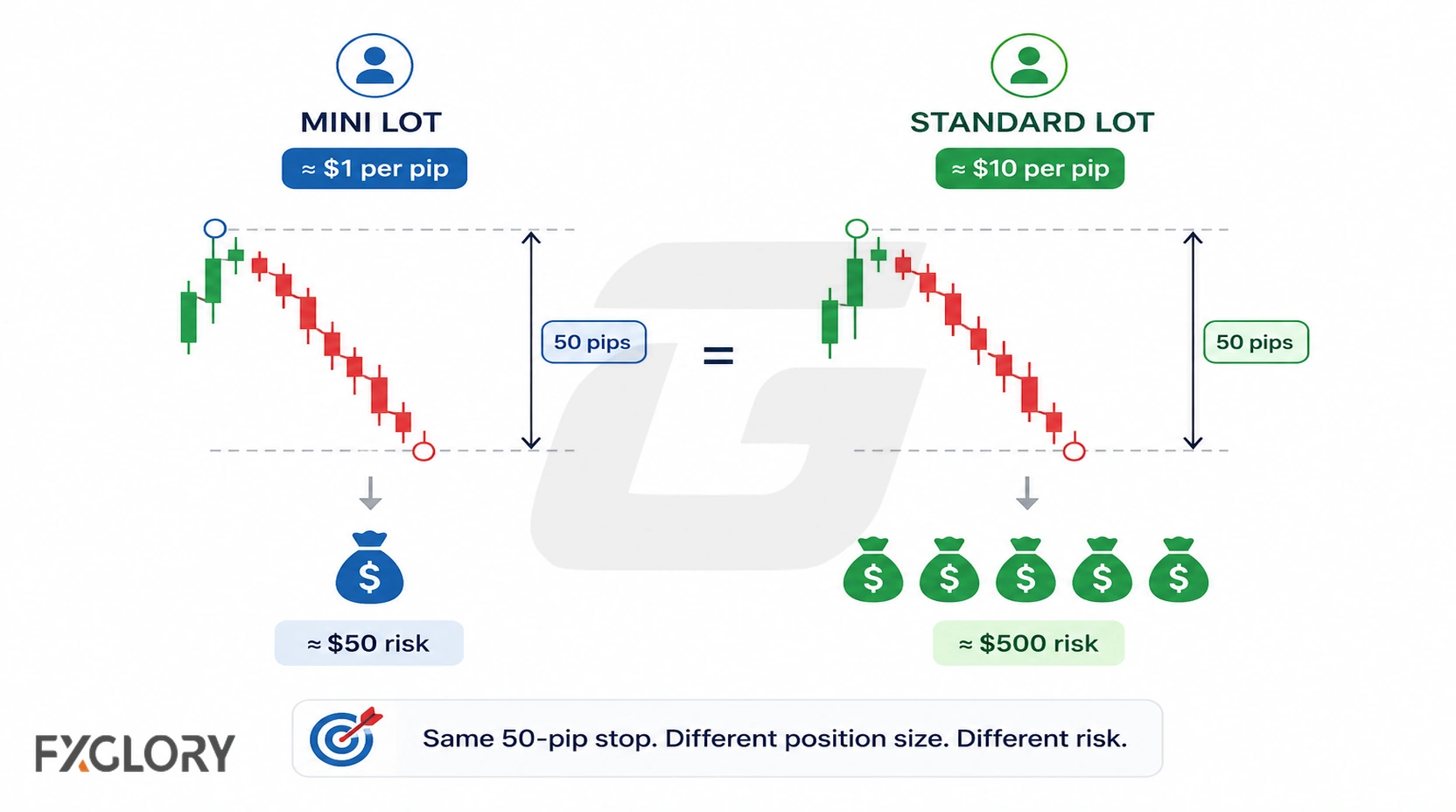
Pips become more useful when they are connected to risk. A stop loss measured in pips only tells you the price distance. To estimate possible money risk, you also need pip value.
Imagine a trader plans a EUR/USD trade with these assumptions:
- Entry price: 1.1000
- Stop-loss price: 1.0950
- Pip distance: 50 pips
- Position size: Mini lot
- Simplified pip value: About $1 per pip
If the same 50-pip stop were used with a standard lot at about $10 per pip, the estimated risk would be about $500 before costs and adjustments. The pip distance is the same, but the money risk is much larger because the position size is larger.
How Pips Relate to Spread
The spread is the difference between the bid price and the ask price. In forex, spreads are often discussed in pips or pipettes.
For example, if EUR/USD has a bid price of 1.1000 and an ask price of 1.1002, the spread is 2 pips. If the prices are shown with five decimals, the spread may also be shown in fractional pips.
Spread matters because it affects the cost of entering and exiting a trade. A trade usually needs to move enough to overcome the spread before it can show a net gain, depending on platform conditions and execution.
For a focused explanation of bid, ask, and spread, see bid and ask price in forex. For the broader quote structure, see how to read forex quotes.
How Leverage Relates to Pips
Leverage is often mentioned with pips, but the relationship should be understood carefully. Leverage does not change the value of a pip by itself. Position size changes pip value.
However, leverage can allow a trader to open a larger position with less margin. A larger position size can make each pip movement worth more money. This is why leverage can indirectly make pip movement more significant for the account.
- Same position size: Leverage does not change pip value by itself.
- Larger position size: Each pip can have a larger money impact.
- Higher leverage: May make it easier to open larger positions, which can increase risk if not controlled.
For more context, see what is leverage in forex trading.
Common Beginner Mistakes With Pips
Many beginners learn the definition of a pip but still make mistakes when applying it to live or demo trading. These mistakes usually come from confusing pip movement with money risk.
- Confusing pips with profit: A trade can gain pips, but the money result depends on pip value and position size.
- Ignoring JPY quote differences: Many JPY pairs use the second decimal place for one pip, not the fourth.
- Forgetting pipettes: The last digit on a five-decimal quote may be a pipette, not a full pip.
- Ignoring the spread: Spread can reduce the effective result of a trade.
- Using too much lot size: Larger position sizes make each pip worth more money.
- Counting only the target: Beginners may focus on possible pips gained without measuring possible pips lost.
- Ignoring trade direction: A 20-pip move is helpful only if it moves in the trade's planned direction.
- Assuming pip value is always fixed: Pip value can vary by pair, exchange rate, account currency, and position size.
- Thinking leverage changes pip value directly: Leverage does not change pip value by itself; position size does.
The goal is not only to count pips correctly. The goal is to understand what pip movement means for the specific trade, position size, and risk plan.
Quick Recap: Forex Pips Explained
A pip is a standard unit used to measure price movement in a forex pair. For most non-JPY pairs, one pip is usually 0.0001. For many JPY pairs, one pip is usually 0.01. A pipette is one-tenth of a pip and is often shown as an extra decimal place.
Pips help traders describe movement, spreads, stop losses, targets, and trade results. But a pip is not money by itself. Pip value depends on lot size, currency pair, exchange rate, and account currency.
Leverage does not directly change pip value. Position size changes pip value, while leverage can make it easier to open a larger position. Beginners should learn pips together with quotes, spread, lot size, leverage, and risk management. For the full beginner pathway, return to forex basics for beginners.
Frequently Asked Questions
What is a pip in forex trading?
A pip is a standard unit used to measure movement in a forex currency pair. For most pairs, one pip is usually 0.0001. For many JPY pairs, one pip is usually 0.01.
What are pips in forex trading?
Pips are units used to count price movement in forex pairs. Traders use pips to measure spreads, targets, stop-loss distance, and trade results.
What does pip mean in forex?
In forex, pip means the small price movement used to describe how far a currency pair has moved. It is a price-distance unit, not money by itself.
What does pip stand for in forex?
Pip is often explained as percentage in point or price interest point. In practical forex trading, it is used as the standard unit for measuring currency-pair movement.
What is the difference between a pip and a pipette?
A pipette is one-tenth of a pip. If one pip is 0.0001, one pipette is 0.00001. On many JPY pairs, if one pip is 0.01, one pipette is 0.001.
Is a pip the same as money?
No. A pip measures price movement. Pip value measures the money impact of that movement. Pip value depends on the currency pair, lot size, exchange rate, and account currency.
How do you calculate pip movement?
Subtract the starting price from the ending price, then divide the price difference by the pip size. For EUR/USD, a move from 1.1000 to 1.1050 is 0.0050 divided by 0.0001, which equals 50 pips.
How much is one pip worth?
One pip does not have one fixed money value. On many USD-quoted pairs, simplified examples often use about $10 per pip for a standard lot, $1 per pip for a mini lot, and $0.10 per pip for a micro lot, but actual pip value can vary by pair, exchange rate, and account currency.
Does leverage change pip value?
Leverage does not change pip value by itself. Position size changes pip value. However, leverage can allow a trader to open a larger position with less margin, which can make each pip movement affect the account more.
How many pips is 1.1000 to 1.1050?
The move from 1.1000 to 1.1050 is 50 pips because most non-JPY pairs measure one pip at the fourth decimal place.
How many pips is 150.00 to 150.50 on USD/JPY?
The move from 150.00 to 150.50 is 50 pips because many JPY pairs measure one pip at the second decimal place.
Why are pips important in forex?
Pips are important because they help traders measure price movement, compare spreads, set stop losses, plan targets, calculate pip value, and manage trade risk.
Related Contents
Practice Before Trading Live
Use a free demo account to test your strategy, risk rules, and execution process before placing a real-money trade.
Open a Free Demo Account