Time Zone: GMT +3
Time Frame: Daily (D1) / Weekly Outlook
Weekly Fundamental Overview:
The USD/ZAR currency pair remains sensitive to economic data trends and global risk sentiment. High-impact US releases, including GDP updates, inflation gauges, and comprehensive labor market data, serve as major catalysts for US Dollar valuations. Market participants continue to gauge underlying economic resilience and interest rate expectations, which directly influence flows into emerging market currencies like the South African Rand.
Price Action:
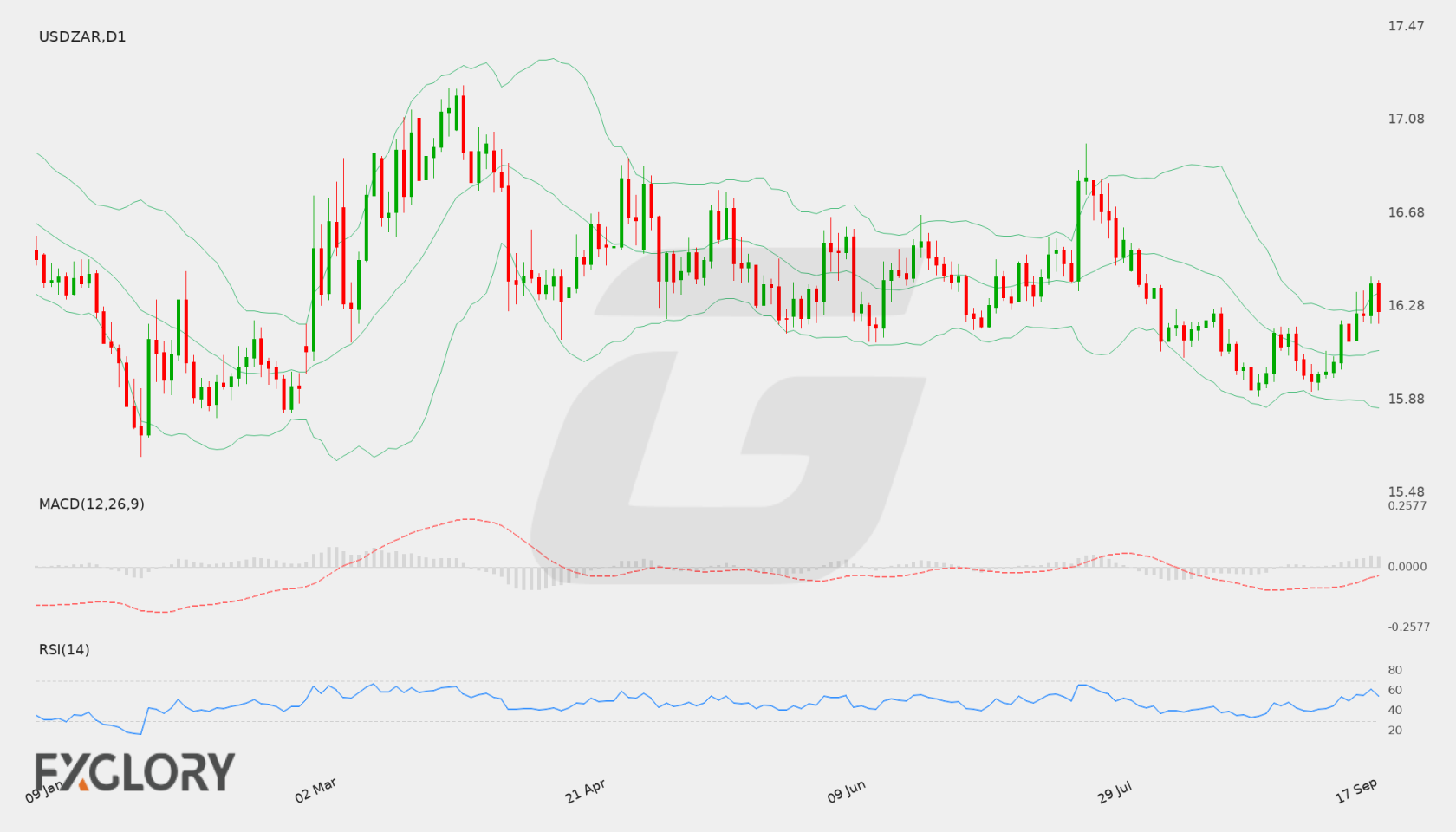
On the daily (D1) chart, USD/ZAR (USDZAR) recently closed at 16.25807, consolidating after a brief rise toward the 16.3746 level. The pair continues to trade within a broader structure defined by a key support zone at 15.89213 and an upper resistance level at 16.97254. Recent daily candles display a mix of modest upward pushes and pullbacks, reflecting balanced trading conditions.
Key Technical Indicators:
Bollinger Bands: The Bollinger Bands indicator shows a middle band (20-day moving average) at 16.08876, an upper band at 16.33481, and a lower band at 15.84272. With the last close at 16.25807, USD/ZAR is trading above the middle line and near the upper boundary, indicating that recent price action has leaned toward the upper half of the band envelope.
RSI: The 14-period Relative Strength Index (RSI) stands at 54.49. Positioned slightly above the neutral 50 level, the RSI reflects a balanced market with a slight bias toward buyers, remaining well clear of overbought or oversold territories.
MACD: The Moving Average Convergence Divergence (MACD) indicator records a reading of 0.00858. Operating above the zero mark, the positive MACD value suggests mild bullish momentum, although the histogram signal remains moderate.
Support and Resistance:
Key technical levels for USD/ZAR include immediate support around 15.89213, reinforced by the lower Bollinger Band area. On the upside, major resistance is established at 16.97254, which bounds potential bullish rallies.
News to Watch for USDZAR This Week:
- CB Consumer Confidence: Shifts in consumer sentiment can impact economic outlooks and influence dollar demand.
- JOLTS Job Openings: High job openings reflect labor market strength, which can alter rate expectations.
- ADP Non-Farm Employment Change: Private sector employment gains offer insights into overall labor market performance.
- Core PCE Price Index m/m: Key inflation metrics guide central bank decisions on monetary policy adjustments.
- Final GDP q/q: Growth data provides confirmation on overall economic expansion and currency strength.
- ISM Manufacturing PMI: Manufacturing sector health reflects broad economic activity and business sentiment.
- Average Hourly Earnings m/m: Wage growth trends feed into underlying inflationary pressures and policy outlooks.
- Non-Farm Employment Change: Broader employment data significantly influences market volatility and currency trends.
- Unemployment Rate: Joblessness metrics help gauge labor market slack and economic stability.
Weekly Outlook and Consideration:
The weekly outlook for USD/ZAR (USDZAR) presents a neutral-to-slightly bullish technical setup on the daily timeframe. Price trades at 16.25807 above the 16.08876 middle Bollinger Band, supported by a modest positive MACD of 0.00858 and an RSI of 54.49. While technicals point to mild constructive momentum within the 15.89213 support and 16.97254 resistance corridor, market momentum will largely depend on incoming economic releases and risk sentiment.
Disclaimer: The analysis provided for USD/ZAR is for informational purposes only and does not constitute investment advice. Traders are encouraged to perform their own analysis and research before making any trading decisions. Market conditions can change quickly, so staying informed with the latest data is essential.