Time Zone: GMT +2
Time Frame: 4 Hours (H4)
Fundamental Analysis:
Today’s EUR/USD fundamental outlook is influenced by a series of economic data releases from both the Eurozone and the United States. For the euro, traders will closely monitor industrial output, foreign trade data, and retail sales figures from key economies such as Germany, France, and Italy. These indicators are essential in gauging the region’s economic momentum, particularly as inflation and production pressures remain in focus. If actual results exceed expectations, the euro may find support. On the US side, critical data releases including Non-Farm Payrolls (NFP), the Unemployment Rate, and Labor Costs are scheduled. These indicators are vital for assessing the Federal Reserve’s next moves on interest rates, especially as recent speeches from FOMC members continue to signal a hawkish stance. A strong US labor market could continue to strengthen the dollar against its counterparts.
Price Action:
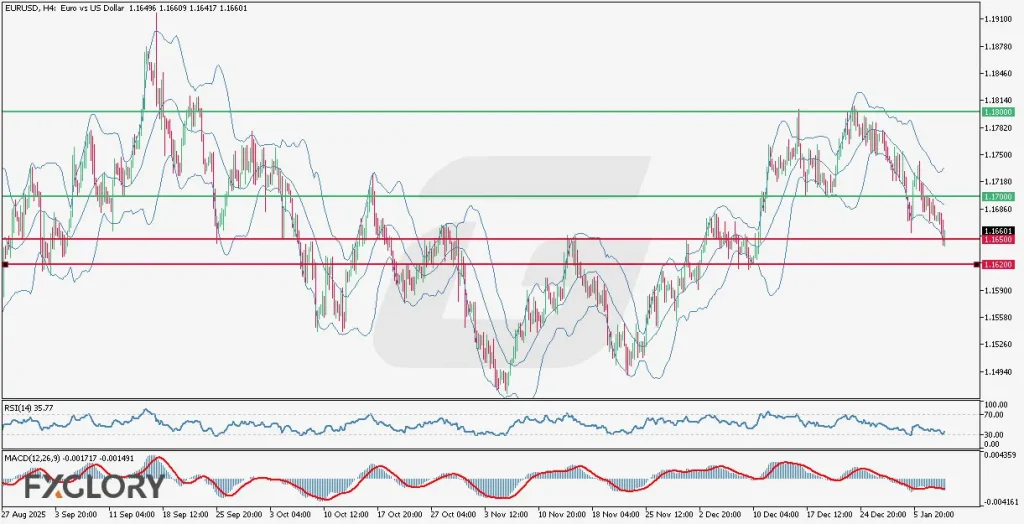
The EURUSD pair has continued its bearish trajectory on the H4 timeframe. After peaking near 1.18000 in late December, the price broke below the significant 1.17000 level at the beginning of January and has since maintained a steady decline. Currently, the pair is hovering just above the 1.16500 support zone, consolidating near this level after failing to regain upward momentum. Price has consistently adhered to the lower boundary of the Bollinger Bands, indicating ongoing downside pressure. If this consolidation resolves lower, the next key level to watch is 1.16200, which may act as the next potential target for sellers.
Key Technical Indicators:
Bollinger Bands (20,2): The price is currently trading along the lower band, indicating strong bearish momentum. The absence of a move toward the mid-band suggests a lack of bullish correction. The bands are slightly widening, reflecting increased volatility and supporting the continuation of the downward move.
MACD (12,26,9): The MACD line stands at -0.001717 and remains below the signal line at -0.001491, confirming the bearish trend. Although the histogram shows a slight decrease in selling momentum, there is no sign yet of a bullish crossover. As long as the MACD remains negative and below the signal line, downside pressure is likely to persist.
RSI (14): The Relative Strength Index is currently at 35.77, indicating weakening bullish strength and proximity to the oversold threshold. While not yet in oversold territory, the RSI suggests limited buying interest at current levels. A further decline toward or below 30 could signal an approaching reversal or short-term correction.
Support and Resistance:
Support: The key support level lies at 1.16500, which is being tested. A break below this level may open the door for further losses toward 1.16200.
Resistance: Immediate resistance is seen at 1.17000, previously a strong support that has now turned into resistance. A move above this level would be needed to ease the current bearish bias.
Conclusion and Consideration:
The current EUR-USD H4 technical chart and price action analysis suggest a continuation of the bearish trend, as supported by the RSI, MACD, and Bollinger Bands. The market remains under pressure following a rejection from 1.18000 in December and a decisive break below 1.17000 in early January. Unless eurozone fundamentals surprise to the upside or US economic data disappoints, the pair is likely to test the next support around 1.16200. Traders should closely monitor upcoming economic releases, especially labor and trade figures from both regions, which may shift short-term sentiment. This technical and fundamental chart daily analysis of EURUSD H4 is intended for traders seeking a structured forex forecast, combining price action with key technical indicators to build a consistent trading strategy.
Disclaimer: The analysis provided for EUR/USD is for informational purposes only and does not constitute investment advice. Traders are encouraged to perform their own analysis and research before making any trading decisions on EURUSD. Market conditions can change quickly, so staying informed with the latest data is essential.